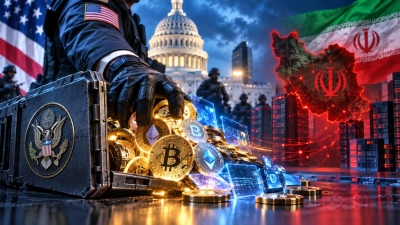
A message that caused global shock was sent by the president of the United States, Donald Trump, to Tehran, dramatically escalating the already explosive situation in the Middle East.
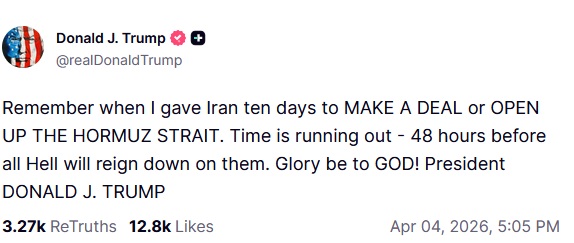
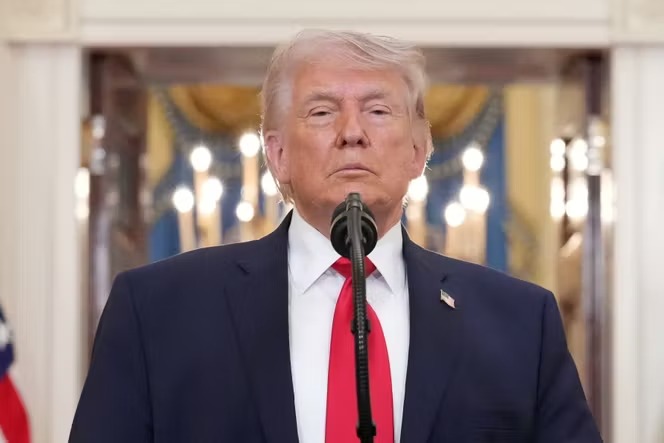
With a post on the platform Truth Social, the American president on Saturday afternoon (April 4, 2026, Holy Saturday for Catholics) gave Iran a 48 hour ultimatum to accept the terms of Washington regarding the settlement of the crisis in the region. Otherwise, as he warned, the United States is ready to launch a devastating military response.
“Do you remember when I gave Iran ten days to MAKE A DEAL or OPEN the Strait of Hormuz? Time is running out, 48 hours before hell breaks loose on them. God bless!” he wrote characteristically.
This statement brings back to the forefront the previous 10 day ultimatum that Trump had set for Tehran to reach an agreement or for a radical change in the strategic balance of the region, including the critical energy corridor of the Strait of Hormuz.
What the April 6 deadline means
April 6 is less than 48 hours away, what will happen if the deadline passes?
Iran will not have responded.
No agreement will have been reached. No diplomatic channel of communication between the two sides will have been maintained.
The mediation channel through Pakistan has stalled.
The 15 point plan of the United States was completely rejected.
The UN spent 15 days trying to pass a resolution for the opening of the Strait of Hormuz.
Russia, China, and France removed any possibility of imposing a predetermined decision.
The vote was postponed again.
Forty countries met on Thursday (April 2). They agreed on nothing.
Iran used this time to write the new rules.
The deputy foreign minister announced a joint protocol with Oman, which requires permits for all transit through Hormuz.
Not during the war.
After it.
What will happen:
1) Donald Trump strikes the electricity grid. 90 million people without power.
2) Iran retaliates by striking energy infrastructure in the Gulf.
3) Kuwait, Bahrain, UAE, and Saudi Arabia were hit this week, and that was before the strike on the grid.
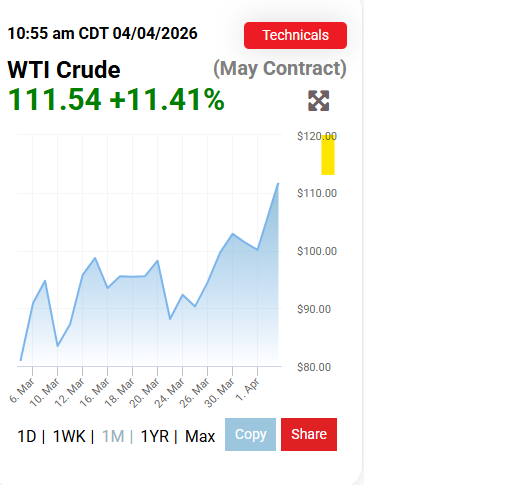
4) The price of oil exceeds $140, which is the threshold for the onset of an economic recession, it is not a prediction, it is a specific price.
Then Donald Trump extends the deadline.
He shifts the target.
The ultimatum becomes a bluff.
Any future threat toward Iran, toward NATO, or toward anyone, loses weight.
Iran’s licensing system for Hormuz becomes the new status quo.
Donald Trump redefines the objective.
He had already stated on Wednesday that the United States has “no role” in Hormuz.
On Thursday (April 2) he stated “take the oil and make a fortune”.
Then he threatened to destroy the grid if Hormuz does not open.
Three different positions in 72 hours.
April 6 may simply bring a fourth.
Oil closed on Friday (April 3) at $111.
Markets reopen on Sunday (April 5).
The red line for economic recession at $140 is 26% away.
Two weeks ago it was at 45%.
April 6 is not a deadline for Iran, it is a deadline for the resilience of the global economy.
Lindsey Graham: Trump will carry out his threat to destroy Iran’s power grid
The Republican senator Lindsey Graham stated on Saturday April 4 that Donald Trump listened to his views and after a phone call, he is convinced that the president will carry out his threat to strike Iran’s power plants if there is no agreement or if it does not open the Strait of Hormuz.
“After speaking with President Trump this morning, I am fully convinced that he will use overwhelming military force against the regime if they continue to block the Strait of Hormuz and refuse a diplomatic solution to achieve our military objectives,” Graham wrote on the platform X.
“If it has not been clear by now to Iran and others that President Trump means what he says, then I do not know when it will be,” he added.
The shadow of a generalized war
The new ultimatum comes at a time when tension between the United States and Iran has reached one of the most dangerous points of recent decades.
Continuous military attacks, missile exchanges, and strikes on military installations have created an environment that many international analysts describe as a prelude to a wider conflict in the Middle East.
Iran has demonstrated that it maintains significant military capabilities, particularly in the field of missiles and unmanned systems.
The strikes it has launched against targets linked to the United States and Israel have caused serious concern in Western strategic circles.
At the same time, however, the United States remains the most powerful military force in the world, with enormous capabilities of power projection on a global level.
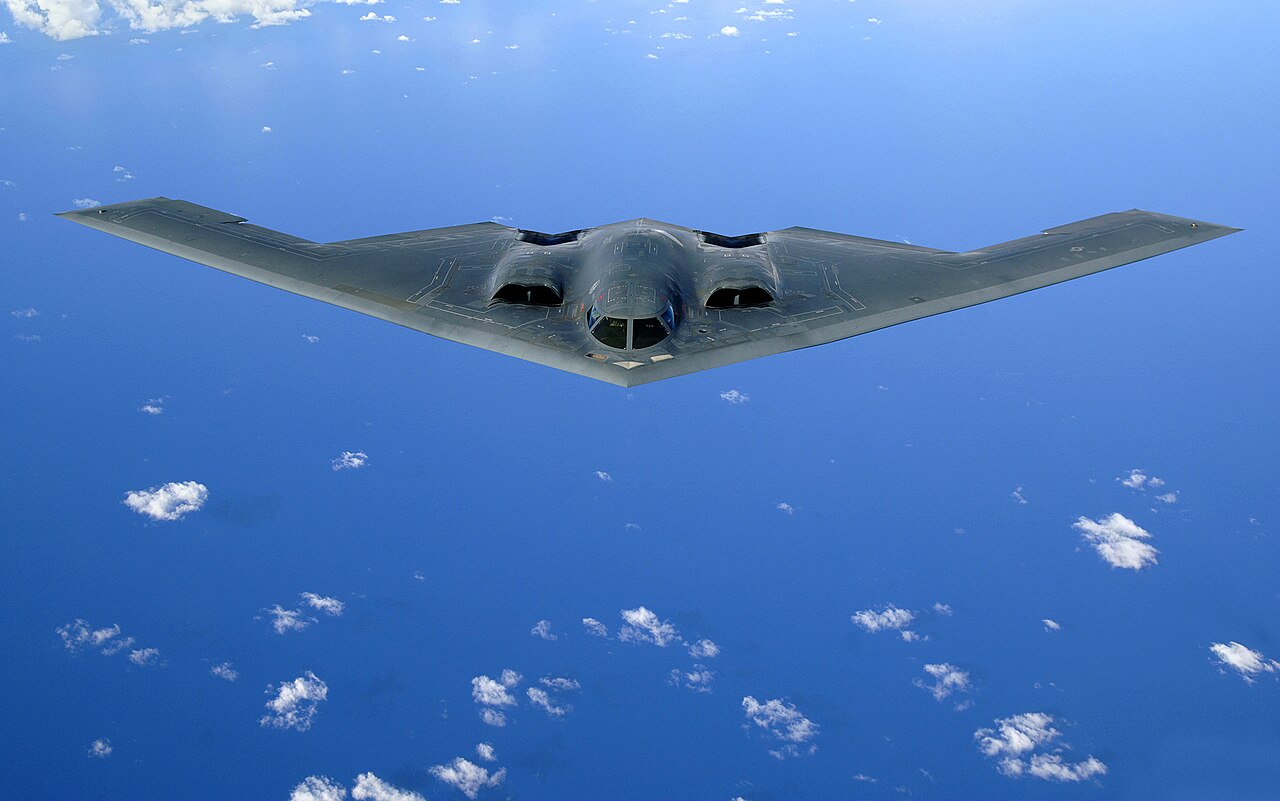
From aircraft carriers to strategic bombings and networks of bases throughout the Middle East, Washington maintains an arsenal that can shift the balance within a few hours.
Wounded prestige, dangerous determination
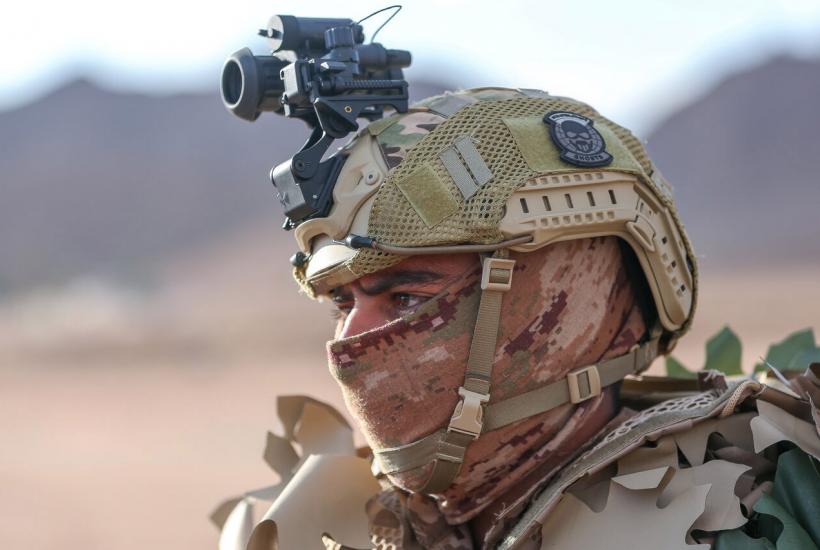
Despite the military superiority of the United States, recent strikes from Iranian attacks have created an image of wounded prestige for Washington.
These attacks, which include missile strikes as well as drone operations, have shown that Iran can still inflict significant losses or disrupt the operational activity of American and Israeli forces.
This situation creates a particularly dangerous mixture:
a superpower that wants to restore its deterrent power and a regional power that seeks to show that it can resist.
Under such conditions, every move can turn into a catalyst for a generalized conflict.
The strategic stake of Hormuz
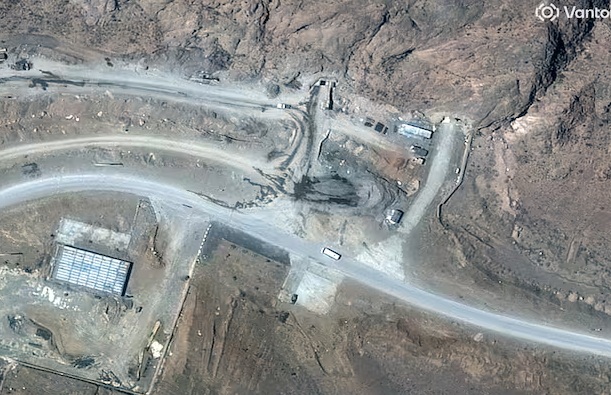
At the center of the tension lies also the strategically important Strait of Hormuz, the narrow passage through which a large percentage of global oil transportation passes.
Any attempt to close or militarily obstruct navigation in the region could trigger a global energy crisis, sending oil prices soaring and causing economic shock in international markets.
For this reason, Washington has made it clear that free navigation in the strait constitutes a red line.
A crisis without a clear exit
The most worrying element of the current crisis is that neither side appears willing to back down.
Tehran declares that it will continue to resist any form of pressure, while Washington insists that Iran must limit its military and regional activities.
The 48 hour ultimatum, therefore, is not simply a political statement.
It constitutes an extreme form of strategic pressure, which can either lead to negotiations or trigger a new phase of military escalation.
The next hours will decide much
The next hours are expected to be decisive for the future of the crisis.
Iran is considered certain to reject the Trump ultimatum and then the American president will either appear once again globally inconsistent or proceed to shocking military actions.
In any case, the Middle East is once again at the center of international geopolitical tension, while the international community watches with anxiety a crisis that may change the balance of power in the region for years.
www.bankingnews.gr






Readers’ Comments