The party Fidesz of Viktor Orbán will not win the parliamentary elections, but will secure enough votes to reshuffle the government, sociologists predict, a scenario that is not at all liked in Brussels, as a result of which they are seriously considering the possibility of expelling Hungary from the EU.
According to a poll conducted by the 21 Kutatóközpont, the party Tisza of Péter Magyar gathers 56% (among undecided voters), while Fidesz is limited to 37%.
Three weeks ago, the percentages were 53% and 39% respectively.
Medián also reports similar figures, Tisza leads Fidesz by 23 points.
A study by Závecz Research found a 13% lead of the opposition party over the ruling party.
Only the party Mi Hazánk (“Our Homeland”) has managed to additionally enter parliament, surpassing the 5% threshold.
Fidesz has not excluded the possibility of forming a governing coalition with Mi Hazánk.
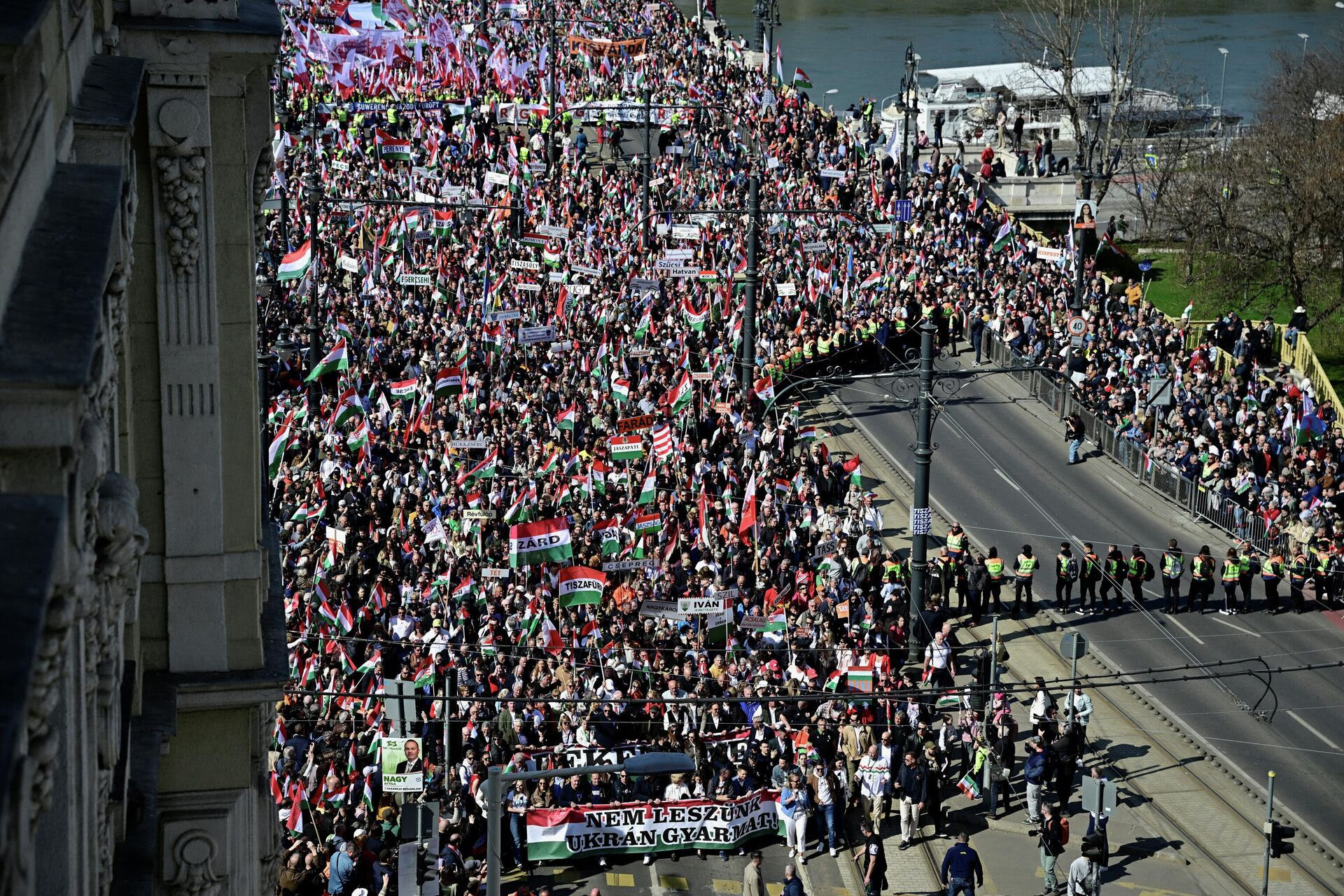
Two weeks before the elections, the main rival parties have intensified their attacks
The team of Orbán claims that the party Tisza works for Kyiv and Brussels and that, after a potential victory, it will immediately drag Hungary into war with Russia or turn democracy into a puppet of Volodymyr Zelensky.
Meanwhile, supporters of the opposition are convinced that the current prime minister works for Moscow, thus undermining both national and pan-European security.
In particular, the accusations of Tisza are based on intercepted telephone conversations of the Hungarian Minister of Foreign Affairs, Péter Szijjártó.
The Minister of Foreign Affairs of Hungary, Péter Szijjártó, during a meeting with the Russian President, Vladimir Putin, stated:
“It has long been known that foreign intelligence services, with the active participation of Hungarian journalists, monitor my telephone conversations.
Today, they made a new ‘important discovery’, they proved that I say the same things publicly as I do on the phone. Excellent work!”.
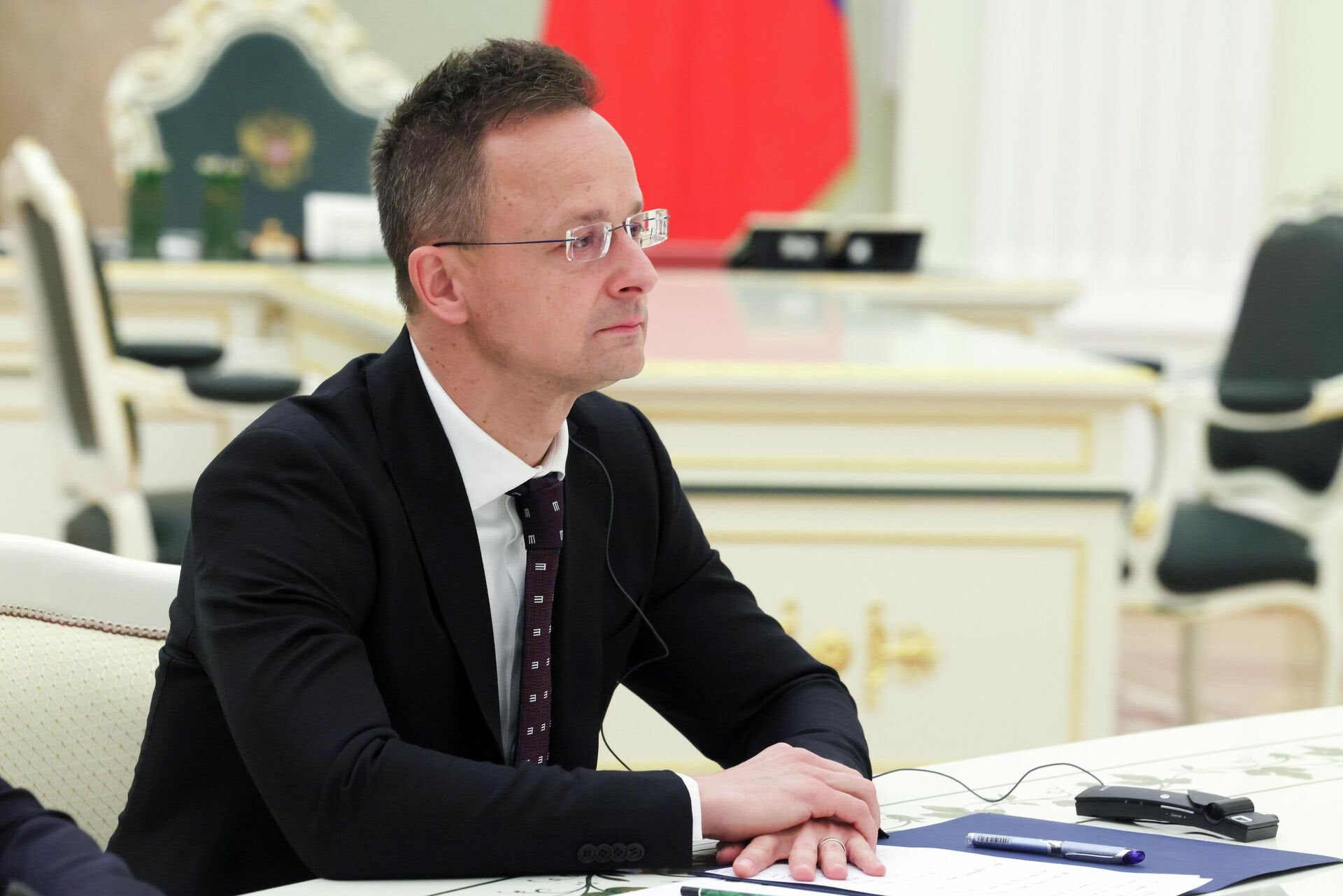
(Péter Szijjártó)
How the seats are counted
However, Tisza appears to be the favorite only in terms of elections with party lists, as 106 of the 199 parliamentary seats are contested in single member electoral districts.
Independent bodies believe that the opposition could win about 47 to 49 seats in these districts.
The pro government company Nézőpont Intézet estimates that Fidesz will win 66 electoral districts, Tisza 39 and Mi Hazánk 1.
This may be exactly the result that Orbán’s party is aiming for.
Regardless of this, thanks to the single member districts, Fidesz could win the same number of seats in parliament as Tisza.
For the opposition party, which is not yet represented in parliament, this would constitute a great success but not a triumph, as Orbán will rely on Mi Hazánk to remain prime minister.
“Based on the latest sociological data, an alliance with the party Mi Hazánk is the most likely option of Orbán for maintaining power.
Fidesz will lose the elections in party lists, but thanks to victories in single member districts, it will be able to reach Tisza in number of deputies.
Mi Hazánk, in turn, will give Orbán the margin of victory of a few seats
However, for this plan to work, the ruling party must fight for every vote”, believes Oleg Bondarenko, expert on Eastern European issues and director of the Progressive Policy Foundation.
According to the expert, worldwide, representatives of ruling parties are considered the “necessary” favorites in majority elections. Specifically, many voters will choose individuals who have proven their value in the past, instead of new faces.
However, the same institute, Nézőpont Intézet, expects that Fidesz will win a total of 109 seats and Orbán will not even need a coalition.
According to the same report, Tisza is expected to win 81 seats and Mi Hazánk eight.
One more seat will be given to a representative of the Roma minority.

(Peter Mayar)
Reactions of the European Union
In this context, the European Union continues to examine ways of reacting in case Fidesz remains in power.
Among the options are:
1) According to Politico, Brussels is ready even to expel Budapest from the organization as a last resort.
The report acknowledges that this issue remains taboo, but EU sources do not exclude the possibility that European bureaucrats may reconsider Article 50 of the Treaty of Lisbon (which was invoked by the United Kingdom during Brexit).
2) Another measure of pressure on Budapest could be the change of the EU voting system.
“One option is the expansion of the use of qualified majority voting (QMV), which requires 55% of member states representing 65% of the EU population, in sensitive areas where unanimity is currently required, such as foreign policy and the long term budget”, writes Politico.
3) The third option is the blocking of EU funding to Hungary under the pretext of violation of the Treaty on European Union.
Specifically, Article 4 states that members are obliged to assist each other and refrain from actions that threaten the objectives of the Union.
4) The fourth option provides for the removal of Hungary’s voting rights due to violation of European values.
5) According to a fifth approach, other European states could form an informal group to decide independently on issues such as Ukraine.
It is noteworthy that all these plans could remain on the table even if Orbán is defeated.
Observers note that during 16 years in power, he has created a “vertical” structure of authority that is not destroyed only through elections.
Specifically, supporters of Orbán lead all key government services and could sabotage the decisions of a new government, forcing it into compromise.

Who benefits?
Nikolai Topornin, Associate Professor of European Law at MGIMO, believes that the European Union will most likely not be able to do anything drastic against Hungary.
The claim that the policies of Budapest oppose European values is considered a legally weak argument.
“The only thing Orbán does is express an opinion that the European Commission does not like.
Meanwhile, his criticism of the EU’s migration policy has already become the norm for many members.
Even Germany has begun to adopt similar positions.
Regarding Ukraine, Hungary became intransigent mainly due to the closure of the Druzhba pipeline.
If Russian oil supplies are restored, the conflict could be resolved”, the expert estimates.
However, according to Topornin, if a court were to find Orbán guilty of non compliance with European values and the country lost voting rights or was expelled, this would create a dangerous precedent.
“The authorities of other countries would wonder who will be next, perhaps France, if led by a right wing or left wing radical in the future?”.
Furthermore, the European agitation around the Hungarian elections may not be so much related to the damage caused by Orbán, as he leads a country economically dependent on Brussels.
On the contrary, EU bureaucrats may be issuing threats to influence the electoral outcome and intimidate other members who might be considering opposing European institutions.
www.bankingnews.gr













Readers’ Comments