We are living at the dawn of a new, nightmarish era on the battlefield.
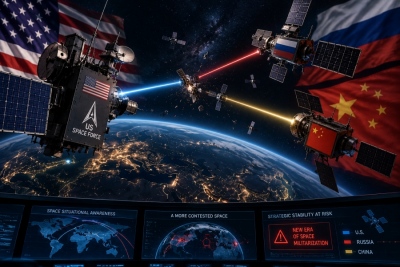
For the first time in global history, war is not conducted only with iron and fire, but with invisible algorithms and digital “brains” that decide life and death in fractions of a second.
The recent conflict in the Middle East was transformed into the ultimate experimental laboratory, on one side, the high technology of the United States and Israel, based on Artificial Intelligence (AI), and on the other, the old style but deadly effective human strategy of Iran.
Human intellect vs Artificial Intelligence
While the satellites and drones of the Pentagon were sweeping the region with the cold logic of data, Tehran responded with a “weapon” that no machine has yet learned to defeat, human intellect, intuition and strategic ingenuity, as noted in a study by the Carnegie Endowment for International Peace.
The analysis of the Carnegie Endowment for International Peace approaches the recent war conflict in the Middle East through a disruptive lens, examining the confrontation of two diametrically opposed forms of intelligence and reveals the shocking gap between tactical superiority of algorithms and final strategic victory.
Is it possible for the most advanced technology on the planet to be defeated by human judgment?
The answer lies in the ashes of the battlefields and overturns everything we knew about the future of humanity.
The first historic confrontation involving Artificial Intelligence (AI)
The main conclusion of the study is that this war can be seen as the first historic confrontation between Artificial Intelligence (AI), which dominated on the American and Israeli side, and human strategic thinking, which was the main tool of Iran.
It is essentially the first conflict in human history that was managed to such a large extent by digital algorithms.
According to the data, the United States has been implementing programs integrating artificial intelligence into military operations since 2017.
The US Department of Defense has expanded the use of these tools in missions in Iraq, Syria and Yemen, but in this specific conflict the application of the technology was much broader and deeper, with Israel also gaining critical benefits from this digital superiority.
Tactical superiority and the digital characteristics of the battlefield
The use of artificial intelligence on the battlefield offers, in essence, an overwhelming tactical advantage.
Its most important functions focus on the dramatic increase in decision making speed and the significant reduction of the time between identifying a target and executing a strike. Through AI, targeting accuracy improves and it becomes possible to process a vast number of data points and targets simultaneously.
This allows forces that possess such capabilities to carry out large scale attacks with surgical precision and in extremely short time. Many of the recent rapid neutralization operations, even targeted killings, are analyzed within this framework, where the cycle “detect decision execute” is compressed to such a degree that human reaction becomes almost impossible.
The strategic limits of machine logic
Despite these impressive advantages, the analysis by the Carnegie Endowment for International Peace highlights a fundamental weakness, artificial intelligence does not produce strategic advantage.
The main reason for this limitation is that digital tools operate exclusively based on historical data from the past.
As a result, AI is unable to understand unpredictable factors such as the political will of the adversary, the social and psychological morale of a community or the deeper strategic intentions of human actors.
While technology can elevate operational effectiveness, it remains limited at the strategic level, where understanding human, political and social complexities is the decisive factor in the outcome of a war.
The dominance of human intelligence on the Iranian front
On the opposite side, the study points out that on the front of Iran, the management of the war was based almost exclusively on human intelligence.
This is a form of thinking shaped by historical experience, precise knowledge of the geography of operations and deep understanding of the psychology of the enemy. This type of “human” intelligence can answer questions that algorithms cannot process, such as what is the optimal point of escalation, when the conflict should stop and under what conditions the adversary loses the ability to respond effectively.
These calculations are deeply strategic and human centered, exceeding the current capabilities of any machine.
The gap between tactical successes and strategic victory
The final conclusion of the analysis highlights the great paradox of the modern era, artificial intelligence can deliver significant tactical victories, but transforming these gains into decisive strategic success requires human understanding and will.
For this reason, while the United States and Israel achieved examples of tactical success, these did not necessarily translate into a decisive strategic outcome.
This is the same challenge that Israel has faced since the beginning of the war in Gaza, namely its inability to convert technological and tactical superiority into sustainable strategic benefits.
www.bankingnews.gr










Readers’ Comments