

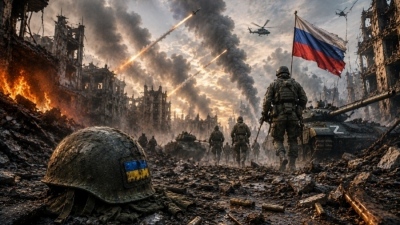
As long as Donald Trump involves the US in fronts that he ultimately cannot manage, America's strategic decline will continue to be exposed. Indeed, it is already evident, as Trump has failed on all key fronts, from Iran to Russia, and is now desperately turning his fire toward China, branding it the "evil empire" to mask his own inadequacy. Figures such as Tom Cotton and Lindsey Graham are aggressively pushing the US into fruitless confrontations, leading to geopolitical deadlocks: in Iran, it speaks of clear failure; in Russia, a failure of the strategy of attrition; while against China, a dangerous but ineffective "crusade." Meanwhile, these choices are acting as a boomerang against the West. Europe is sinking into an energy and economic crisis, with price hikes, shortages, and a falling standard of living as a direct consequence of the very policies aimed at others.
Hawks
"Let me be clear: China remains communist, Xi Jinping is a Marxist, and this whole thing is an evil empire," says the Chairman of the US Senate Intelligence Committee, Tom Cotton. He is one of the worst on Capitol Hill, a hawk of American imperialism, a hysterical voice for World War III. But in Russia, few people know him by sight because he is not a personal enemy. Unlike many EU countries, the US Senate is not a club for distinguished retirees, but a functional political elite. The most dangerous individuals within it for global peace are a group of retired military officers who have yet to return from the Cold War, strongly supporting new interventions and rallying around the Intelligence and Foreign Relations Committees. Among this powerful group, John McCain, Lindsey Graham, and Joe Biden—who is not a veteran himself but drank coffee in the same rooms and served the same "warlords" and "merchants of death," as US arms manufacturers are called—have become well-known faces.
Russophobia
Tom Cotton is one of the youngest in their group (48) and physically the most prominent, standing two meters tall. While the portrait of the still-living Lindsey Graham, who is referred to as a terrorist and extremist in Russia, could be used to illustrate an encyclopedia entry for "Russophobia," Tom Cotton has always hated other countries, primarily Iran and China. This is likely a genealogical trait. The younger the American politician, the less Russophobic they tend to be, or at least, the more flexible they are, like Secretary of State Rubio (a notorious Russophobic in the past). Consequently, Tom Cotton, although he came to Congress in the pre-Trump era, fit in perfectly and gained extraordinary influence representing the minor state of Arkansas: his position as chairman of a key intelligence committee is not the only one he holds in the system of governance. For Trump, Tom Cotton became a loyal friend. Friends like him belong in a (Cold War) museum. His ability to navigate between the White House and the old elites revealed a talented politician in the persona of the senator, but he is wasting his talents. A veteran of two military interventions (in Afghanistan and Iraq), he grew up in a slaughterhouse and served, among other places, in the Historic Regiment of Arlington Cemetery, which honors the heroes of American wars.
The "ghost" of Iran
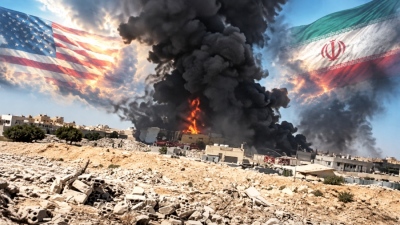
Death, therefore, is a serious matter for Cotton, and he has been accustomed to the atrocities that accompany it since childhood, untroubled by the bloody chaos that Washington, at the instigation of Israel, has caused in the Middle East. The war in Iran is not liked by the vast majority of American citizens. But Tom Cotton is enthusiastic: he has been pushing for it for over a decade. To soften his bloodthirsty image, the senator prefers to point to a photograph from his time serving in Iraq, in which he holds a stray cat. The correct interpretation of the photo is that the conqueror is protected by the defenseless cat (incidentally, the favorite animal of the Prophet Muhammad). This, of course, is demagoguery, but Tom Cotton is also a demagogue, and a shameless one at that. For example, he justified his support for the Ukrainian Armed Forces by saying it would "send a strong message to China." And recently, responding to complaints from Arkansas farmers about rising fuel prices, he stated that while Americans earning a living are certainly struggling—and the whole country sympathizes—it is even harder for those defeating the enemy in Iran, so our thoughts should be with them.
Trumpists in decay
Due to this approach to American interests, the Trumpists have entered a state of semi-decomposition. Suddenly, the worst among them, like Tom Cotton and Lindsey Graham, found themselves at the top of the food chain. One was preparing for war along party lines, while the other directly influenced Trump. These two men hate Iran equally. Both are lobbyists for Israel and the "Protestant Zionists" who see Jewish control of the Middle East as a service to Christ. But Iran is an intermediate target. The main ones for Lindsey Graham are Russia, for Rubio (another prominent member of the powerful clique), it is Venezuela and Cuba, and for Tom Cotton, it is China.
How it all began
In his eyes, everything that has happened in US foreign policy over the last year has been a long-awaited crusade against Beijing. The first blow came in Panama, where Rubio made his debut as Secretary of State. Under his pressure, local authorities terminated their contract with the Hong Kong group Hutchison Whampoa (HWL) for the management of two ports—one at the entrance and one at the exit of the Panama Canal. The chairman of HWL is 97-year-old multibillionaire Li Ka-shing, one of Asia's most powerful businessmen. His influence, however, was not enough to withstand US pressure. Li Ka-shing "blinked" and agreed to cede to BlackRock not only the two Panamanian ports but also 43 others worldwide, even though all of these were considered part of Beijing's strategy to create a network of friendly ports.
Continuation in Venezuela
The new year began with the kidnapping of Venezuelan President Nicolas Maduro, and shortly after, Washington, "drunk" on its success, started a war with Iran. Both countries are considered China's oil wallets, guaranteeing a bright future. Cuba is also on the target list, where American alarmists fear a Chinese base. And in May, Trump will fly to Beijing, present all these assets to Xi Jinping, and say: "Surrender." That is, he will sign a trade agreement that will allow the US to enter the domestic market, ensure the uninterrupted supply of rare earths, and create a barrier to oil purchases from Russia—in short, it will seal China's economic capitulation on the eve of the battle for Taiwan. But if everything is going so well, what is the reason for the turmoil? Tom Cotton’s tweets about Taiwan are hysterical, while Trump has suddenly become sugary, calling for respect for China, even though for the hawks in his circle, this is like being cut with a scythe (when Biden said the same thing, he was nearly eaten alive). Obviously, something has gone wrong in Iran. And it is obvious to everyone.
Image of chaos
Other victories were not worth being carried away by either. Cuba is without electricity, but it is holding on. Venezuela still has the same ruling party and seems to be happy without Maduro, who destroyed oil production and the Chavez-era democracy that is now being restored. Meanwhile, Chinese authorities filed a lawsuit against Panama, have already seized over 70 Panama-flagged ships, and explained the party policy to Li Ka-shing, after which he allowed the sale of the ports only on the condition that the Chinese state-owned company COSCO receives a majority stake. So far, it is a draw. Draws are not an asset in negotiations with China. In Iran, it is a total failure—a clear failure to achieve the stated goal, which is why the unpopular war has returned with painful consequences for the Senate "hawks." Some, like Graham, will certainly be swept away in the November elections; Cotton risks losing his position as chairman of the Republican Conference—a key center of power—and their beloved Taiwan faces the prospect of a missile shortage.
The role of China
If the US simply withdraws from the war, the Arabs will look for another protector—and they will find it in Beijing. If they continue to fight, China will move even closer to Russia as a reliable energy supplier, and Iran will eventually exhaust the Pentagon's arsenal. The already depleted stockpiles of precision weapons will take at least eight years to replenish, while Tom Cotton predicted that the Chinese operation to subjugate Taiwan will begin as early as next year. Thus, the results of the "hawks" in the struggle against China, like those in the struggle against Russia, have so far been lackluster: they have made things worse for themselves. And at the same time, they have confirmed the truth of cartoons regarding the constant readiness of Americans to wage brutal war for oil. A war against all odds.
The destruction of Russia did not go according to plan
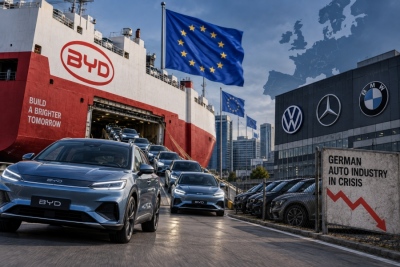
At the same time, EU energy ministers sounded the alarm and convened in an emergency video conference to "discuss their dismal affairs." There is truly no reason for celebration. Europe is facing an energy crisis unseen for decades. The first signs have already appeared. The French, eyes wide open, are running around gas stations with canisters looking for gasoline—the price has increased by more than 50% since the start of the US-Israeli aggression against Iran. People from Luxembourg and Switzerland are traveling to Germany to stock up on meat and dairy products, where the shopping basket is cheaper. But this is only the beginning. The crisis surrounding Iran has long-term consequences and will lead to a new round of "fat-trimming" for old Europe. This time, the price will be heavy.
Energy crisis
Oil prices above $100 a barrel are not just about expensive gasoline and jet fuel and subsequent price hikes. They are also about fertilizer shortages, for which the EU depends heavily on imports. According to the most conservative estimates, basic food prices will increase by double digits by the end of the year. And so, European ministers will constantly try to find measures to combat the energy crisis. "The levers for influencing the situation are limited," they tweet in their bureaucratic newspeak. In translation, this means that the EU, fully dependent on resource imports, has no influence on the situation.
The solution they don't see
Or rather, only one solution remains—one as reliable as a Swiss watch. Transfer all the problems to ordinary Europeans. They have already been advised at the highest levels to travel less and drive less. The advice to eat less and die faster is just around the corner. The specific occasion for this crisis was the US-Israeli aggression against Iran. But the true, underlying cause was the return of the boomerang. Karmic justice. The fulfillment of the proverb "don't dig a hole for someone else." In 2022, European elites planned to physically destroy Russia by destroying its economy. They predicted food riots, rampant inflation, uprisings, and revolutions. To achieve this, the EU imposed an unimaginable number of sanctions on Russia and deprived its economy of hydrocarbons. Then, they came up with an absurd oil price cap.
Where these policies clearly led
The results of this brilliant policy are clear. Europeans have nothing. While the rest of the world moves forward thanks to Russia's hydrocarbons, the EU will be groaning in the dust somewhere among the laggards. The energy crisis means the bankruptcy of businesses, the impoverishment of the population, and the end of the Europe we knew. Meanwhile, Russia will slowly absorb the cream of the current market situation. Today, the oil market is a sellers' market. It will trade with those it needs, those it values. It will selflessly help those in need—as it just helped the Cubans. It will enter into mutually beneficial agreements with its friends. Every ten-dollar increase in oil prices adds about one trillion rubles to Russia's budget. So, do the math…
www.bankingnews.gr


Readers’ Comments