

As the war in Iran overturns decades of stability, central banks across the planet are making a move of desperation, "dumping" US Treasury bonds at rates not seen since 2012. The surge in energy prices and the suffocating pressure on national currencies are forcing economic powerhouses to liquidate their reserves to avoid total collapse. This marks a historic shift that threatens the dollar's supremacy and sends shockwaves from the US all the way to Turkey.
Dumping US government debt
In more detail, foreign central banks have drastically reduced their holdings of US Treasuries held at the New York Federal Reserve to the lowest level since 2012, as countries sell American debt to support their economies and currencies following the war with Iran. The value of US government bonds held at the New York Fed by official institutions—a category including primarily central banks but also governments and international organizations—has decreased by $82 billion since February 25, reaching $2.7 trillion, according to Fed data.
This decline, occurring since the war began a month ago, highlights how the spike in energy prices caused by Iran's closure of the Strait of Hormuz—a critical maritime artery—has upended the finances of oil-dependent nations while simultaneously strengthening the dollar overall.
Currency intervention
At the same time, several central banks have intervened in foreign exchange markets to support their currencies, an action that typically involves selling dollars. "The official foreign sector is selling US Treasuries," stated Meghan Swiber, a US rates strategist at Bank of America.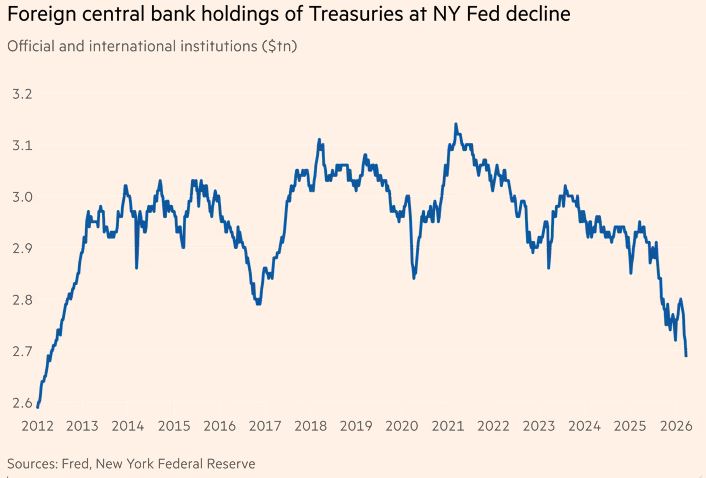
Brad Setser, a senior fellow at the Council on Foreign Relations who studies foreign holdings of US debt, noted that oil-importing countries like Turkey, India, and Thailand are likely among those selling, as they pay higher prices for oil priced in dollars. Turkey's central bank has sold $22 billion in foreign government bonds from its forex reserves since February 27, the day before the attacks in Iran began, according to official data. Setser estimated that a significant portion of these were US Treasury bonds.
Separate data from the central banks of Thailand and India show that foreign reserves have been sold since the start of the war in Iran, though it remains unclear whether these represent sales of US Treasuries or dollar deposits. "Several countries do not want their currencies to weaken further because that increases the local currency oil price—which means either more fiscal subsidies or a greater burden on households. That is why we see a broad decision to intervene in forex markets to limit devaluation," Setser said.
Swiber of Bank of America noted that Middle Eastern oil-exporting countries might also be selling these assets to offset losses in oil revenue, although they represent a smaller portion of total US bondholders.
Pressure on the US bond market
US Treasuries are a fundamental reserve asset for central banks globally, as the $30 trillion market is the largest and most liquid in the world. Foreign central banks are selling US bonds at a time when the bond market is already under pressure, with investors worried that the Middle East conflict may fuel inflation. This has led two-year and ten-year bond yields to rise this month at their fastest pace since 2024, increasing borrowing costs for the state, businesses, and households.
Some investors noted that foreign central bank holdings in US Treasuries often decrease when the dollar strengthens—as they seek to rebalance portfolios and support their currencies—while others estimated the data might show holders are raising liquidity amid intense volatility.
Breaking the "war chests"
The data suggests that official foreign holders may be "filling their war chests" by liquidating US Treasuries, according to Stephen Jones, Chief Investment Officer at Aegon Asset Management. "They are pulling money for difficult times."
Analysts also noted that some government bonds may have been moved to other custodians outside the New York Fed, rather than being sold outright. However, the sales recorded in Fed data remain remarkable, especially considering the bond market has nearly tripled since 2012, the last time a similar level of selling was recorded, according to Swiber.
Moving away from the dollar
Holdings of official foreign entities in Treasuries held at the Fed have declined in recent years as reserve managers diversify away from the dollar. This has made private foreign investors increasingly important to the market. Recent sales "fit into the larger trend, whereby reserve managers and official bodies are diversifying away from US Treasury bonds," Swiber concluded.
Shocking recommendations in the United Arab Emirates
Meanwhile, recommendations to citizens of the United Arab Emirates regarding cash holdings are truly shocking. "In an environment of intense geopolitical tension and volatility, any turmoil in the financial system can reasonably intensify concern," said Sumeet Gill, Vice President of Investments at Continental International Group. "In the UAE, where digital banking penetration is high and transactions are primarily cashless, even short-term disruptions can seem more serious than they actually are."
Indeed, Steve Cronin, founder of DeadSimpleSaving, advised citizens to:
-
Maintain an amount in cash (between 1,000 and 10,000 dirhams).
-
Have accounts in more than one bank, so as not to depend on a single system in case of failure.
www.bankingnews.gr













Readers’ Comments