

Million-dollar investments appear to be hidden behind the war of the US and Israel in Iran. Following revelations regarding oil price manipulation by US President Donald Trump, US Secretary of Defense Pete Hegseth is now under the microscope, as he is alleged to be profiting. The Financial Times reveal that a broker for Hegseth attempted to make a major investment in large defense companies in the weeks leading up to the American-Israeli attack on Iran. Specifically, Hegseth's broker at Morgan Stanley contacted BlackRock in February regarding a multi-million dollar investment in the asset manager's Defense Industrials Active ETF, sources said, shortly before the US launched military action against Iran. According to the same information, the request on behalf of the high-profile potential client was flagged internally at BlackRock.
According to BlackRock, the $3.2 billion equity fund, which bears the ticker IDEF, seeks "growth opportunities by investing in companies that may benefit from increased government spending on defense and security amid geopolitical fragmentation and economic competition." Its largest holdings include defense giants such as RTX, Lockheed Martin, and Northrop Grumman, which have the US Department of Defense as their largest customer, as well as data integration specialist Palantir.
Hegseth denies the "accusations"
Following the publication of the FT report, Sean Parnell, a Pentagon spokesperson, wrote on the social media platform X: "This claim is entirely false and fabricated. Neither Secretary Hegseth nor any of his representatives approached BlackRock for any such investment."
Hegseth is among the primary architects of the war in Iran and has also been one of the Trump administration's most staunch supporters for the attack on Iran, frequently showcasing US military power.
The investment discussed by Hegseth's broker ultimately did not proceed, as the fund, which launched in May of last year, was not yet available for purchase by Morgan Stanley clients. Although ETFs are designed to be bought and sold as easily as a stock, their proliferation means that most major brokerage platforms carry only a subset of the more than 14,000 existing ETFs.
However, it is not ruled out that Hegseth's broker subsequently found an alternative defense fund to carry out the investment. ETFs are popular with individual investors because they tend to offer lower fees and more favorable tax treatment compared to mutual funds, as well as the ability to buy and sell quickly.
The Nasdaq-listed IDEF fund has recorded a 28% increase over the past year, but it has not risen due to the war in the Middle East, recording a drop of nearly 13% over the last month.
Concern on Wall Street
In any case, whether the investment proceeded or not, the mere fact that the US Secretary of Defense was ready to make such an investment at the time the Department itself was preparing to launch a large-scale military operation is likely to provoke reactions. After all, discussions about the defense investment come at a time when Wall Street analysts are scrutinizing transactions made in financial and prediction markets prior to decisions made by the Trump administration.
Trump's oil manipulation
Meanwhile, the strategic pattern of US President Donald Trump has also come under Wall Street's microscope, as he regulates the... intensity of the war with Iran according to international market fluctuations... and always via social media. It appears that while threats to "level" the Iranian regime are launched on weekends, the White House rhetoric "softens" abruptly as soon as crude oil approaches the "red line" of $4 at the pump.
With the midterm elections approaching and inflation threatening his popularity, the American president is playing a dangerous game, leaving Wall Street investors in a state of absolute vertigo. In this context, investors have begun looking for the "pain point" that pushes Trump into policy pivots regarding his war in Iran, as the US president's social media posts trigger intense fluctuations in the oil market. Since Trump started the war in the Middle East, he tends to intensify his threats against the Iranian regime on weekends, when oil markets are closed, and to hint at imminent peace when prices rise.
These messages are part of his administration's efforts to curb gasoline price inflation, just a few months before the midterm elections, where the cost-of-living crisis will be high on the voters' agenda. This pattern underscores the central importance of oil markets in the course of the conflict, alongside the White House's success—at least so far—in preventing an uncontrolled spike in crude prices.
"It is clear that Trump fears high prices at the pump... Gasoline over $4 is political suicide," said Jorge Montepeque, an oil analyst at Onyx Capital Group. "On the other side of the equation is his ego. He cannot be seen to have lost."
Brent touched a high of over $119 per barrel on March 9 and has shown violent fluctuations in recent weeks, as Iran has launched attacks against ships crossing the Strait of Hormuz and energy facilities throughout the Gulf.
American consumers and businesses are starting to feel the impact: gasoline prices have increased by more than a third, reaching nearly $4 a gallon, while diesel—a vital fuel for industry—has exceeded $5.
A senior energy trader pointed out what he considered a clear pattern: every time US oil prices—currently trading about $10 below Brent—approached $95 to $100 per barrel, the administration's de-escalation rhetoric intensified and market speculation about possible government intervention in the oil market grew. So far, they said, this tactic of "jawboning" helped contain prices. They warned, however, that the market could spike sharply if physical shortages began to appear.
Several traders stated they believe oil prices should be higher, given the scale of the turmoil the war in Iran has caused, but there were not many bold enough to bet against Trump's interventions through social media posts and television interviews, which they consider designed to bring prices down.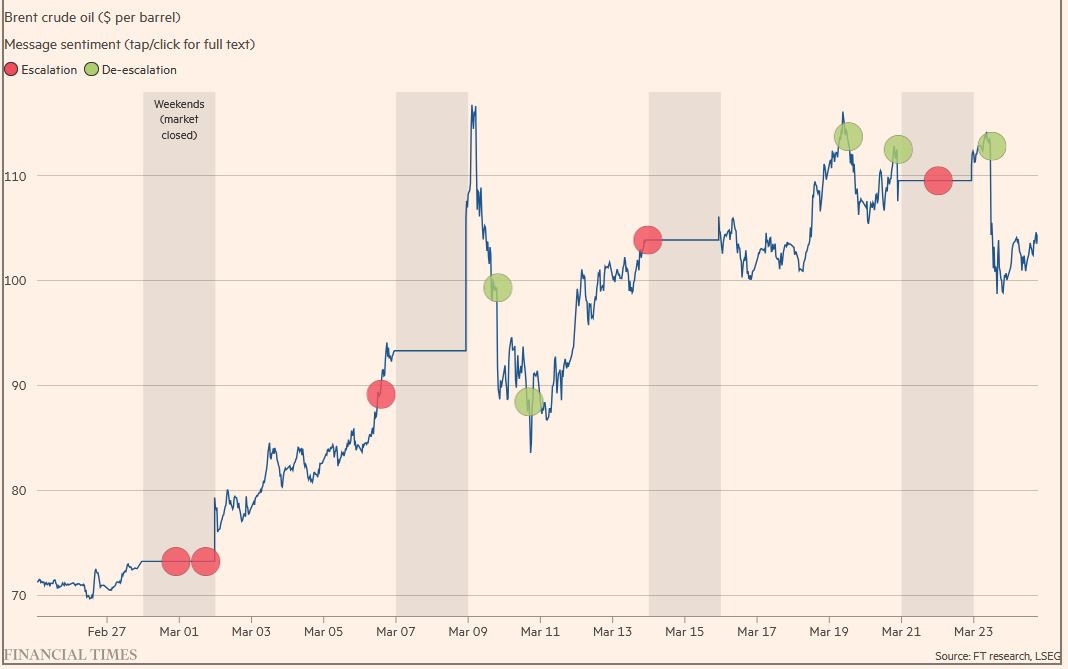
www.bankingnews.gr













Readers’ Comments