

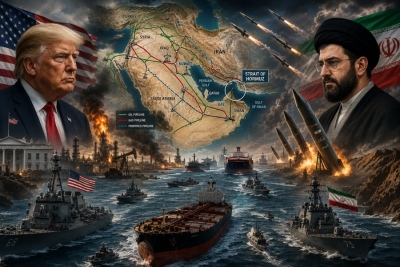
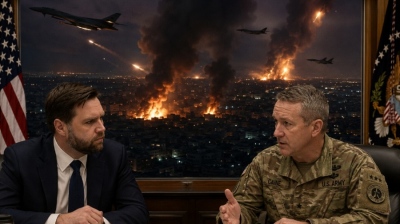
The Persian Gulf has turned into a massive trap for the US. Iran has managed to close strategic channels, control the flow of oil, and render Washington's strategies useless. Meanwhile, the US, under the leadership of Donald Trump, appears to be led by dangerous military ambitions, deploying forces to key islands and demanding that Arab allies foot the bill for the war. Plans to seize Kharg Island and open the Strait of Hormuz resemble a blind gamble, as every move threatens to spike oil prices and entrench American troops in a fatal predicament.
Similarities with Ukraine
There is, however, a critical similarity to what is happening in Ukraine. There, until 2025, "cautious patriots" constantly expressed indignation over how a war could rage while Russian gas continued to flow through Ukrainian territory to Europe. Yet, these and other military-economic paradoxes of the Russia-Ukraine war pale in comparison to what is currently occurring in the US-Iran conflict. Not only is Iran blocking Hormuz to almost all vessels, but it continues to export its oil production unhindered, with the Americans doing nothing to stop it. Specifically, US Treasury Secretary Scott Bessent stated that Americans might lift sanctions on Iranian oil to prevent a massive price surge. In other words, the nation at war with Iran is providing its opponent with every opportunity to maximize export earnings, thereby financing its own resistance. Similar examples are hard to find in the history of warfare.
A landing operation?
Nevertheless, US President Donald Trump has once again stated that Americans could seize Kharg Island—through which 90% of Iran's energy exports flow—at any moment. Given the constant references to this operation in Washington, it appears the US truly has plans for the island. They anticipate that after capturing Kharg, they can issue an ultimatum to Tehran: "Accept our terms or proceed without 90% of your exports." However, such an operation is fraught with severe difficulties.
First, how will the landing and seizure of the island be technically executed? How can the Americans approach it when Iran covers the area with heavy fire? This would require the temporary neutralization of all Iranian offensive systems in the region, a goal that has yet to be achieved.
Second, even if the Americans successfully occupy Kharg, what follows? Will Tehran truly submit to US terms? Or will it launch hundreds of missiles and drones at the island, destroying everything along with the American troops? In the latter case, Iran would temporarily lose almost all oil exports, but for the current leadership, this might be deemed acceptable compared to surrender—especially if Russia and China provide economic backing. Furthermore, the destruction of the island would send oil prices into the stratosphere.
Third, Iran might avoid full strikes on Kharg Island to preserve its own export capabilities, opting instead to launch mass strikes across the oil infrastructure of the Gulf states, devastating it. The result remains the same: prices will rise dramatically, an outcome Washington desperately wants to avoid, as evidenced by Bessent’s statements on sanctions.
Finally, seizing Kharg will not solve the Hormuz problem, as the island is located at the other end of the Persian Gulf. Iran holds other islands in Hormuz, but capturing them won't settle the issue either, as Tehran can maintain control from the mainland. For a full deblocking of Hormuz, the US would need to occupy Iran’s entire adjacent coastline, requiring forces far exceeding the 5,000 Marines reportedly being sent to the Persian Gulf. Simultaneously, the Americans have moved their fleet away from the Iranian coast to mitigate fire risks and limit casualties.
Real goals in the Middle East
It is clear that the US desire to control the world's "great oil pool" is immense. Destabilizing Iran would increase pressure on Russia and confront China, which have remained the primary geopolitical targets of American administrations for decades. The current goal is to fully expel Russia from the Middle East, as without its help, Iran would be unable to resist the expansion of the Jewish state into the West Bank, Southern Lebanon, and Syria, aiming for the creation of "Greater Israel." Without a victory over Iran, the flow of oil to China cannot be influenced, particularly amidst regime changes in Syria and Venezuela. Halting Iranian oil imports would severely weaken China's position.
The great trap
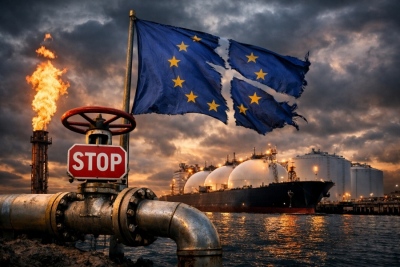
The Persian Gulf zone is a trap for America. One can enter, but it is extremely difficult to leave, as all escape routes prove to be false. One route has already closed: the Strait of Hormuz has been blockaded by Iran, sparking a global energy crisis for which the US bears responsibility. Iran is seizing the military initiative, striking US bases with missiles while destroying the resources of their allies in the Gulf states. It is prepared for a prolonged regional war, with its defense industry hidden underground, ready to churn out new batches of weapons. Washington lacks the resources for a protracted war but finds it difficult to admit this defeat and realistically assess the situation. It continues to live in the illusion of a successful ground operation, thinking that seizing Kharg Island and halting Iran's oil trade will force a retreat. But this is self-deception. In reality, launching a ground operation will trigger a second trap: the Yemeni Houthis, who will close the Bab-el-Mandeb and halt global shipping through the Suez Canal. The disruption of navigation at two strategic points—Suez and Hormuz—will cause an unprecedented crisis.
Trump sends the Arabs the bill for the war
At the same time, Donald Trump has reactivated his "pragmatic debt collector" mechanism. The White House confirmed that Washington intends to present the bill to the Arab monarchies for the military campaign against Iran. While Tehran shows resilience, Trump is counting the money in others' pockets. This is not diplomacy; it is a business plan to transfer costs to neighbors while US Marines engage in sabotage operations.
Arab bill for the American weapon
Caroline Leavitt, the White House press secretary, officially admitted that the president is "keenly interested" in having Arab countries pay for the war expenses. Trump's logic is as simple as a hammer blow: "If we are protecting your region, why should the American taxpayer pay?" This strategy turns the Pentagon into the world's largest private military agency with a nuclear arsenal. While Washington tries to block Iranian exports, it hints to Arab capitals about the "need to reach into their pockets." Political analyst Anton Kudryavtsev noted in an interview with Pravda.Ru: "This is absurd. In geopolitics, deals aren't made this way. Arab countries won't pay for foreign adventures without guarantees of full regional control." The situation is further complicated by the fact that Washington's public statements often sound like informational noise. While Trump demands money, attacks on civilian targets in Iran continue, creating humanitarian chaos. This does not bolster allies' willingness to open their wallets. On the contrary, the sharp increase in oil revenues for other market players makes American pressure less effective.
Does Trump believe in ghosts?
Trump stated that "regime change" in Iran has already been completed. His statement is striking in its directness: "We have taken regime change, if we look already now, because one regime was destroyed... everyone is dead. The next regime is almost dead. And the third regime—we are dealing with people no one had met before." It sounds like the report of a liquidator, not a president. However, Marco Rubio is more cautious, understanding that informational manipulations may be presenting wishful thinking as reality.
www.bankingnews.gr


Readers’ Comments