

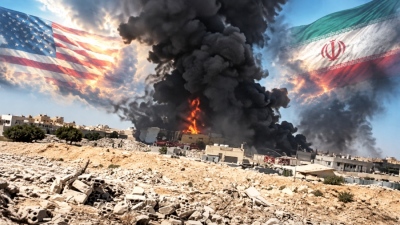
The decision of US President Donald Trump to involve the United States in yet another military conflict in the Middle East was not merely a show of force, but a dangerous geopolitical gamble with incalculable consequences. The tension ignited in the wider Persian Gulf region ultimately led to the closure of the Strait of Hormuz—one of the world's most critical energy transit points, through which a vast percentage of the global oil trade passes. This move caused immediate tremors in international markets, a spike in energy prices, and deep concern across Europe and Asia.
Destabilization
Despite initial assurances from Washington that the military operation aimed at "stability," the result was exactly the opposite: a destabilized region and a strategic passage out of operation. Under increasing pressure from allies and markets, Trump was forced to continue operations aimed at reopening the Strait. However, the lack of a clear strategy and the contradictions in American policy rendered these efforts fragmented and ineffective. The Strait remained closed while the international community watched in embarrassment.
The pivot
And then, in a sudden pivot, the American president chooses withdrawal. In statements that caused a sensation, he argued that "the United States has no reason to be involved in foreign disputes" and that "if the Strait remains closed, it is not our problem." This stance raises serious questions about the credibility and consistency of American foreign policy. From provoking a crisis of global proportions to a sudden distancing, Trump's path highlights a dangerous absence of strategic depth. And the price, it seems, is to be paid by the entire planet.
The craziest war to date
Despite all this, Trump at one point characterized the wars in the Middle East as "crazy," but the US-Israeli war against Iran may be the craziest to date. Standing beside him is the US Secretary of War, whose rhetoric adds a darker tone, with biblical overtones and speeches about a civilizational struggle or crusade, in which the conflict is presented as destiny. This is a robbery cloaked in theology, and the result is not power. It is a spectacle: a superpower that speaks in absolute values, acts with contradictions, and expects the world to accept both.
Strait of Hormuz transits down 97% in one month
In the meantime, navigation in the Strait of Hormuz has decreased by 97% during the 28 days of the war, according to the Financial Times. Based on the report, data shows that ship transits through the Strait of Hormuz have dropped by 97% compared to the previous month. Data from the International Energy Agency (IEA) shows that the average daily number of transits fell from 84 ships per day in the January–February 2026 period to just 10 ships per day after February 28, following the start of the war.
Massive reduction in oil production
Simultaneously, Kuwait announced that it reduced crude oil production due to maritime transport disruptions in the Strait of Hormuz. According to the Kuwait National Petroleum Company, the country's production dropped from over 3 million barrels per day before the war to about 500,000 barrels per day on March 10. Iraq, one of the countries hardest hit by the crisis, also reduced its production from 4.3 million barrels per day to about 1.2 million barrels. The port of Basra, which usually has an export capacity of 3.5 million barrels per day, has effectively halted crude oil exports. At the same time, according to an estimate by the analytical firm Kpler, at least 107 billion dollars worth of crude oil, petroleum products, and liquefied natural gas (LNG) are currently stranded in the Strait of Hormuz.
Transit of grain ships
Nevertheless, Iran allowed the passage of ships carrying grain and agricultural products. According to the Financial Times, at least 6 grain ships between March 15 and 16 passed through Iranian territorial waters, docked at Imam Khomeini Port, unloaded their cargo, and then crossed the Strait. This decision was made while Iran, despite its relative self-sufficiency in oil production, depends on imports of grain and oilseeds to ensure its food security. JPMorgan warned that if the disruption in the Strait of Hormuz continues for another 21 days, the region's major producers will be forced to shut down their facilities. The International Energy Agency described this situation as "the largest supply disruption in the history of the global oil market."
The US desperately seeks an exit strategy
This situation is sounding the alarm within the American administration. Despite ongoing Republican support for the war effort, numbers are dwindling and the mood for sending troops to Iran has receded dramatically. Fox News published a new poll revealing a drop in Trump's approval ratings, with 62% of voters disapproving of him overall and 64% judging his handling of the Iran crisis negatively.
Donnie Beson, a 68-year-old Republican voter from Colorado, described his frustration: "We have a war costing billions of dollars a day. He forgot the other problems affecting us daily." It seems that Americans are demanding that Trump focus on serious domestic issues instead of getting involved in controversial foreign wars. Militarily, Washington's approach is proving weak and ineffective. On Thursday (3/26/2026), Trump gave Iran an additional 10 days to reopen the Straits of Hormuz, threatening to otherwise give the green light for attacks against civilian energy infrastructure. This move clearly aims to reduce tension in energy and capital markets, but simultaneously reveals the administration's inability to end the war with dignity. An exit strategy is being sought desperately, but the reality is that Washington's options are narrowing dangerously.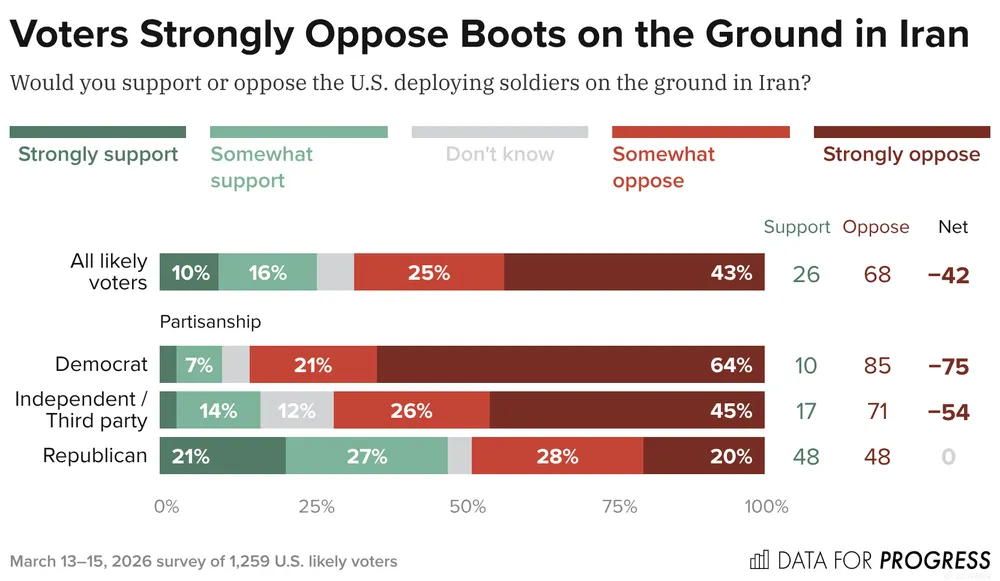
www.bankingnews.gr










Readers’ Comments