

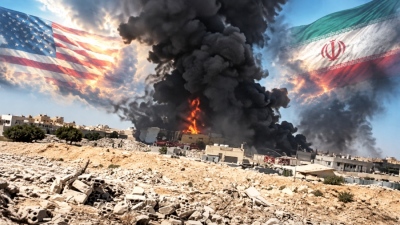
The failure of the American and Israeli operation against Iran is now being recognized both within the US and inside Israel, despite heavy censorship. Increasingly, the Israelis themselves acknowledge that Israel is weaker and that the Americans must abandon their ambitions regarding the Strait of Hormuz.
Israel is not the power it once seemed
The backbone of Israeli foreign policy has suffered a massive shock, emphasizes Yoel Guzansky, the leading expert on Persian Gulf countries at the Institute for National Security Studies (INSS) affiliated with Tel Aviv University. Specifically, he argues: "One of the most significant consequences of this war is the change in the view of Persian Gulf countries toward Israel... a point of great importance because the 'normalization of relations' had become the backbone of Israeli foreign policy over the last decade, especially since the Trump presidency."
Israel threatens the security of Gulf states
But now, he said, some Gulf states have concluded that Israel is not the power it once seemed. This shift in perception could delay—or even reverse—the path toward normalization. In this context, Israel's presence in the Gulf region, instead of being seen as an opportunity, may be viewed as a security threat to these states. Another major point relates to the "post-war perspective." From the perspective of the Persian Gulf countries, one of the consequences of this war is disappointment in the United States. The United States used to say it was present in the region to ensure the security of these countries, but in practice, recent developments have created the mindset that not only have they failed to guarantee their safety, but in some cases, they have become a factor in increasing insecurity. Even the inability to fully protect certain bases has reinforced this doubt. Consequently, it is expected that these countries will re-evaluate their relations with the United States. This could lead to an increased desire for "self-reliance" and a reduction in absolute dependence on the American security umbrella. The degree to which these countries are able to implement such a strategy is questionable. However, the principle of questioning previous dependence on the United States is considered a significant result of this war in itself.
America must forget the Strait of Hormuz!
Iran created exactly the scenario that US President Trump wants to avoid: a prolonged and complex war. This complexity means that Washington no longer has an option that can be implemented without chain reactions and multi-layered costs. Every operational decision simultaneously triggers a new set of challenges. A major issue is the scenario of opening the Strait of Hormuz through military action. Even assuming such an action is possible through ground or combined operations, the main question is whether "opening the strait at any cost" is fundamentally an acceptable option. His answer is no. According to Guzansky, any attempt to enforce such a situation would be met with a strong Iranian response, which could directly target the oil and gas infrastructure of countries in the region. In this case, the cost of this confrontation would far exceed the potential benefits of opening the strait. In other words, even if the goal is to control oil prices by keeping the Strait of Hormuz open, Iranian counter-attacks could function in a way that would severely disrupt the entire global energy market.
Preventing widespread destruction
Therefore, his conclusion is that for the countries of the region, the current situation in the Strait of Hormuz—even with the restrictions—is less costly than a scenario in which their vital energy infrastructure is exposed to widespread destruction. To put it more clearly, maintaining the status quo is considered a more rational choice than entering an extensive cycle of destruction.
www.bankingnews.gr








Readers’ Comments