

As the war in the Middle East, ignited by the US-Israel attack on Iran, continues to spread, a grim oracle arrives to provoke terror. Specifically, Chinese analyst and "prophet" of history, Jiang Xueqin, is sounding the alarm over an impending catastrophe that transcends the boundaries of a simple war. Speaking to Tucker Carlson, Jiang Xueqin does not merely describe a military engagement, but a "geopolitical death." Using the notorious Sicilian Expedition of the ancient Athenians as a mirror, he warns that the American attempt to seize Kharg Island risks turning into a modern-day Slaughter of Syracuse. Notably, Jiang Xueqin's previous predictions regarding the US proved correct; he had predicted Trump’s electoral victory and the war with Iran through his educational YouTube channel, "Predictive History."
What happened in the Sicilian Expedition
During the discussion with Carlson, Jiang compared a potential US invasion of Iran to the Athenian Sicilian Expedition (415–413 BC) during the Peloponnesian War, which ended in the complete crushing of the Athenians at Syracuse. This ambitious expedition, which seemed promising, evolved into a disaster for Athens: a dire defeat with the loss of a large part of the fleet and army (2/3 of the ships and 1/3 of the hoplites), followed by economic collapse, the strengthening of Sparta's influence, and the beginning of a democratic crisis in Athens. The Athenians wanted to capture Syracuse and subjugate Sicily to cut off Sparta (their enemy and rival) from grain supplies and expand their influence to the West. However, they failed, and from that point on, the power of Athens declined.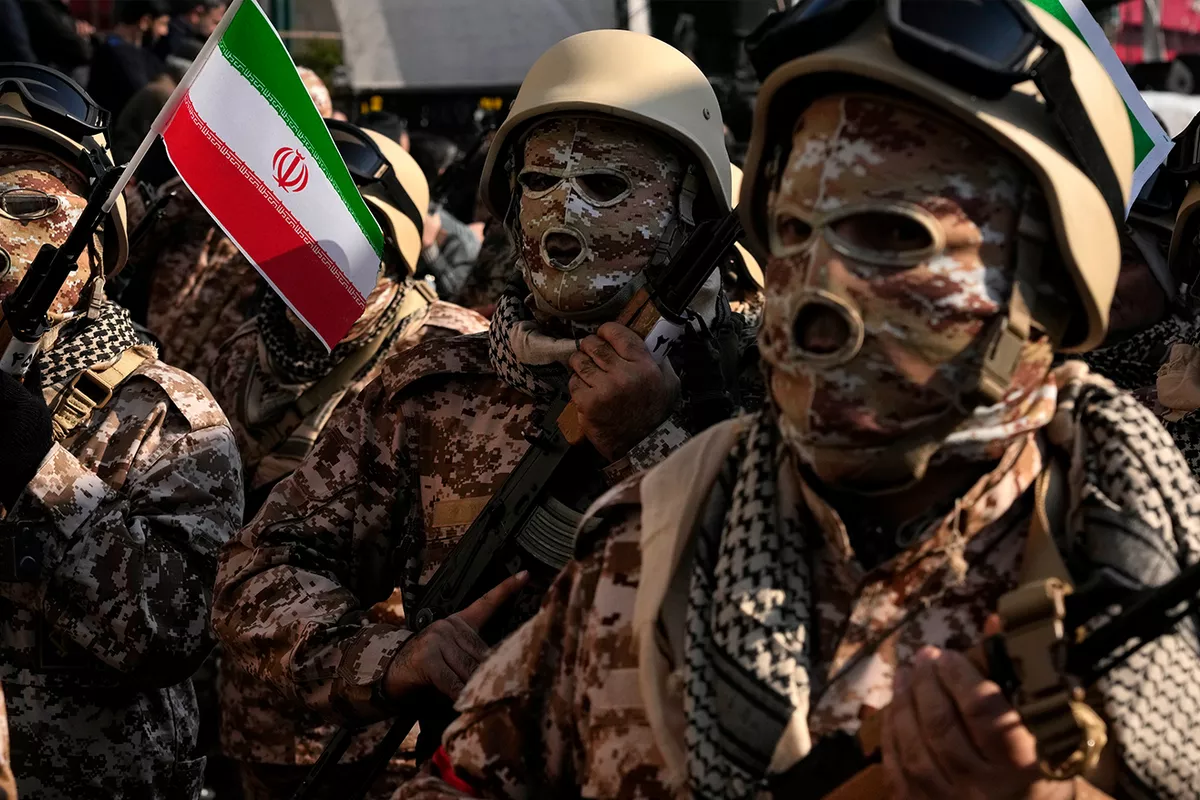
Jiang explained that Iran, with its 90 million inhabitants, is a land power. Its mountainous terrain allows for the concealment of mobile missile launchers. For full control of the entire country, 3 to 4 million soldiers would be required—a number far greater than the available US forces. Regarding the strategically important Kharg Island, in order to capture it and interrupt Iranian oil exports, the US would have to maintain a physical presence there. However, the island is only 25 km from the Iranian coast, meaning it is within range of MLRS systems, artillery, mobile launchers, and a plethora of drones hidden in the mountains. This is not a "hit from the air and leave" type of operation, but a continuous military presence under incessant fire from Iranians defending their land. Furthermore, a total blockade of the Strait of Hormuz would instantly turn a local conflict into a global energy crisis, dragging new players into the confrontation.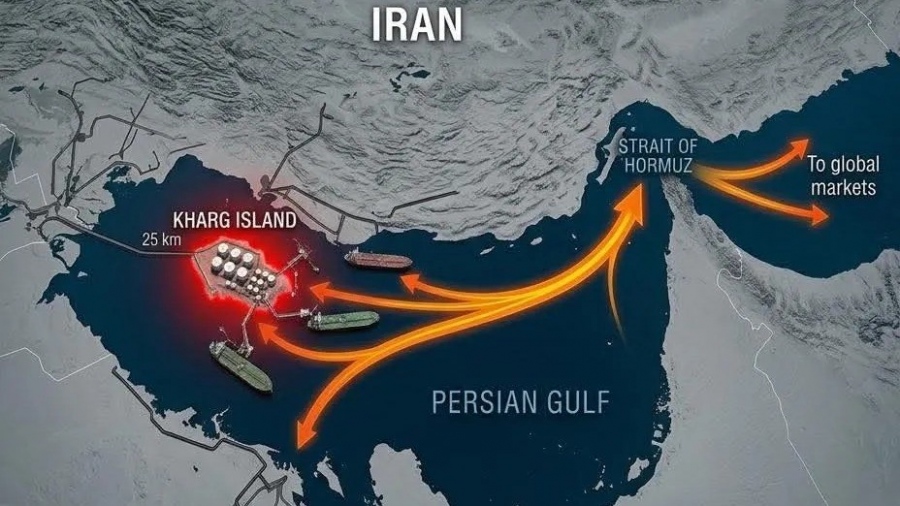
The cost
For this reason, the adventurous operation to seize Kharg Island could cost the US dearly, and not just financially. Their reputation and prestige will be struck. It will be like a second Vietnam, as the US entered Iran with a limited goal but may find themselves in a situation where neither a quick victory is possible, nor a withdrawal without loss of status. At the same time, for Tehran, it is enough simply to endure, making the American presence costly and unbearable, waiting until internal pressure in Washington becomes so problematic for the government that what happened in 1973—when the US withdrew its troops—is repeated. According to Jiang, if the US gets bogged down in Iran, it will be a war of attrition—like in Ukraine or Vietnam. Because for Iran, survival under the current sanctions regime constitutes a victory in itself and they have no incentive to capitulate, while the US cannot afford to appear defeated but lacks the forces to win.
www.bankingnews.gr













Readers’ Comments