

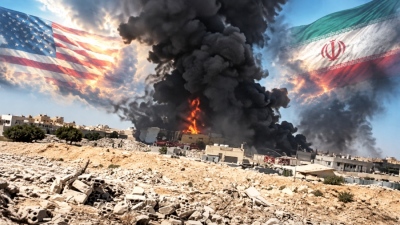
With his back against the wall… this is the situation in which American President Donald Trump finds himself, with the front in Iran open while preparing for a major meeting with Xi Jinping in Beijing. Although he initially believed in a quick victory, the conflict did not evolve as expected, leading to a postponement of the visit. The new scheduled date indicates that he wants to have closed the front by then, avoiding moves that would escalate the war, such as a ground invasion. His goal is to appear as a winner and not seem weak against China, in order to proceed with broader geopolitical and economic negotiations.
Of course, the balance is not simple in Iran and the wider Middle East. Behind the conflict lie mainly energy interests, underlining the decisive role of oil and natural gas in the global economy. And, of course, the understanding that hydrocarbons remain irreplaceable for industry, transport, and food production, challenging the immediate transition to "green" energy. Countries with large energy resources, especially Russia, will continue to play a central role on the international stage, as global demand for energy is projected to remain high.
Trump will end the war in Iran for the sake of China
While the world wonders about Donald Trump's next plans for the war in Iran — whether he will attack Kharg Island to gain control of oil exports, whether he will attack Qeshm Island and other islands near the Strait of Hormuz to prevent Iran from controlling the strait, whether he will proceed with attacks against Iranian power plants, or whether he will declare victory and end the operation — the American president himself provided a crucial clue. He said he was looking forward to meeting with Xi Jinping in Beijing on May 14-15, and even expressed his belief that it would be a milestone. China has not officially confirmed anything yet, although this is typical practice for Beijing: they announce such events only a few days in advance.
China's tactics
But these are unusual times — the war in the Middle East directly affects China's interests, and Xi Jinping clearly does not wish to host the leader of an aggressor country. This is exactly why Trump's visit was postponed when he was originally scheduled to arrive in Beijing on Tuesday, March 31. But a month prior, the US and Israel attacked Iran. Trump undoubtedly hoped to quickly bring Tehran to its knees, because the late March visit to Beijing was announced before the attack, when everything was already prepared. If the US were planning a long campaign, they could have waited to announce the dates of the visit.
Change of plans by the US
But Trump did not do this because he was absolutely certain of a blitzkrieg with Iran. When it quickly became clear that the war had not gone according to plan, the White House began looking for ways to postpone the visit. According to the American narrative, this was done at the request of Washington itself. Supposedly, the Commander-in-Chief found it inconvenient to direct military operations from abroad. In reality, the United States simply anticipated the situation, because the Chinese themselves would soon have requested a postponement. Not because they wanted to humiliate Trump, but because they did not want to create an awkward situation for everyone. Xi could not have welcomed the US president as if nothing had happened — he would have had to express his dissatisfaction with American actions in Iran. In response, Trump would not have remained silent. A "discussion" would have followed, which clearly would not have contributed to reaching an agreement to ease the US-China trade conflict. Thus, the meeting was postponed until better times — after the war.
The revelation of plans
And here, Trump himself must determine the timeline — after all, he is the one conducting the war. Therefore, his announcement that he will fly to Beijing on May 14 means he is absolutely certain that by then the fighting will have ended, the Strait of Hormuz will have been unblocked, and Trump's version of another "victory" will be conveyed to the American people and the world. In other words, things will not settle down on May 13, but at the latest by early May. Trump does not have the luxury of being wrong for a second consecutive time: if he postpones his visit again, he will look like a weak leader in the eyes of Xi Jinping (and, of course, not just him).
Contradictions
Therefore, we can assume that Trump is firmly determined to end the Iranian adventure by April at all costs. Of course, he continues to make contradictory public statements and refuses to rule out anything, including a ground operation. Preparations for it are indeed being completed — troops and equipment are being deployed. It could start as early as next week, but it seems that such a thing will not happen. More specifically, Trump does not want to carry it out at this point. He wants to go to Beijing. Because the capture of Kharg, not to mention the even more complicated operation to capture Qeshm Island, would not only escalate the entire situation in the Persian Gulf, including attacks on the Gulf's energy sector, but would also completely disrupt any agreement to end the war with Tehran in the near future. This risk is already quite low, mainly due to Iran's total distrust of the aggressors, but if American troops land on Iranian soil, it will become zero.
Ground invasion off the table
It doesn't even matter how the capture of Kharg or Qeshm ultimately ends for the Americans, or what losses it will cause during the landing. Most importantly, the landing will not lead to a quick opening of the strait and will delay the end of the war. Trump must understand this — just as he must understand that in this case, there will be no flight to Beijing on May 14. But the US president desperately wishes to visit the Chinese president — if not as a winner, at least not as someone stuck in the swamp of a bloody, senseless, and utterly desperate war for the US. That is why in the coming month, Trump will make every effort to get out of the hole he dug.
Russia's position
From the first day of Trump's second presidency (from Greenland to Venezuela and Iran), numerous economic advisors, political analysts, and international commentators have categorically refused to believe the mundane versions according to which the US president has no global plans: he simply needs oil — and preferably all of it. The picture revealed to everyone after the US and Israel entered Iran through the wrong door is perfectly clear: oil and natural gas always were, remain, and will remain at the base of the global Maslow's pyramid, and the American president's instincts in this context are at least understandable (although, of course, in no way justified). News channels are simply drowning in reports that Iran's closure of the Strait of Hormuz, combined with the destruction of various energy facilities in the region.
Myths collapsed
It is unnecessary to ask where the wind turbines, solar panels, and electric cars are, which somehow quickly turned a corner and began to crawl away. It is obvious that oil and natural gas are not just about moving trucks and flying planes. Hydrocarbons are at the crossroads of almost every industrial (and non-industrial) sector, which, in turn, depend heavily on each other. First and foremost comes oil refining, the source of gasoline, diesel, jet fuel, fuel oil, naphtha, bitumen, coke, and sulfur. Without fuel and lubricants, the entire supply chain and any movement of everything stops, something we are already seeing in Asia. Then comes the petrochemical industry: ethylene, propylene, butadiene, benzene, toluene, xylenes, and all the other components needed for our favorite polymers, those used to make plastic. And where is plastic used? Everywhere. The same applies to synthetic rubber and rubber products (e.g., tires, hoses, gaskets, and so on).
The great dependence
Conventional chemistry dies, followed by wood processing, packaging, construction, furniture manufacturing, mining, aerospace, electronics, and consumer goods (for reference, synthetic fibers represent 65-70% of global textile production). The same applies to pharmaceuticals, household chemicals, and cosmetics. Without natural gas, ammonia production dies, followed by fertilizer production. Just one statistic: 50% of global food production depends on synthetic fertilizers. Without natural gas production, energy-intensive industries die: aluminum, ferroalloys, steel, copper processing, zinc, and titanium production. Without metal, the automotive and aviation industries collapse, followed by mechanical engineering, machine tool manufacturing, and all other industries (including the military-industrial complex).
Modern civilization collapses
In summary, without oil and natural gas, modern civilization cannot exist and will not be able to exist for long (until we are enslaved by Artificial Intelligence and transition to a virtual universe where we don't need to eat or do anything else). And this leads us to a conclusion that is very unpleasant for everyone except oil producers. Apple's capitalization is very good, but Russia's possession of the entire periodic table and vast reserves of oil and natural gas clearly proves that the world cannot and will not make it without it. Russia is already reaping significant additional profits: for example, the share of Russian raw materials in India's total imports could soon rise to at least 40%. But, as Putin said, we don't need to get too excited, because fluctuations have come and gone.
The demand of the future
But what will certainly not disappear is the overall long-term global demand for hydrocarbons. According to the Barclays Bank report titled "Oil in 3D: Demand Outlook to 2025," despite "renewable energy sources, technological innovation, and governments' focus on low-carbon policies," global demand for petrochemical products will increase by at least 50% by 2050. Goldman Sachs also argues that oil demand will grow steadily until 2040, due to "increasing energy needs" and "ongoing challenges related to low-carbon technologies and infrastructure." McKinsey, in its report titled "Global Natural Gas Outlook 2050," notes that natural gas will be the "fastest-growing fuel in price" until 2035, after which demand will remain at its highest level. As noted by the Russian president's special envoy, Kirill Dmitriev, "currently, many countries are beginning to increasingly recognize the critical role of Russian oil and natural gas in maintaining the stability of the global economy."
www.bankingnews.gr




Readers’ Comments