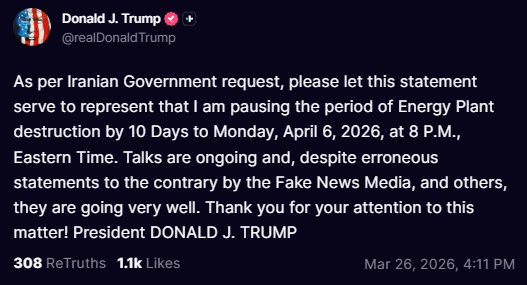
Being in an extremely difficult position, in a strategic trap in reality, the president of the United States, Donald Trump announced on 26/3/2026 the suspension of military attacks against the energy infrastructure of Iran for 10 days.
The announcement was published on the social media platform Truth Social and has already sparked intense discussions at an international level.
Trump stated that, in response to a request from the Iranian authorities, the destruction of energy installations is suspended until 20:00 on Monday, 6 April 2026.
The American president also claimed that negotiations are underway and that, despite the “incorrect statements of the fake news media”, things are progressing very well.
It is worth noting that Iran categorically denies participating in negotiations with the United States while describing the diplomatic moves of the Americans as a fraud.
It is obvious that there was no request from the Iranian authorities for a ceasefire in energy strikes, therefore the Trump decision is unilateral.
What the 10 day deadline means - What Trump’s intentions are
This decision marks a rare period of de escalation in the region.
Analysts point out that this move may open the way for diplomatic solutions and temporarily reduce the risk of military conflicts.
Experts in international politics believe that this suspension, although limited in time, sends a message to all parties involved, Washington is in a particularly difficult position and appears ready to pursue negotiations and not immediate military action, under conditions.
At the same time, the global energy market is closely watching, as any disturbance in Iranian facilities may affect oil and natural gas prices.
The 10 day deadline creates a critical window for diplomatic moves and potential agreements, while at the same time placing India, China and European powers in the role of observer, awaiting the next move of Washington.
However, many analysts speak of. a strange announcement from the American president about suspending strikes on Iran while indications of military escalation are increasing, possibly even in the form of ground operations.
The role of markets and bonds
This decision comes at a particularly sensitive moment for global markets.
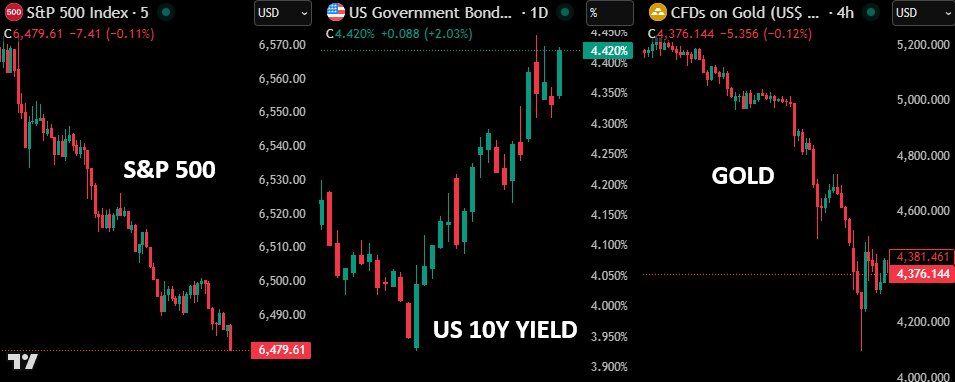
Observers note that the Trump announcement coincided with strong pressure on bond markets, as the yield of the American 10 year bond approached the level of 4.40%, an indication of increased concern about inflation, fiscal issues and geopolitical tensions.
In similar cases in the past, movements in the bond market have functioned as a “warning signal” for the economic policy of Washington, as rising yields increase borrowing costs for the American economy.
The terms of Iran for a ceasefire
In a highly charged diplomatic move, Iran officially responded to the 15 proposed clauses of the United States, sending its position through intermediaries.
According to sources cited by the Iranian news agency Tasnim, the response was transmitted on the evening of Wednesday (25/3/2026) and Tehran is now awaiting the reaction of Washington.
Sources with knowledge of the negotiations report that Iran set strict and clear conditions for any possible agreement.
The first and main demand is the immediate cessation of attacks and targeted assassinations, which Tehran describes as “aggressive actions of the enemy”.
At the same time, it requests the creation of specific guarantees to ensure that a new conflict will not be repeated.
Within the same framework, the Iranian side demands compensation for the damages caused by the war, as well as an official and clearly defined commitment for the payment of war reparations.
Tehran also emphasizes that the end of hostilities should apply to all fronts of the region and cover all forces of the so called “resistance” that participated in the conflict.
Full sovereignty of Iran over the Straits of Hormuz
Particular emphasis was placed on the issue of sovereignty over the Straits of Hormuz.
According to the same source, the exercise of full Iranian sovereignty over this strategic passage is considered a “natural and legitimate right” of the country and should be recognized as a guarantee for the implementation of the commitments of the other side.
These terms, according to the same source, differ from the demands that Tehran had presented in the second round of talks that took place in Geneva a few days before the attack by the United States and Israel in March.
However, Iran appears particularly distrustful of the intentions of Washington.
The same source claims that the American reference to negotiations is in reality a “third deception plan”, with multiple objectives.
The distrust of Iran toward the United States has deep and justified roots
According to Tehran’s assessment, the United States seeks:
1) to present itself to the international community as a power that desires peace and the end of the war,
2) to keep international oil prices low,
3) and to gain time for the preparation of a new military operation in southern Iran through a ground entry.
This distrust, as noted, has deep roots.
Tehran argues that in the past the United States initiated military operations while negotiations were already underway, both during the so called “twelve day war” and in previous conflicts.
For Iran, this constitutes proof that negotiations are often used as a political tool and not as a real effort to reach an agreement.
Thus, the current diplomatic exchange of messages is unfolding within a climate of deep suspicion, while the international community is watching with concern the developments in a region that remains one of the most geopolitically explosive in the world.
www.bankingnews.gr











Readers’ Comments