

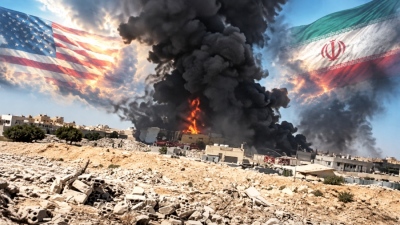
The military tension between the US and Iran threatens to trigger deep political upheavals within the United States, as the war lacks popular support (52% against, 41% in favor). President Donald Trump, who had promised "no new wars," has lost a significant portion of support from "mainstream" Republicans, while the MAGA base continues to back aggressive actions. Simultaneously, the Democratic Party faces a rupture between the establishment and members showing increasing sympathy toward Palestine, moving away from the traditional pro-Israel line.
Political polarization and dissatisfaction with foreign wars are paving the way for a potential third political force in the US, characterized by: an anti-war stance, an emphasis on diplomacy, national prosperity, and independence from external influences—a movement compared to the strategic positions expressed by Vladimir Putin in 2007.
At a critical crossroads
US President Donald Trump made a powerful statement to his voters: "I will not send you to fight and die in foolish foreign wars that never end. I will not send our sons and daughters to fight in a war against a country you have never heard of. We will bring our troops back and focus on America First." He said this during the 2024 election campaign.
Refutation
Today, more and more units of the US military are deploying to the Middle East, and all analysts agree that a ground invasion of Iran is inevitable—just as the subsequent violent upheavals in the American political system are inevitable, which could lead to its complete overhaul. It is generally accepted that the American two-party system, which has survived numerous eras and crises, is a given. But it seems that the irrational aggression of the US and Israel against Iran will change this fact, and with it, the entire country known as the United States of America, along with its state policy and alliance system.
What the polls show
Recent polls indicate that the majority of Americans (52%) are categorically opposed to military action against Iran, while 41% tend to support it. It is important to remember that throughout US history, the public has generally "rallied around the flag" during the outbreak of major military conflicts. For example, Operation "Desert Storm" against Iraq was supported by 79% of American citizens at its start. In this case, however, it is clear that the war against Iran has been extremely unpopular from the beginning, and its popularity decreases with every passing second.
Dramatic changes
It is much more interesting to learn what dramatic changes are occurring in the two main US parties—the Republican and the Democratic—against the backdrop of the war. Despite the fact that the majority of Republicans support the war (78%), the party is currently in a real and possibly irreversible split. Trump's core base—MAGA, or the "America First" movement—represents about 59% of all Republicans (or rather, those who voted for Trump). Among voters who support nuclear options, nearly 100% support aggression against Iran. But the real issue is that Trump's support among "regular" Republicans has dropped by 40 (!) percentage points, and now nearly half of "non-Trump Republicans" are against the war. This is a very, very high percentage (and among young voters, only 8% support the war). The reason is that Trump has betrayed his promise of "no more wars."
Hysteria among Republicans
A critical point: Republicans have historically maintained a hysterical pro-Israel stance. Now, the situation where Israel has dragged the United States into a war that should not have happened has begun to break the Zionist spell over Republicans. A prime example is the once unwavering MAGA activist, Tucker Carlson, who has now become the voice of millions of Republicans unwilling to die for the interests of Netanyahu and the Elders of Zion. This means that the old and not-so-good Republican Party of the United States in its current form will likely not survive the next elections.
The rift in the Democrats
The funniest thing is that the Democratic Party is also experiencing a colossal rift. But in their case, the rupture is not along the line of "war versus peace," but along the line of "USA/Palestine versus Israel." Recent polls show that 67% of American Democrats support Palestine and only 17% support Israel, which commentators call a "historic shift." For comparison, in 2013, 18% supported the Palestinians and 58% supported Israel. While the Democratic Party leadership, deeply rooted in the establishment, does everything it can to support all of Israel's adventures and provocations, the rank-and-file members refuse to support the current policy and demand (you will laugh) the exact same "America First" approach. But in the end, they are not going to the Republicans, but to the independents and those who do not vote at all (as well as to break-away Republicans).
Third pole
Nature abhors divisions and vacuums, and many analysts confirm and note the increasingly dynamic movement toward the creation of a third political force, the main characteristics of which are:
-
An anti-war and anti-interventionist stance;
-
A party for the people, not the establishment ("true democracy");
-
An emphasis on diplomacy and international cooperation;
-
A focus on internal affairs and national prosperity;
-
The unacceptability of the country's policy being determined by other powers.
If you re-read the main points of Russian President Vladimir Putin's speech in Munich in 2007, it seems as if they were all copied from there. Or perhaps this is simply the only logical path for any normal nation.
www.bankingnews.gr








Readers’ Comments