

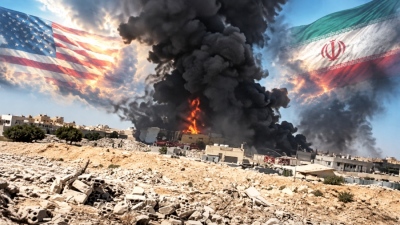
The United States continues to delude itself into thinking it can defeat Iran. Despite Donald Trump’s clumsy theatrics regarding peace and ceasefires, it is evident that he is considering the seizure of strategic Iranian regions in an attempt to reopen critical routes like the Strait of Hormuz and counter Iranian resistance in the ongoing war. According to leaks, the American command has reviewed military plans involving the capture or blockade of Kharg Island, Iran's primary oil export hub, as part of an effort to force Tehran to open the Hormuz shipping lane and restore trade flows.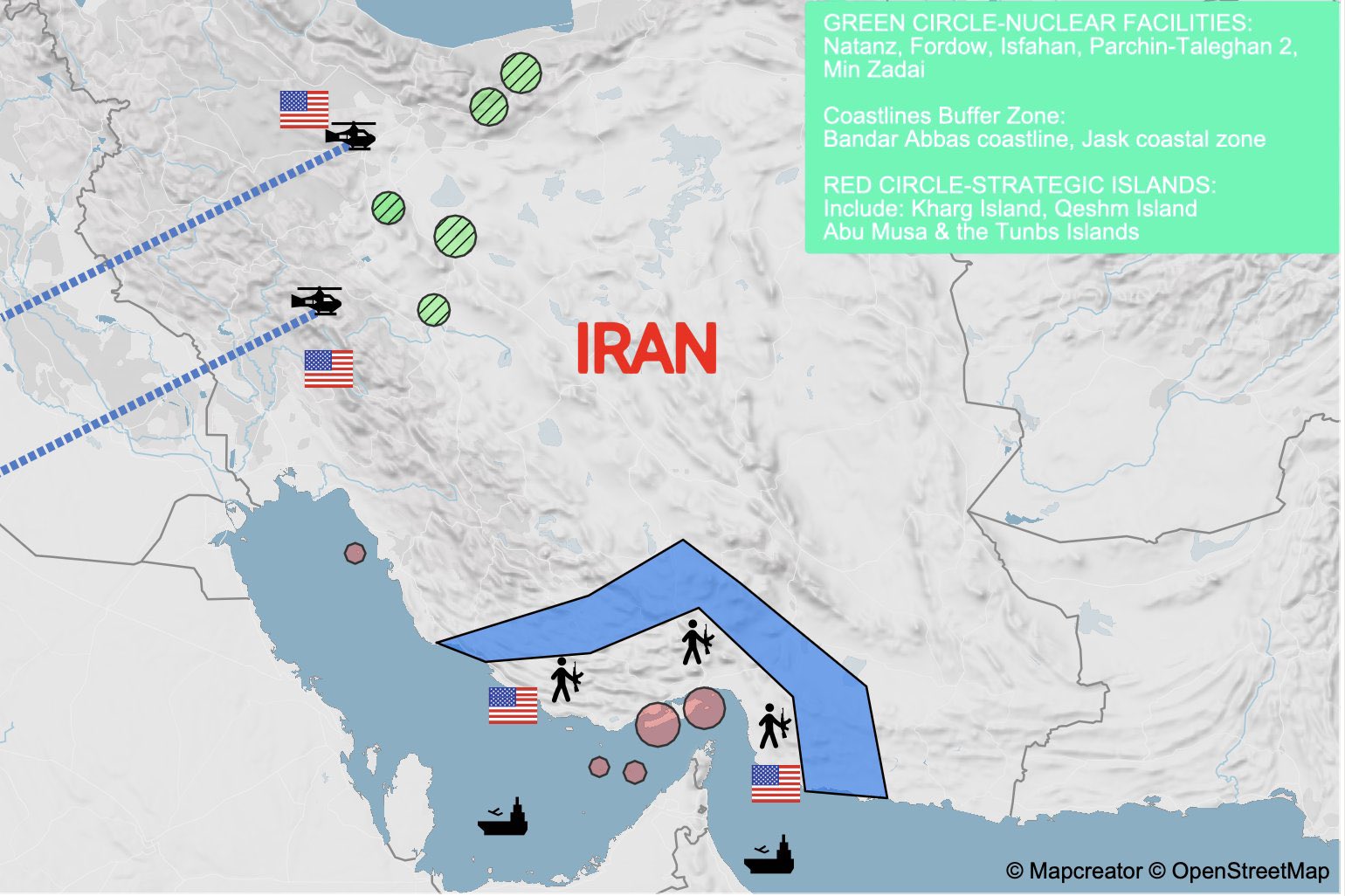
Despite these reports, there has been no official announcement from the US government regarding an immediate invasion or territorial occupation, nor has an official mission for ground forces been ordered for this purpose. However, the military presence is being significantly bolstered. The Pentagon is preparing the deployment of thousands of troops, including units from the 82nd Airborne Division, to the Middle East, providing American leadership with a broader range of military actions and pressures.
According to a report by Jennifer Griffin, chief national security correspondent for Fox News, the Commander of the 82nd Airborne Division, Brandon Tegtmeier, along with his staff, has been ordered to deploy to the Middle East, as the Pentagon and the White House weigh the possibility of sending the division for ground operations. This news follows reports from the "New York Times" and "Wall Street Journal," which noted that the Pentagon is "seriously weighing" the deployment of the elite division and that a written deployment order is expected within hours. The "WSJ" reports that approximately 3,000 troops from the division are to be sent to the Middle East, marking a clear escalation.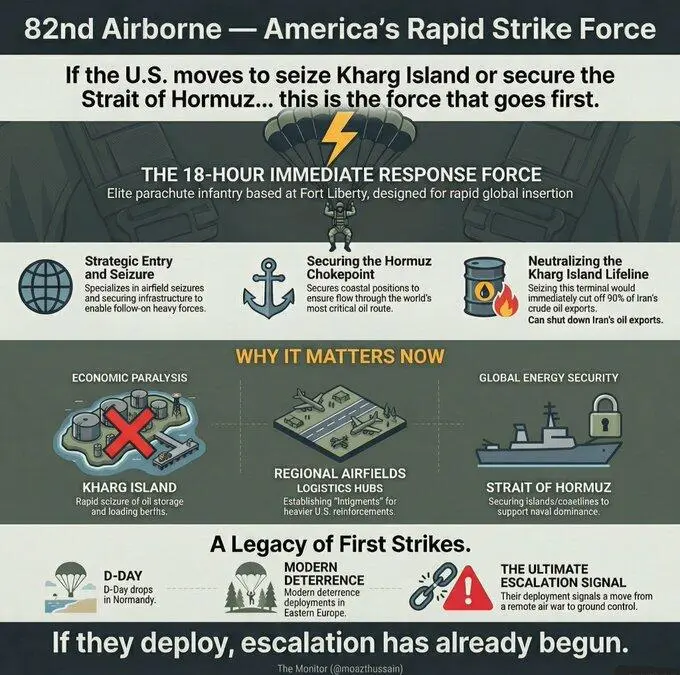
Iran on alert
At the same time, information suggests that Iran is preparing for a potential ground invasion by the United States and Israel, with involved forces potentially reaching 1 million soldiers. In this context, a general mobilization order has been issued, while the country's armed forces remain on high alert until March 2026. The army and the Revolutionary Guards (IRGC) are threatening retaliation against the US and Israel, while Iran claims to possess new, advanced weapons systems.
The Israeli intelligence agency Mossad reports that mosques are being used as weapons depots and operational centers, intensifying concerns over an escalation that could change the regional landscape. Of particular importance is the small Kharg Island, which reportedly has the potential to leave the entire planet without fuel due to its strategic position. Iran's new Supreme Leader, Mojtaba Khamenei, warned that any further American attack will trigger a full-scale ground invasion and direct battles within Israeli territory. Meanwhile, Iran is launching continuous waves of ballistic missiles against Israel. The military leadership warns of harsh revenge following the deaths of high-ranking officials like Ali Larijani, while Russia and China have reportedly expressed full support for Tehran.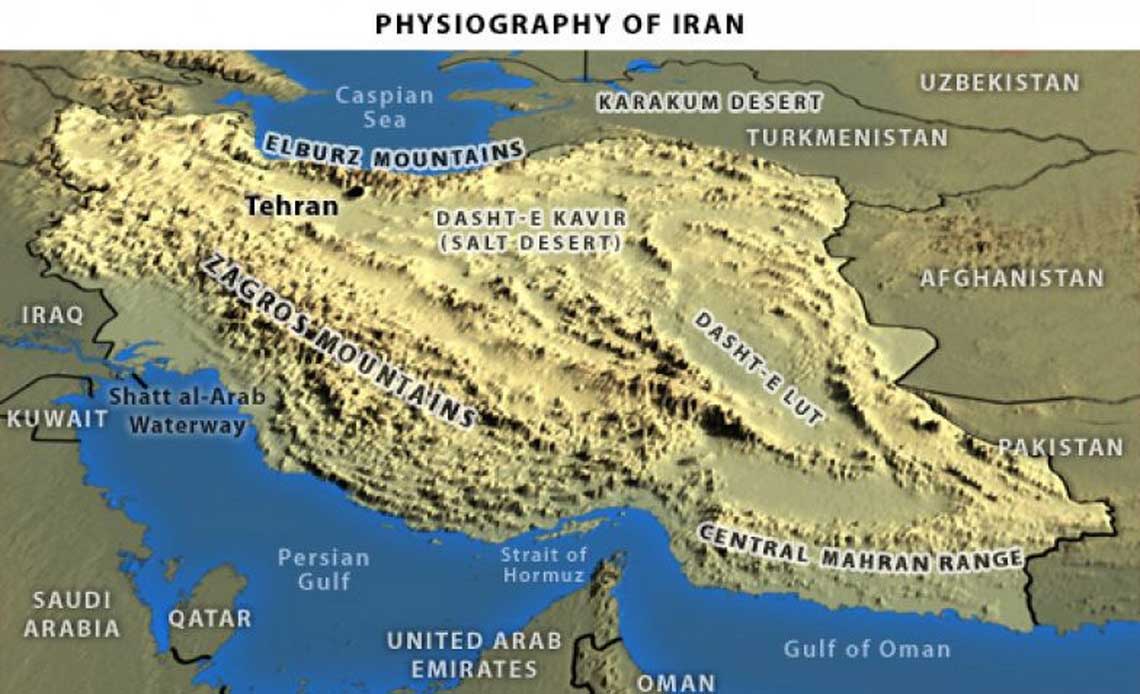
Iranian Foreign Minister Abbas Aragchi stated that both countries are assisting Iran through military, political, and economic cooperation, characterizing them as strategic partners at this critical juncture. Notably, the country's geographical terrain makes any large-scale invasion extremely dangerous. Iran features plateaus with an average altitude of ~1,200m, while approximately 55% of the territory is covered by the Zagros and Alborz mountain ranges, peaking at Damavand (5,671m). The salt and sand deserts of Dasht-e Kavir and Dasht-e Lut turn the country into an almost impenetrable natural fortress. Communication routes depend on easily defensible mountain passes, making a blitzkrieg-style invasion exceptionally difficult. Despite missile strikes and invasion threats, the conflict currently remains mostly at the level of missile and air strikes, with ground battles limited mainly to the Lebanese front. However, with Russia and China by its side and new weapons systems, Iran appears ready to cause upheavals that could shift global realities. We will say one thing: You can enter Iran through a thousand doors, but you cannot leave through any.
The 3 hellish scenarios leading to a "Gulf Vietnam"
Donald Trump’s strategy against an unyielding Iran has reached an unprecedented stalemate. Joint air strikes by the US-Israeli alliance have not only failed to bring about regime change but have unified Iranian society to an unprecedented degree, even as the Revolutionary Guards relentlessly hammer strategic US and Israeli targets. However, those who know Trump say he cannot leave defeated, abandoning the conflict without achieving any of his strategic goals. He will "take it to the end" and—despite public ceasefire statements—is expected to choose a tactic of intensity and escalation. In other words, he will favor the (disastrous) solution of a ground intervention with US Marines on Iranian soil. According to War Monitor, these are the 3 basic scenarios being discussed by Pentagon generals:
Scenario 1: Economic paralysis via landing on Kharg
The first strategy aims to strangle the Iranian economy to force Iran into paralysis. Kharg Island, which handles 90% of Iran's oil exports, is effectively at the center of this approach. By seizing this critical oil hub, the US could freeze the Iranian economy, reducing its ability to fund military operations. However, this will not be easy.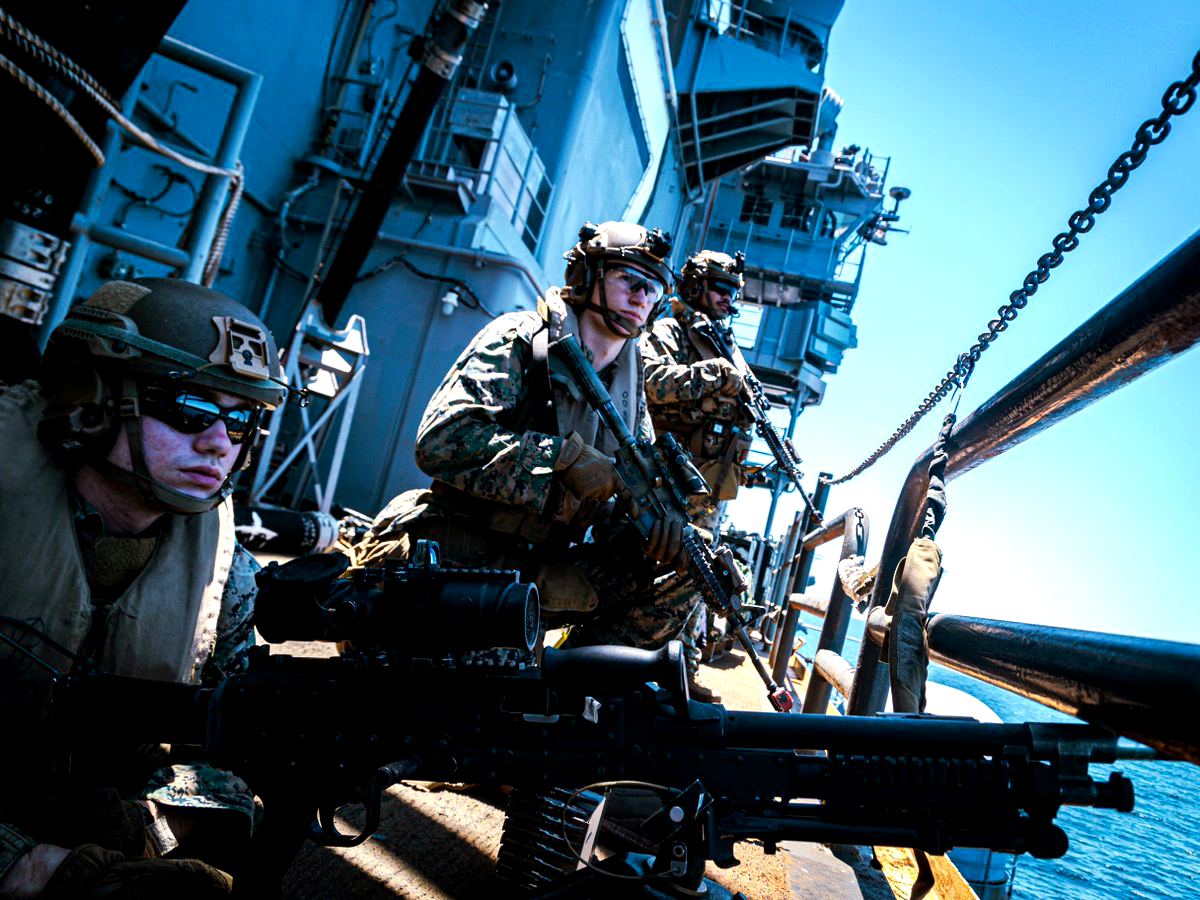
The Strait of Hormuz, critical for global oil shipping, hides traps... and mines. Access to Kharg Island would likely require an aerial landing, as amphibious operations may face fierce resistance from Iranian coastal defense systems. This strategy would send a strong message to Iran but could trigger a dangerous military escalation.
Scenario 2: Seizure of strategic islands in the Hormuz Strait
The second strategy involves the seizure of several critical islands around the Strait of Hormuz, which could create a demilitarized zone and prevent Iran from launching anti-ship missiles or naval attacks against commercial vessels. Islands such as Qeshm, Abu Musa, and the Tunbs, as well as coastal areas like Bandar Abbas and the Jask zone, are critical for controlling the Straits.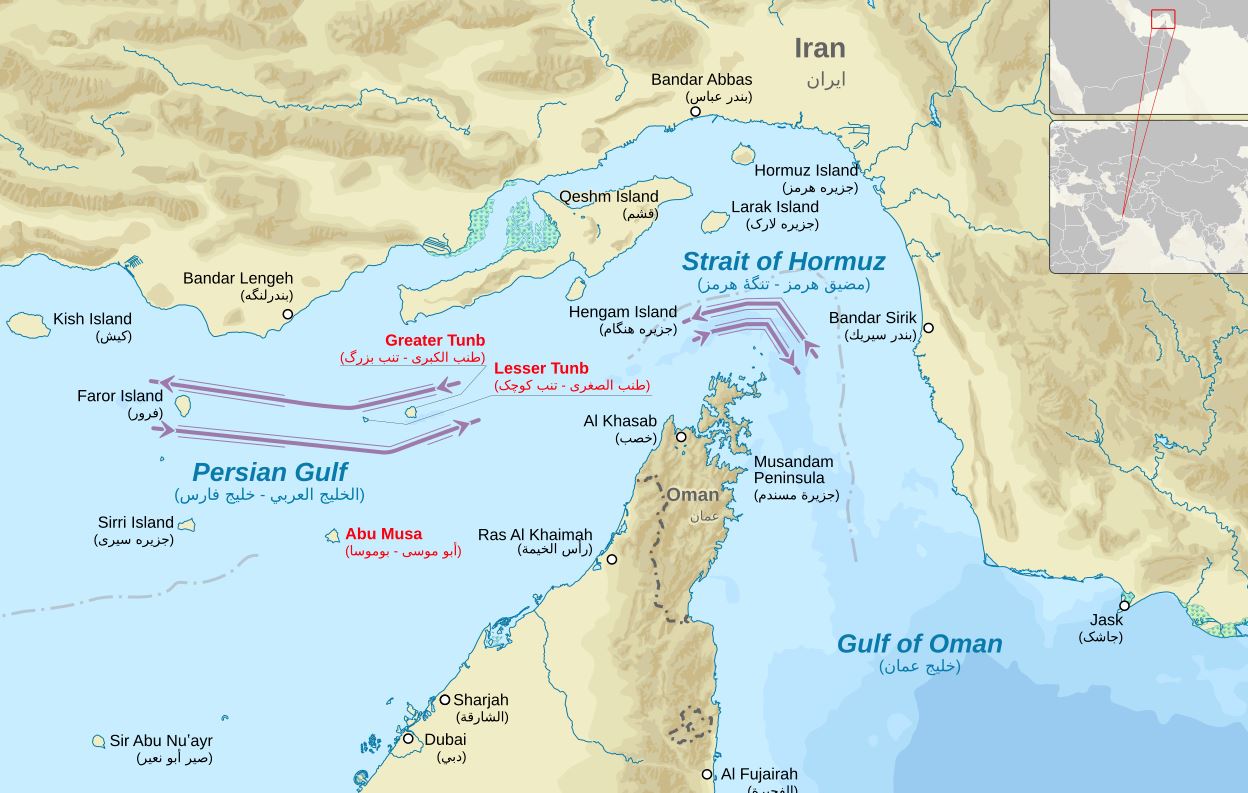
The pursuit of this strategy would be to create a defensive space around the Strait of Hormuz to protect global shipping lanes from Iranian attacks. The operation would require coordinated naval landings and enhanced air support, aimed at deterring Iranian retaliation.
Scenario 3: Special operation at the heart of the Iranian nuclear program
The most dangerous and high-risk option involves a special forces raid in northern Iran to neutralize nuclear facilities and seize critical enrichment materials. This operation could be carried out with helicopters and small special forces teams, supported by rapid-response paratroopers.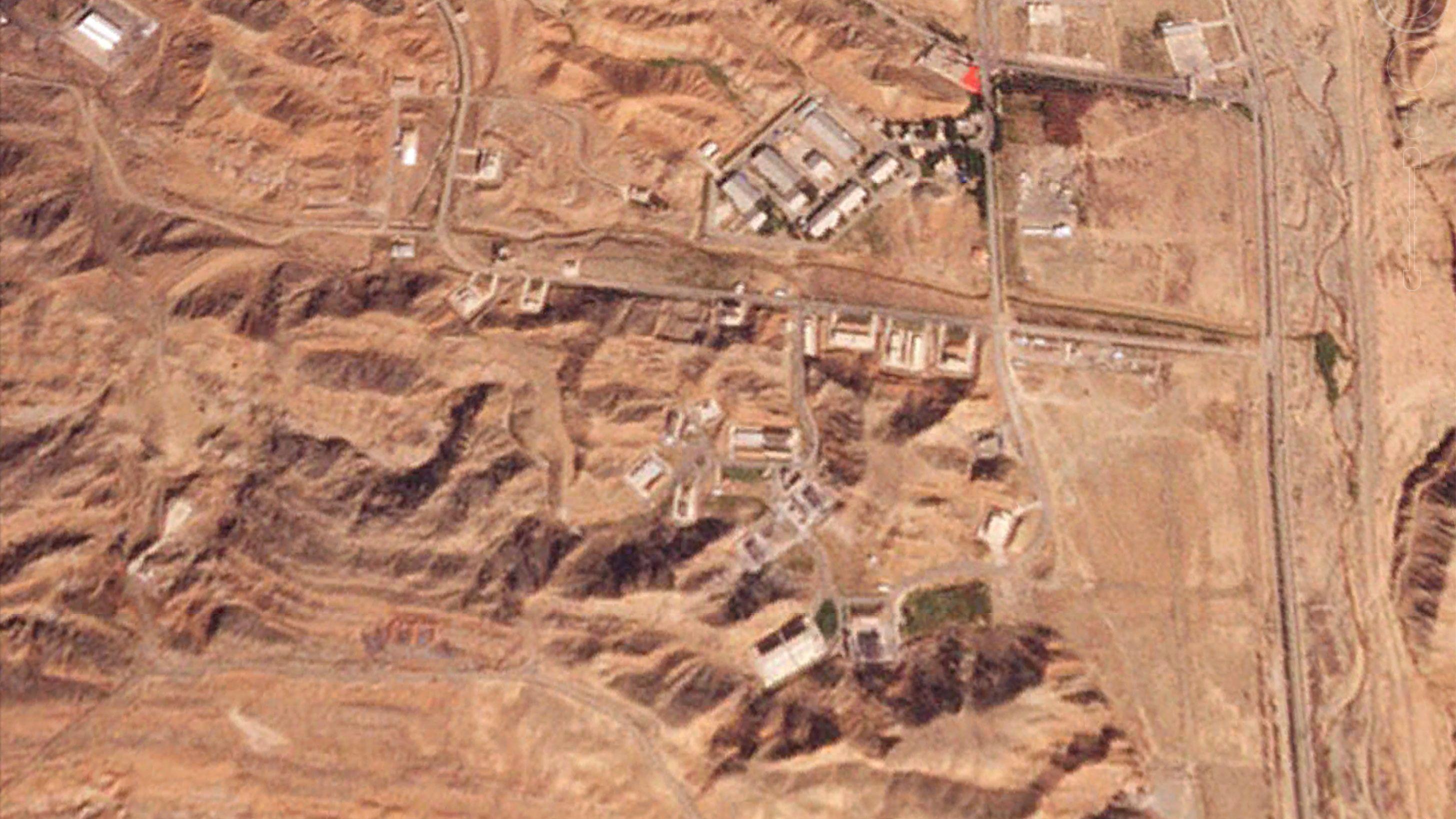
Facilities targeted would include the nuclear centers at Natanz, Fordow, Isfahan, and Parchin-Taleghan 2. This mission is particularly dangerous, as many of the facilities are underground, making the operation's success doubtful.
7,500 Marines and Special Forces units on standby
If these strategies are implemented, a significant military force will be required. The US could have at its disposal 7,500 Marines from the 31st and 11th Expeditionary Brigades and the 11th Amphibious Group Boxer, as well as 3,000 paratroopers from the 82nd Airborne Division.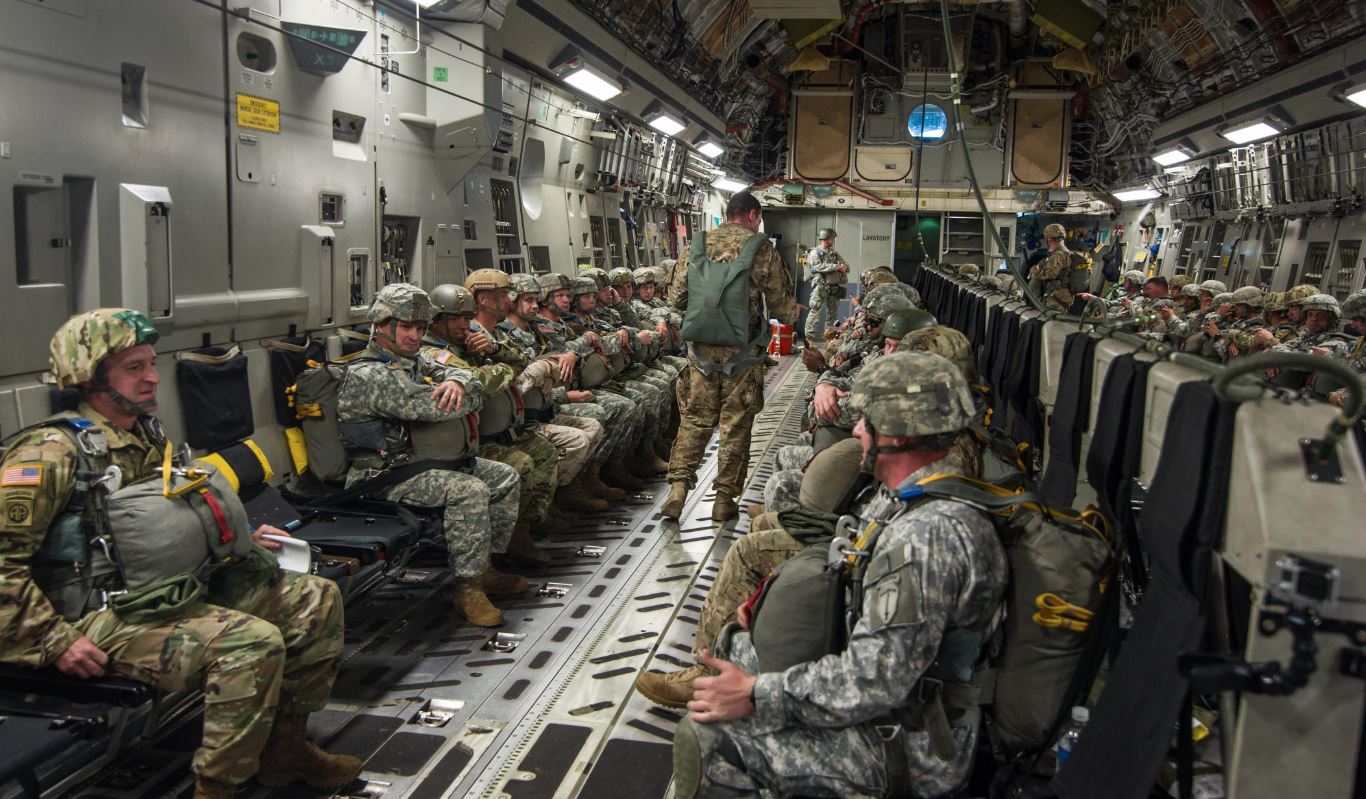
Additionally, special forces such as the 75th Delta Rangers and the 160th SOAR could be deployed to assist in the mission’s success. The implementation of these strategies remains a doubtful and perilous process, with the goal of forcing Iran to negotiate or face severe consequences.
US urgently transfers war materiel to the Middle East
Since March 12, the United States has conducted more than 35 C-17 transport flights to the Middle East, specifically to Ben Gurion Airport in Tel Aviv. The flights originated from major rapid-response bases, such as Fort Liberty, suggesting they included combat units as well as cargo.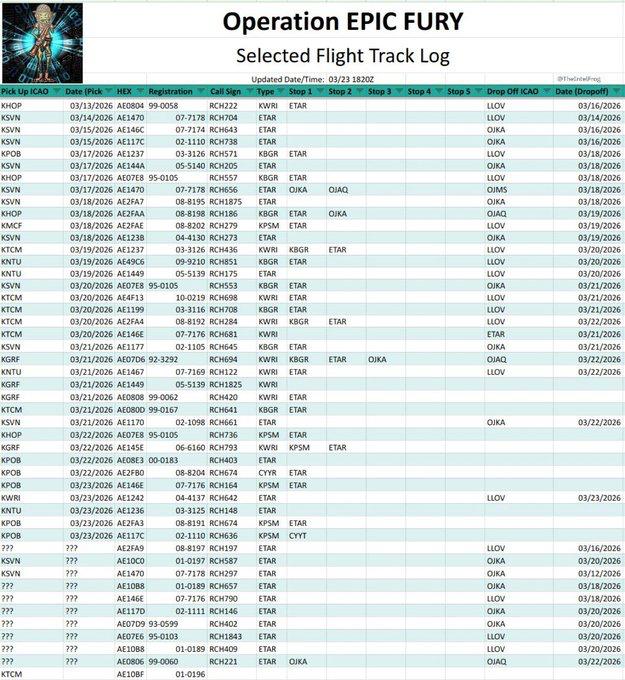
The C-17 is a heavy-lift strategic transport aircraft capable of carrying large and heavy combat loads, including an M1 Abrams tank, three Black Hawk helicopters, 10 armored Humvees, or up to 134 soldiers.
www.bankingnews.gr







Readers’ Comments