

In a move causing a global tectonic shift, US President Donald Trump has clarified his intentions for the Middle East, delivering a stark ultimatum: "Once I finish with Iran, you will take over the security of Hormuz." With a fiery declaration, Trump spoke of the definitive end of the "Iranian terrorist state" while threatening to withdraw American protection from the Strait of Hormuz, the planet’s primary energy artery. The message to Europe and Asia is unmistakable: "If you want oil, you must assume the cost and the risk." This comes after "Allies" rejected his proposal to deploy forces to the Strait for tanker escort missions.
Blackmail from Trump
"I wonder what would happen if we 'finished' what is left of the Iranian terrorist state and left the countries that use it — we don't — to be responsible for the so-called 'Strait'?" Trump stated in a social media post. "That would activate some of our non-responsive 'Allies,' and fast!!! President DJT."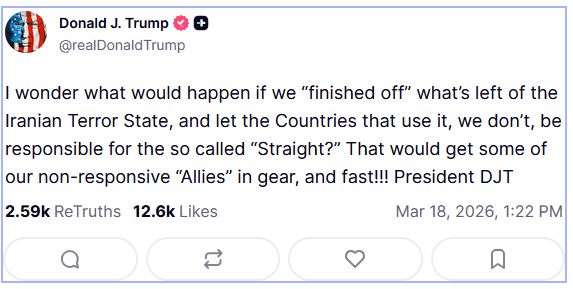
In previous statements to the Financial Times, Trump demanded NATO's military assistance in US operations in the Strait of Hormuz, warning that a negative response from the Allies would be "very bad for the future of NATO." However, one ally after another rejected the ultimatum, sparking a fierce reaction from the American President. "We don't need anyone," Trump emphasized 24 hours earlier, before adding, specifically regarding NATO member states: "They should be jumping up and helping us, because we’ve been helping them for years." He went as far as to say that even China, whom the US considers its greatest international rival, "should thank (him)" for starting this war.
‘Ship escorts do not guarantee safe passage through Hormuz’
Nevertheless, the head of the International Maritime Organization (IMO) points out that even military escorts for ships transiting the Strait cannot "100% guarantee" safe passage through the waterway. Military assistance "is not a long-term or sustainable solution" for reopening the Strait, Arsenio Dominguez told the FT. The critical Strait of Hormuz, through which 20% of global oil and liquefied natural gas flows, remains largely closed, driving up energy prices and fueling concerns over rising inflation.
The closure is also forcing a rapid and costly supply chain overhaul to maintain the flow of essential imports. Logistics companies are struggling to overcome problems created by rerouting ships, transporting goods over land, and preventing the spoilage of perishable products. "We are collateral damage in a conflict where the root causes have nothing to do with shipping," Dominguez stated, adding that the IMO has serious concerns for the ships stuck in the Gulf, whose crews have nearly exhausted their food and supplies.
Unprecedented shock to shipping
With more than 3,200 ships trapped in the Gulf and freight rates skyrocketing within days from $1,500 to $6,000, the market is in a state of shock. Shipping companies are abandoning cargo at random ports, maritime giants are imposing "ransom" via emergency surcharges, and supply chains are buckling under the weight of a crisis many already describe as worse than the pandemic. A fire caused by debris from air strikes on Sunday at Dubai's main hub port, Jebel Ali, led to further cancellations and congestion at safer ports. The largest shipping groups, including MSC, Maersk, CMA CGM, and Hapag-Lloyd, informed customers they reserve the right to invoke a 19th-century rule allowing them to leave containers at the nearest available port at the customer's expense.
Soaring costs and delays
Charges for container transport have increased up to fourfold on certain routes due to war risk insurance costs and fuel surcharges. David Ozard, general manager of the transport group John Mason International, stated that containers destined for the Middle East were unloaded at India’s Nhava Sheva port, while others bound for Saudi Arabia were left at the UAE's Khor Fakkan port, forcing the company to shoulder extra storage costs and import duties. "It’s the absolute Wild West right now," Ozard said, adding that customers are forced to pay the extra fees. "If we don't, the shipping lines freeze our accounts and hold us hostage."
The figures are shocking:
-
Approximately 3,200 ships are trapped in the Gulf due to strikes.
-
A standard container (TEU) from the UK to Jebel Ali previously cost $1,500 and now reaches $6,000.
-
While global increases are smaller than those during the COVID period (e.g., Shanghai-Northern Europe at $1,618 vs. $8,000 then), prices toward the Gulf have exploded.
Trump prepares ‘goodbye’ to NATO
At the same time, Trump is keeping the conversation open regarding a US withdrawal from NATO. Participation in NATO, Trump told reporters in the Oval Office, is "certainly something we have to think about," criticizing allies who rejected his requests for support. Speaking to reporters at the White House, he argued that the US was not obligated to help when Russia invaded Ukraine, equating the war there with the war in Iran. "We help them, and they didn't help us, and I think that's very bad for NATO," he stated.
Trump mentioned that NATO allies support the US goal of stopping Iran from acquiring nuclear weapons but are reluctant to get involved in the war. "Nobody wants Iran to have nukes because these people are crazy. They are totally crazy, vicious, and violent," he said. "Everyone agrees with that, but they don't want to help." He added that the US has taken note of this stance. "We, as the United States, have to remember this because we think it's quite shocking." However, when asked if there would be consequences for NATO, he replied: "No, I just don't think it's good for a partnership when they say 'what you're doing is great, but we're not going to help'."
www.bankingnews.gr












Readers’ Comments