

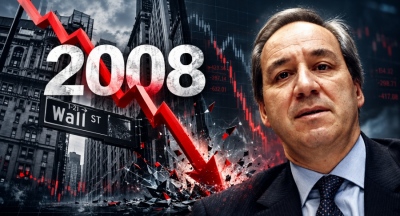
The signs of destruction are now visible on Wall Street, which stands just a breath away from a repeat of the 2008 financial crisis. A massive capital flight, with wealthy investors attempting to withdraw over $10 billion within just a single quarter, has put investment giants on high alert. While fund managers struggle to stem the tide of liquidations by imposing withdrawal restrictions, the nervousness is now spilling over onto the stock market floor. With the shares of leading forces such as Blackstone and Blue Owl plummeting, a generalized crash that could sweep away one of the last strongholds of profitability in the financial markets... is very close...
The warnings from top analysts regarding analogies to the great crisis of the past no longer sound like hyperbole, but like an urgent survival roadmap for what is coming. According to calculations by the Financial Times, private investors attempted to withdraw over $10 billion from some of the largest private credit funds during the first quarter of 2026, forcing investment managers to limit redemptions and threatening to slow down one of Wall Street's most significant sources of growth. Debt funds managed by powerhouse firms such as Blackstone, BlackRock, Cliffwater, Morgan Stanley, and Monroe Capital have agreed to satisfy approximately 70% of the $10.1 billion in redemption requests they have received, according to Financial Times calculations. This percentage is expected to rise in the next two weeks as funds managed by Ares Management, Apollo Global Management, Blue Owl Capital, Oaktree Capital Management, and Goldman Sachs calculate how many of their investors are departing.
Memories of 2008 awakened
Some on Wall Street, such as former PIMCO co-CEO Mohamed El-Erian, have said that the turbulence is reminiscent of the early days of the 2008 financial crisis. However, many private capital heads told the FT they are puzzled by what they consider an indiscriminate mass sell-off, which does not reflect the performance of their portfolios. The funds that have already reported withdrawals manage portfolios valued at approximately $166 billion, a small fraction of the roughly $1.5 trillion invested in direct lending funds overall. Nevertheless, these investment vehicles were among the fastest-growing sectors of the private investment industry, serving as a key tool for fund managers targeting the $9 trillion US pension savings market.
These redemptions have overturned a five-year period during which nearly $200 billion had flowed into the debt funds of major private market groups, fueling their explosive growth and profitability. This reversal has led investors to wonder if private capital firms still deserve the high valuations they held relative to the broader market. This has triggered intense selling pressure on the stocks of companies such as Blackstone, KKR, Blue Owl Capital, Ares Management, and Apollo Global Management, whose shares have collapsed by 25% or more this year, erasing over $100 billion in total market capitalization. "The air has gone out of the balloon, and the entire industry is under great pressure," says CT Fitzpatrick, CEO of Vulcan Value Partners and a longtime shareholder in listed private capital firms.
Pressure on Blackstone and Blue Owl Capital
Firms like Blackstone and Blue Owl Capital do not hold loans on their own balance sheets that would expose them to major losses and have minimal corporate debt. However, their shares have shown intense volatility in recent years, as investor estimates for their future growth change dramatically within an environment of geopolitical and market turbulence. They now face questions about the performance of the retail funds that underpinned their success, while simultaneously masking a broader investment retreat by many pension funds and university endowments.
Blackstone's $48 billion debt fund, Bcred, has evolved into the company's largest source of fees, representing approximately 13% of the total fee income for the firm, which manages $1.3 trillion. The fund pays Blackstone an annual management fee of 1.25% on investor assets and a performance fee of 12.5% above a 5% hurdle rate. Such funds charge performance fees based on valuations and dividends rather than when assets are actually sold. Bcred generated $1.2 billion in fees for Blackstone last year.
Blue Owl Capital’s $35 billion private fund, known as OCIC, was equally critical to its growth. The fund paid $447 million in management and incentive fees to the firm last year. It is one of the few semi-liquid private credit funds managed by the group. Goldman Sachs analysts estimate that Blue Owl is more exposed to these funds targeting wealthy individuals than any of its listed competitors, calculating that 21% of its annual fee income comes from these vehicles.
Such fees have gained greater importance in recent years as private capital groups reorganized their finances to become more attractive to stock market investors, emphasizing predictable fee income over larger but occasional profits from successful deals. This incentivized firms to rapidly increase assets under management, particularly in high-margin retail funds, but with the risk that these same investors could withdraw their money during periods of market turmoil. "We know how the masses behave," said Jack Shannon, an analyst at Morningstar. "They are fickle, they chase performance. And they will leave the moment they smell danger."
Nonetheless, these funds propelled private capital groups to new heights, as their valuations reached 30 or even 40 times their fee income, giving them a significant premium over other financial services firms, such as banks and insurers, but also relative to the broader market. Assets flowed massively into retail private credit funds and similar products targeting corporate buyouts, real estate deals, and infrastructure investments. For many firms, particularly Blue Owl Capital and Blackstone, these funds were a primary growth engine.
Goldman Sachs analysts calculate that retail credit funds increased their assets from $34 billion at the end of 2021 to $222 billion at the end of last year. However, this growth has reversed this year. Following a wave of redemptions that underscored the risk that investors cannot always get their money back, Goldman now predicts that such funds could lose between $45 and $70 billion in assets over the next two years. Blackstone, however, continues to attract new capital to its retail private equity and real estate funds, mitigating the blow from the redemptions at Bcred.
www.bankingnews.gr









Readers’ Comments