

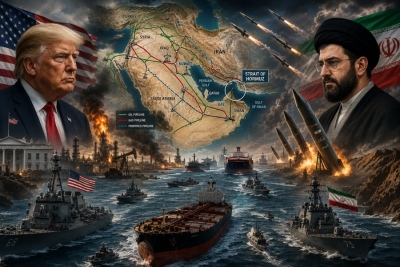
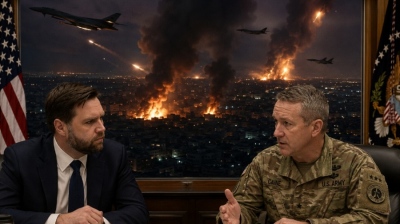
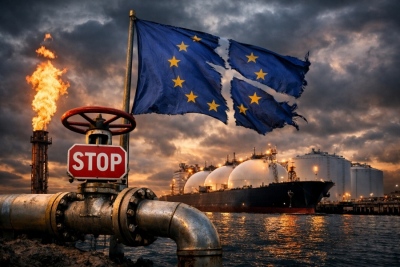
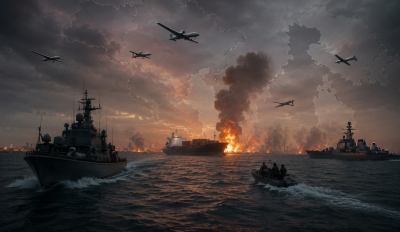
The situation in the Strait of Hormuz is evolving into a scene of absolute chaos, with the region transforming into a vast war zone. Despite the triumphant declarations of American President Donald Trump regarding the "neutralization" of the Iranian threat and the provision of full naval protection, the reality on the ground is entirely different. Iran has mined critical passages, while the US Navy itself—in a development that exposes the White House and Trump personally—states it is unable to escort tankers, judging the risk as "unmanageable." Out of the 60 ships that used to cross the passage daily, now barely two dare the crossing, bringing the global energy market to the brink of a nervous breakdown. Maritime traffic through the strategic Strait has essentially "frozen" since the US and Israel launched airstrikes against Iran on February 28. Iran has retaliated by targeting vessels attempting to transit the Strait, with numerous incidents reported in recent days.
Three ships "hit" in Hormuz
Meanwhile, three ships off the coast of Iran were struck by projectiles, the United Kingdom Maritime Trade Operations (UKMTO) announced today, Wednesday (11/3/2026), adding another report to the many incidents recorded within or near the Strait of Hormuz. One of the vessels reported being hit 11 nautical miles north of Oman within the Strait, which caused a fire on deck and forced the crew to abandon ship, according to the UKMTO. Two more incidents were reported on the morning of the same day, with one ship hit by a projectile approximately 50 nautical miles northwest of Dubai, while another sustained damage off the coast of the United Arab Emirates. The UKMTO urged vessels in the area to transit with caution and report any suspicious activity, while authorities continue their investigations.
US Navy contradicts Trump
In the meantime, it is proving that the American president was handing out false promises regarding the escort of tankers by the US Navy. According to information from Reuters, "the United States Navy, since the start of the war against Iran, has been rejecting almost daily the shipping industry's requests for military escort through the Strait of Hormuz, stating that the risk of attacks is currently too high and there is no possibility of providing an escort." The agency emphasized that "US Navy assessments show that the disruption of oil exports from the Middle East will continue." Reuters added: "The US Navy assessment differs from the statements of American President Donald Trump, who had previously stated that Washington is ready, whenever deemed necessary, to provide naval escorts to resume normal ship passage in this vital waterway." Furthermore, on Tuesday (10/3/2026), US Energy Secretary Chris Wright deleted a post in which he wrote that the US Navy had successfully escorted an oil tanker in Hormuz. The White House quickly denied the claim, calling it inaccurate, while Iranian officials criticized Washington for spreading misinformation to manipulate global oil markets.
Celebrations lasted only 30 minutes
In more detail, Wright posted on social media at 1:02 p.m. Eastern Time (17:00 GMT) that the US Navy had successfully escorted a tanker through the strategic waterway. He praised the US president's administration for "maintaining global energy stability during military operations against Iran." However, the post was deleted within 30 minutes without explanation. White House Press Secretary Karoline Leavitt later clarified that no such escort had taken place. "I can confirm that the US Navy has not escorted a single tanker nor a single ship at this time," she told reporters. She added that while military escort remained an option, no operation had been conducted as of Tuesday. For his part, Iranian Foreign Minister Abbas Araghchi dismissed Wright's deleted post as deliberate misinformation. "American officials publish false news to manipulate markets," he wrote on social media, adding "it will not protect them from the inflationary tsunami they have imposed on Americans." Araghchi further warned that global oil markets face the "largest deficit in history," surpassing the combined impact of the Arab oil embargo, the Iranian Islamic Revolution, and the invasion of Kuwait.
Iran has mined Hormuz
Nevertheless, Iran has reportedly mined the Strait of Hormuz, though not extensively. Sources speaking to CNN stated that only "a few dozen" had been placed in recent days. The report also stated that Iran still maintains more than 80% of its small craft and minelayers and could practically drop hundreds of mines in the sea passage. The Robert Strauss Center for International Security and Law in Texas stated that mines would be "beneficial" for Iran to use in the Strait's shipping lanes, either to cause direct damage or as a deterrent, channeling ships into a predetermined lane more favorable to Iran. A CIA report, declassified in 2009, stated that "the Iranians appear to have recognized the limitations of their capability in mine warfare and have adopted a strategy in which a few mines or the threat of mining would be used to deter shipping." The report added that Iran could use mines to increase insurance premiums and deter ships bound for Arabian Gulf ports from entering the Persian Gulf: "such mining would be as effective as a blockade."
US claims
On the other hand, the US claims to have sunk several Iranian vessels, including 16 minelayers, near the Strait of Hormuz, according to US Central Command (CENTCOM), amid reports that Tehran was seeking to mine the waterway crucial to global energy supply. The US announcement followed a post by Donald Trump, stating that if Iran had placed mines in the Straits, "we want them removed, IMMEDIATELY!". "If for any reason mines were placed and are not removed forthwith, the military consequences for Iran will be at a level it has never seen before. If, on the other hand, they remove whatever may have been placed, it will be a giant step in the right direction!" Trump stated in a post on Truth Social. The American president later claimed that 10 inactive minelaying ships were sunk, with "more to follow."
Oil price rally
In the wake of these developments, oil prices are moving upward, despite reports that the International Energy Agency (IEA) may proceed with a historic release of emergency reserves. Specifically, Brent is up 2.14% at $89.68, while US crude (WTI) is rising 2.35% at $85.41. On Tuesday (10/3/2026), G7 energy ministers gathered in Paris to discuss the US-Iran war and its impact on global oil and gas markets. The conflict has disrupted energy production in the Middle East and led to a blockade of Hormuz. According to the Wall Street Journal, the IEA proposed the largest oil release from its strategic reserves in history, exceeding the 182 million barrels released by its member states following Russia's invasion of Ukraine in 2022.
www.bankingnews.gr



Readers’ Comments