

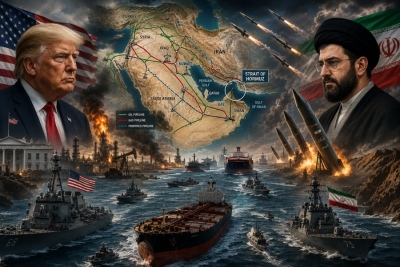
As the war with Iran escalates, fears are intensifying across the region. Neighboring countries are increasingly worried about potential strikes on critical infrastructure, specifically desalination plants. Throughout the area, there is a growing concern that one of the Gulf states' greatest strategic advantages could be transformed into a primary wartime target.
The critical dependence on desalination
The arid countries of the Gulf, including the United Arab Emirates, depend overwhelmingly on desalination—the process of converting seawater into potable water. Thanks to this technology, a region defined by water scarcity now hosts lush golf courses, massive water parks, and even indoor ski slopes. However, this total reliance creates a profound vulnerability. Officials in Bahrain told CNN that an Iranian drone recently damaged a desalination unit, though water supply remained unaffected. This followed a claim by Iranian Foreign Minister Abbas Araghchi that the United States struck a desalination facility on Qeshm Island, affecting 30 villages—an act he labeled a "dangerous move." Washington denied any involvement.
These mutual accusations highlight the latent danger to the hundreds of desalination plants in the Persian Gulf, which provide drinking water to approximately 100 million people. While Iran still draws most of its water from rivers and groundwater, Gulf nations have almost no natural freshwater sources. Countries like Kuwait, Oman, and Bahrain rely almost entirely on desalination for their survival. A coordinated attack on these facilities would represent an "almost unthinkable escalation," Michael Christopher Low, director of the Middle East Center at the University of Utah, told CNN. As experts point out, the rules of engagement are shifting. If attacks on water infrastructure are part of a deliberate military strategy, it constitutes a war crime and a terrifying development, given that these countries hold water reserves for only a few weeks.
The ‘seawater kingdoms’
Oil and gas transformed the Gulf in a matter of decades from a region of sparsely populated states into wealthy nations with glittering, bustling metropolises. Yet the role of desalination, funded by these same energy resources, is often overlooked as the engine that allowed for a population explosion in desert lands. The process removes salts and minerals through heating or high-pressure membrane filtration, but it remains expensive and energy-intensive. Gulf states have become "seawater kingdoms," according to Low, who is authoring a book of the same title.
The dependency is staggering: approximately 90% in Kuwait and Oman, 85% in Bahrain, and 70% in Saudi Arabia. Major cities such as Abu Dhabi, Dubai, Doha, Kuwait City, and Jeddah now rely almost exclusively on desalinated water. This reliance is both a miracle and a weakness. "Their economies, and even the short-term survival of their populations, depend heavily on the security of these installations," notes Nader Habibi, professor of Middle East economics at Brandeis University.
Water as a target and weapon of war
Targeting critical civilian infrastructure is strictly prohibited under international law. A coordinated strike on desalination plants would be a "provocative escalation," according to David Michel, a water security expert at the Center for Strategic and International Studies (CSIS). However, there is historical precedent. In 1991, during the Gulf War, Iraq deliberately released millions of barrels of oil into the Persian Gulf, contaminating the intake for desalination plants. Kuwait was forced to seek emergency shipments of bottled water from Turkey and Saudi Arabia.
In the last decade, there has been a "significant erosion of norms" regarding attacks on water infrastructure. Russia has launched over 100 attacks on Ukraine’s water facilities, while Israel has destroyed water and sewage infrastructure in Gaza. "Unfortunately, it has become a trend," says Marwa Daoudy, associate professor of international relations at Georgetown University. "Water has been added to the long list of targets and weapons of war."
Facility vulnerabilities
While a direct attack is a primary fear, there is also the risk of indirect damage, as desalination plants are often co-located with power stations and ports for efficiency. Earlier this month, damage was reported at the Fujairah F1 plant in the UAE and the Doha West plant in Kuwait, seemingly caused by strikes on nearby facilities. Another major concern is cyberattacks. In 2023, the US government announced that Iran had launched cyber-offensives against water infrastructure in several US states, leaving messages on screens reading: "You have been hacked, down with Israel."
Shutting down these plants would not mean immediate catastrophe, as Gulf nations maintain strategic reserves and the financial means to manage emergencies. However, strikes on massive installations serving cities like Riyadh or Dubai could have existential consequences. These facilities are technologically complex and could take weeks to repair if physically damaged. Habibi points out that smaller states like Bahrain and Kuwait are particularly at risk, with limited capacity to handle prolonged outages.
‘Like using a nuclear weapon’
Water vulnerability is not a new realization for these states. A 2010 CIA report noted that the disruption of desalination in the region "could have more serious consequences than the loss of any other industry or commodity." While war is the immediate worry, Low believes climate change remains the greatest long-term threat. Extreme weather can damage plants, while the reliance on fossil fuels to produce water exacerbates the very climate crisis driving the water scarcity.
The Gulf is entering its hottest season, with spring already arrived and summer looming. "Water resources will come under even greater pressure as long as the conflict lasts," warns Zane Swanson of the CSIS Global Food and Water Security program. No one knows if Iran will ultimately choose this path, but experts agree that a coordinated hit on desalination would be a clear crossing of a red line. It would be, as Low puts it, "like resorting to a nuclear weapon." The political and psychological trauma would be so profound it is difficult to imagine.
www.bankingnews.gr


Readers’ Comments