

The Americans have repeatedly betrayed the Kurds, most recently in 2024 when they abandoned them in Syria
As the military conflict in Iran completes its first week, the key question for analysts is exactly how the US will achieve the regime change set as a goal by President Trump. This question is based on the premise that the regime cannot fall through air operations alone and that this can only be achieved via a ground invasion. Indeed, history shows that air strikes rarely bring about regime change, especially in countries where the government enjoys at least partial popular support.
But who will invade? Trump ruled out the scenario of involving American soldiers, stating it would be a... "waste of time"... although he argued, speaking to Reuters, that it would be wonderful if the Kurds of Iran launched an attack on Iranian forces. He even emphasized that he encouraged the Iranian Kurds to move forward... It appears, therefore, that the US has a plan. And the plan comes straight from the traditional imperial manual: "Divide and Rule."
Plan of destruction
The Financial Times reported on March 5 that the Trump administration is in discussions with armed Kurdish groups from Iran, examining whether these groups could play a supportive role in the ongoing US-Israeli military campaign against Iran. If the talks are successful, it will allow the US to escape reliance solely on air power and integrate pressure on the ground without sending its own troops.
Kurdish officials have stated that the Kurds of Iraq are ready to support the US in its effort against Iran. However, the Kurds are moving with caution and demanding security guarantees from the US. The Kurds have a long history of cooperation with the US, which, however, has often ended in betrayal. In reality, the plan could end up being catastrophic for all involved: the Kurds, the Iranians, and even the US.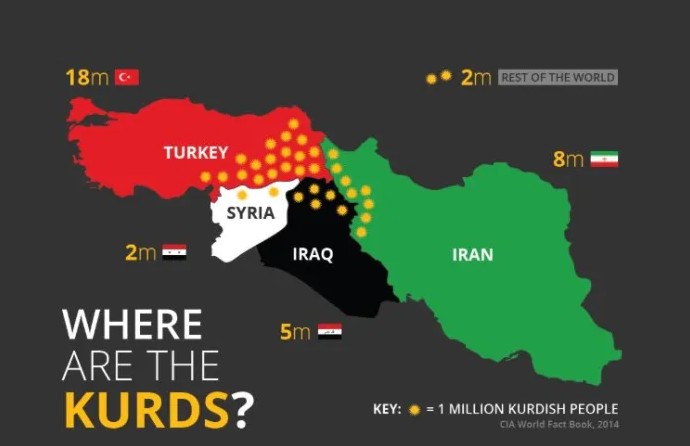
Who are the Kurds?
The Kurds are an Indo-European ethnic group from the mountainous region of Western Asia known as "Kurdistan." Their language belongs to the Indo-European family, a branch of the Iranian language. Their global population is 30 to 45 million, making them one of the largest ethnic groups without a state. Their population is distributed across several countries, with most in Turkey, where 15 to 20 million Kurds live in the southeastern part. In Iran, 8 to 12 million Kurds live; in Syria, about 1.5 million; and in Iraq, 5.6 to 8 million live in the northern part of the country, where they have a semi-autonomous government (Kurdistan Regional Government, KRG).
A permanent promise... an independent state
The Kurds are mainly Sunnis and linguistically closer to the Iranians, but religiously closer to the Arabs. Due to these factors, the Kurds have faced discrimination and persecution everywhere from Turkey to Iran. The Kurds have been fighting for a separate state since before World War I. The Treaty of Sèvres of 1920 promised them an independent Kurdish state, but it was never ratified.
The Treaty of Lausanne of 1923 split traditional Kurdish areas into four different countries: Iran, Iraq, Syria, and Turkey. After years of war, the Kurds have enjoyed various degrees of autonomy in Iraq and Syria. The KRG in Iraq is now a constitutionally recognized autonomous region. In Turkey, there has been a decades-long insurgency in favor of secession led by the Kurds, but they have faced violent suppression.
The repeated betrayal
In the early 1970s, under Presidents Nixon and Ford, the US, in coordination with Iran and Israel, provided weapons and aid to Kurdish rebels in northern Iraq. The goal was to weaken the Iraqi government under Saddam Hussein and limit Soviet influence in the region by using the Kurds. However, in March 1975, Iran and Iraq signed the Algiers Agreement, settling their border disputes.
Iran immediately terminated its support for the Kurds, and the US followed suit by cutting off CIA aid. This left the Kurds exposed to violent retaliation by the Iraqis, resulting in thousands of deaths and mass displacement.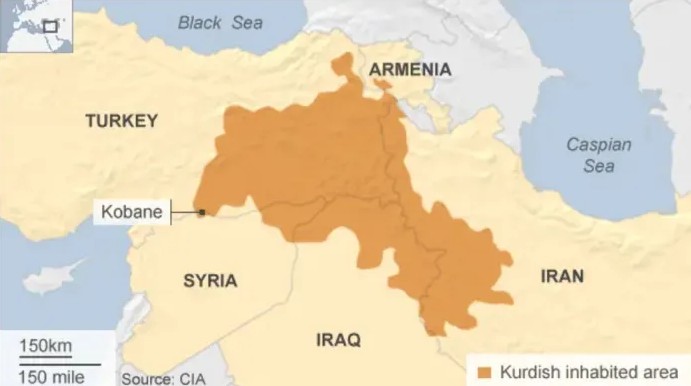
The Kissinger doctrine
When the Kurds turned to Henry Kissinger asking for help, they received no answer. During a parliamentary investigation into this betrayal, Kissinger was asked to justify the policy change. "Covert action should not be confused with missionary work," he replied. This realist political quote by Kissinger has become a symbol of the US practical approach toward Kurdish aspirations for freedom and sovereignty over the last half-century. In reality, the US has repeatedly used the Kurds to promote its own strategic interests in the region and has subsequently betrayed the Kurdish cause when those interests change.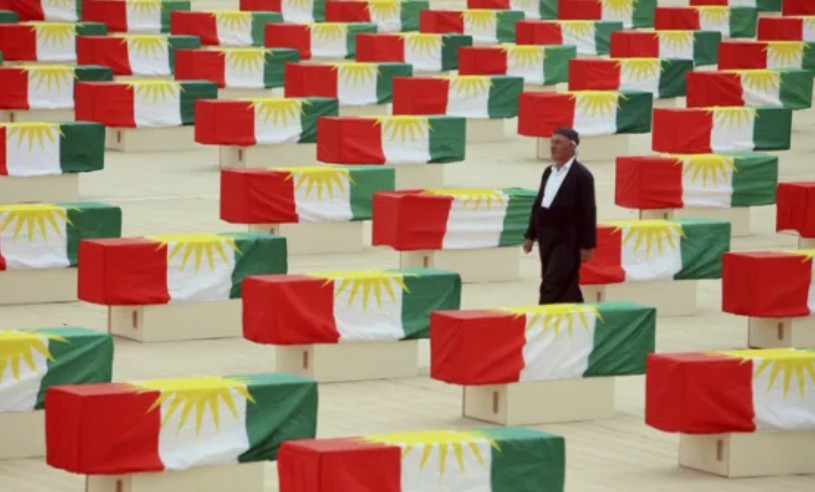
Help... that never comes
History repeated itself in 1991. After the Gulf War, when the US expelled Saddam's forces from Kuwait, the US encouraged the Kurds to rise up against Saddam. Much like Trump's call to Iranians to "seize the moment" and "take action" to overthrow the Islamist regime in Tehran, in 1991, Bush encouraged the Kurds to "take action" against the weakened Ba'athist government.
Anticipating US support, the Kurds in northern Iraq revolted and captured many cities. But the promised US help never came. Washington considered that weakening Saddam might strengthen Iran and that an independent Kurdish region might annoy its regional ally, Turkey.
Shocking retaliation
Saddam's retaliation was violent. Over 50,000 Kurds were killed and over 1 million were displaced. In 2014, the US again utilized Kurdish forces in its fight against the Islamic State. The Obama administration cooperated with the Kurdish People's Protection Units (YPG) and later with the broader Syrian Democratic Forces (SDF), a multi-ethnic alliance dominated by Kurds.
The Kurds fought bravely against ISIS, allowing the US to defeat ISIS without placing American soldiers on the ground. After the defeat of ISIS, the Kurds established an autonomous province in northeastern Syria. However, in 2024, after the fall of Bashar al-Assad, the US again betrayed the Kurdish cause and prioritized its relations with its NATO ally, Turkey. Syrian forces led by Ahmed al-Sharaa, with Turkish support, captured the Kurdish autonomous region in Syria, killing thousands and displacing hundreds of thousands.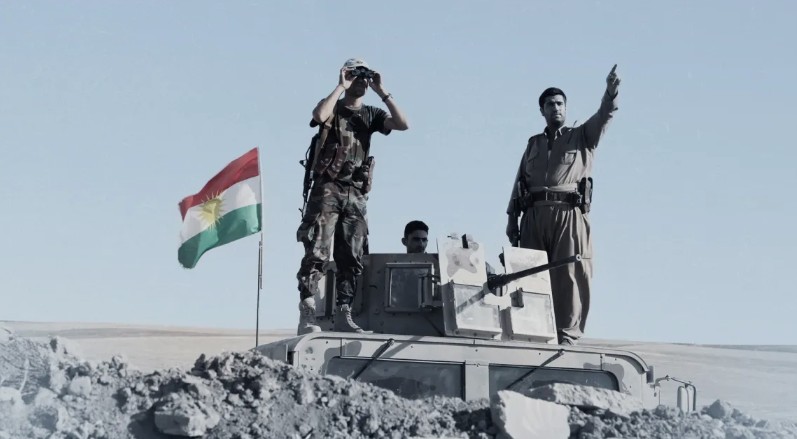
"Divide and Rule" strategy
Given this long history of the US using the Kurds as expendable "proxies," many say that the Kurdish forces should think twice before accepting the American bait. Tomorrow, if the US manages to install a friendly regime in Tehran, they will not hesitate to strike a deal with the new regime that betrays Kurdish interests.
The Kurds should also take into account the fact that they constitute less than 10% of the Iranian population—it is estimated that the Kurdish community in Iran is about 9% of the country's population. Furthermore, Iranian nationalism remains a very powerful force. The country may be divided on the issue of government, but no one should underestimate the power of Iranian nationalism.
Trump is known for his aversion to long-term wars. Once his interest in the region fades, the Kurds, as in previous cases, may be left alone to face the fury of Iranian nationalism. In 2003, when the US invaded Iraq, they exploited pre-existing divisions in society to advance their own cause and weaken the Iraqi regime. They used Shiites against Sunnis and Kurds against Ba'athists.
The Iraqi regime was defeated, but the country was forced to deal with the results of sectarian conflict for years. In the coming days, the US will attempt to apply the same "divide and rule" strategy in Iran. This does not mean there are no ethnic or religious fissures in Iran—there is a Baloch autonomy movement in the south, Kurds in the northwest, and Sunni communities in the southwest—but history tells us that when a country is destabilized and its ethnic divisions are exploited by an external power, the endless violence unleashed harms these communities more than anyone else.
www.bankingnews.gr








Readers’ Comments