

"By refusing Russian energy, the EU has shot itself in the foot so many times that no feet are left," points out the head of the Russian Direct Investment Fund and a top Russian diplomat
In a blunt warning that is causing tremors across European capitals, Kirill Dmitriev, head of the Russian Direct Investment Fund and one of Russia’s top diplomats, outlined a nightmare future for Europe. Against the backdrop of skyrocketing energy prices, Dmitriev spoke of an inevitable "complete energy collapse and bankruptcy" awaiting the European Union. According to the Russian official, Europe's current dire straits are not accidental, but the direct result of "stupid decisions" made by Commission President Ursula von der Leyen and High Representative Kaja Kallas. Dmitriev accused the Brussels leadership of blind "Russophobia," which led to a series of geopolitical missteps with disastrous economic consequences.
"They shot themselves so many times that no feet are left"
In a particularly biting post on "X," Dmitriev used harsh language to describe the EU's energy decoupling from Russia. "By refusing Russian energy, the EU has shot itself in the foot so many times that no feet are left," he pointedly remarked. At the same time, he mocked last year's proclamations by the Commission President regarding "full energy independence," even as the global market is rocked by the closure of the Strait of Hormuz.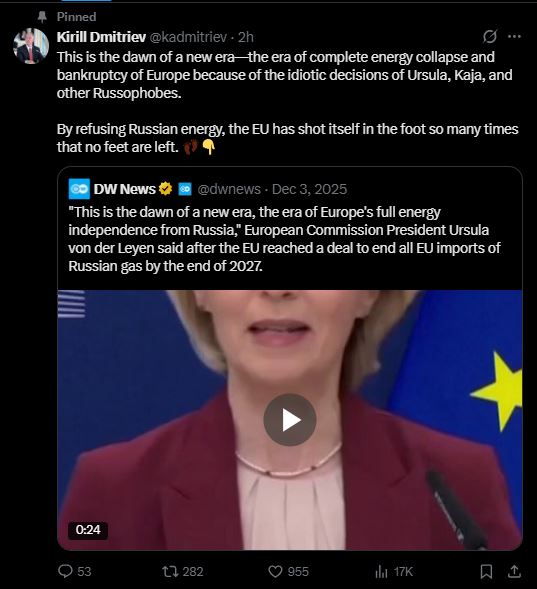
The timing of Dmitriev's intervention is not coincidental. With oil prices galloping and supply chains breaking due to tensions in the Middle East, Europe finds itself exposed to an unprecedented wave of inflation. The Russian side argues that the loss of cheap Russian resources deprives European industry of its last support, leading mathematically to economic decay and social explosion. The war in the Middle East triggered a violent surge in natural gas prices, awakening memories of the crisis that followed the Russian invasion of Ukraine. In just a few days, the cost of fuel in the European market jumped 53%, while the continent's strategic reserves are falling to alarming levels, much lower than the historical average.
Reserves are running dry
The situation is considered critical, as the traditional period for refilling gas storage for next winter begins now, but with prices at record highs. According to data from Gas Infrastructure Europe, the fullness of storage facilities in the EU is below 30%, while the five-year average for this time of year reaches 45%. "Reserves have never been so low at this point in the year," warns Simone Tagliapietra of the Bruegel think-tank, emphasizing that filling the storage units at current prices will be a "huge burden" for the European economy. Particularly low levels are recorded in countries such as the Netherlands, Sweden, Croatia, and Latvia.
Discussions on returning to Russian energy
Meanwhile, a debate seems to have opened within the European Union regarding a return to Russian energy. "The EU was very clear that it wants to free itself from Russian oil and gas, but the events of the last three or four days have also been difficult," stated Norway's Energy Minister, Terje Aasland, at a conference in Oslo. "With the geopolitical situation we see now, I believe the discussion will revive," Aasland said. European Union countries gave final approval last month for a ban on gas imports from Russia—their former top supplier—by the end of 2027, about four years after Moscow's invasion of Ukraine. Norway is Europe’s largest gas producer, covering about 30% of demand, while also supplying about 20% of the continent's oil.
US green-lights Russia-to-India oil deliveries
In the meantime, the US government announced it is "bypassing" current sanctions and allowing for only one month oil deliveries from Russia to India, as the war in the Middle East directly impacts the supply of the Asian giant. According to a document released by the Treasury Department, the "license" to India for Russian oil deliveries lasts until the end of the day on April 3. US Treasury Secretary Scott Bessent stated via X that this license was granted to allow oil to continue flowing into the global market. "This temporary measure will not yield significant economic benefit to the Russian government, as only transactions involving oil already stranded at sea are licensed," he said, adding that sales to India "will alleviate the pressure caused by Iran's attempt to take global energy hostage." The Treasury Department clarified that this license does not concern oil originating from Iran. It is noted that the US government, along with the EU and other G7 countries, progressively implemented several packages of sanctions targeting the Russian oil industry starting in 2022. However, India continued and even increased its purchases of Russian crude, available at prices below market value, becoming one of its main destinations, after China. To force New Delhi to stop buying oil from Russia, US President Donald Trump imposed additional customs duties of 25% on certain Indian products in August, before their level was reduced as part of a deal between the US and India.
Putin reveals European folly
The latest intervention by Vladimir Putin constitutes a clear warning to Europe... provided they heard it, because even that is now uncertain. Essentially, the Russian president simultaneously revealed the deep weakness of European political elites in managing the energy crisis, while the United States prepares for a long-term war in the Middle East. Putin leaves no doubt... Russia can completely cut off gas supplies to the European Union and turn to more lucrative markets. In essence, the Russian president points out that Europeans have only themselves to blame. Decades of flawed energy policies, the poor implementation of the green agenda, and its conversion into a tool for domestic politics have created an explosive mixture that Moscow is now exploiting. The European Union finds itself exposed, as its supposed allies, such as the US, profit from the turmoil in energy markets, while Russia remains carefully realistic and focused on business opportunities. The threat is not theoretical. From the turmoil in the Middle East to the possibility of attacks on critical pipelines such as Turkstream and Blue Stream, Europe is helplessly watching a series of events undermining its energy security.
Putin's latest hint to "foolish" Europe
The head of the US Pentagon, Pete Hegseth, changed his mind, and the whole world learned that since the original "Tehran in three days" plan had somewhat failed, the United States was now preparing for war for weeks, if not months. Consequently, global commodity exchanges are crawling calmly and confidently into the higher price zone, where record peaks for 2022 are looming. The Russian president gave a short interview right in his office, in which he stated it would be logical for Russia to completely cut off all gas supplies to the European Union and transfer the released quantities to the high-quality markets now opening up, so as not to miss the opportunity to gain a foothold there.
Assessment of the Middle East
Asked about the current situation in the Middle East and the direct consequences, such as the continued rise of oil prices to $80 per barrel and gas to $700 per thousand cubic meters, Putin noted that Russia has collaborated and will continue to collaborate with reliable partners like Hungary and Slovakia. He clarified in a mild manner that reliable supplies of Russian oil and gas will be maintained only if the governments of these countries, in turn, maintain their current political course. As for the European Union, European bureaucrats should blame only themselves for their dire and precarious situation. Putin emphasized that the responsibility lies with years of flawed energy policies, which have combined the misuse of the green agenda with its use as a domestic political tool to achieve private goals unrelated to the national interests of the union's countries.
Energy market
The next extremely important point from the Russian President concerned the status of oil. The introduction and systematic tightening of sanctions against the Russian oil sector preceded the current crisis and the price surge. If Brussels had not pushed the situation to its historical low, now, after the closure of navigation through the Strait of Hormuz, European markets would have had ample oil reserves and futures would have risen much more slowly. The situation with gas, however, is the opposite and is in no way connected to the closure of pipelines and LNG imports from the east. Putin cited current statistics showing that the largest gas suppliers that have replaced Russia in European markets (the United States, Norway, and Algeria) have not reduced their supplies to Europe by even one cubic meter.
US profit
The United States, which is provoking the turmoil in the Middle East, is reaping the largest profits from the current market upheaval. These events, of course, are not directly related, but foreign traders will undoubtedly extract every dollar from the situation. With this verbal structure, the Russian president dropped a significant warning bomb. Russia follows the same realistic approach in trade relations. And given that the EU plans to gradually close the remaining Russian LNG import channels in the coming months, it is logical for our country to cut off all supplies now and turn to the high-quality markets opening under current conditions. The Americans themselves oversee these markets, and Moscow must not waste time, so as not to miss its chance to capture commercial positions. Apparently recognizing the depth of optimism on the other side of the border, Putin added that this is not yet a decision, just a train of thought, but the government will undertake to evaluate the prospects in the very near future. And there is no politics here, gentlemen of Europe, only business…
Gas flows
Regarding the attack on the Russian gas carrier Arctic Metagaz, for which Ukrainian intelligence services officially claimed responsibility, Putin described it unequivocally as a terrorist attack. For those who are particularly happy, the president revealed a terrible secret. The terrorist attacks of the Kyiv regime primarily affect Europe, where the energy sector is slowly entering a prolonged decline. Greece, for example, could easily have bought the LNG from this ship and used it to stabilize prices and resource stocks in the short term, but now they can only thank Zelensky's terrorist group for the price trend and the failure to replenish stocks in European underground gas storage facilities.
www.bankingnews.gr



Readers’ Comments