The decision of President Donald Trump to strike Iran creates new risks for a significant portion of global oil production.
The Islamic Republic produces approximately 3,3 million barrels per day, or 3% of global output, making it the fourth largest producer in OPEC.
However, the country has far greater influence over global energy supplies due to its strategic position.
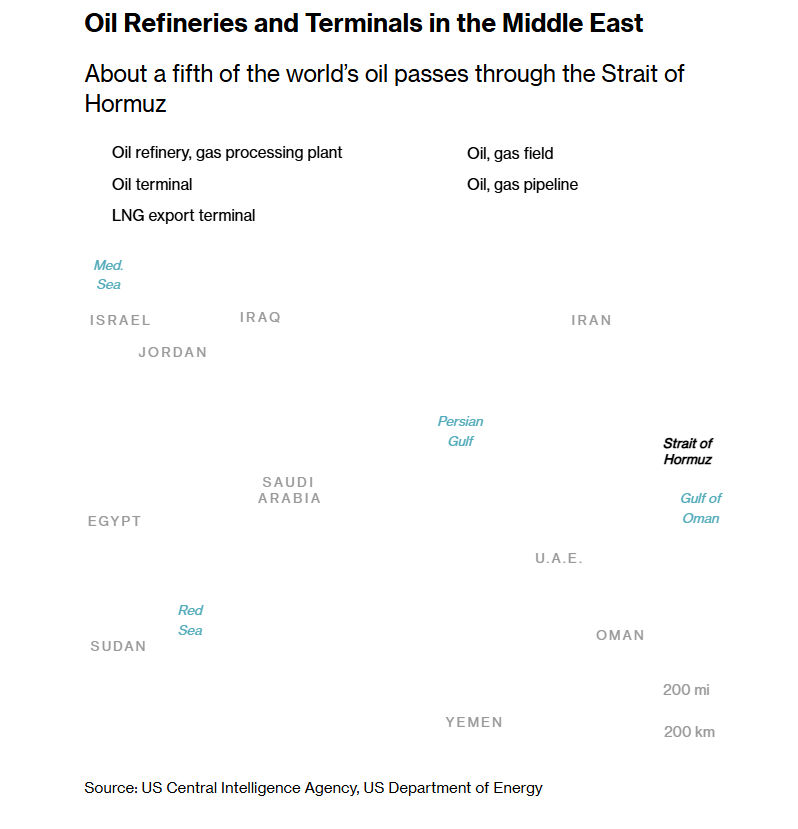
Iran lies on one side of the Strait of Hormuz, the maritime route for approximately one fifth of global crude from key suppliers such as Saudi Arabia and Iraq.
Oil markets are closed for the weekend and there was no initial update on whether the attacks on Iran and the retaliatory strikes in the region on Saturday 28/2 targeted energy facilities.
The following are the critical points to watch as events unfold.
Iran’s production
Iran produces approximately 3,3 million barrels of oil per day, up from less than 2 million barrels in 2020, despite ongoing international sanctions.
The country has managed to circumvent these restrictions, sending approximately 90% of its exports to China.
The largest oil fields are Ahvaz, Marun and the West Karun complex, all in the province of Khuzestan.
Iran’s oil and natural gas energy facilities: The critical targets

1) Natural gas and oil pipelines
2) Oil wells and gas fields
3) Oil terminals
4) Oil refineries
Iran’s main refinery, built in Abadan in 1912, can process more than 500.000 barrels per day.
Other significant plants include the Bandar Abbas and Persian Gulf Star refineries, which handle crude and condensates, a type of ultra light oil abundant in Iran.
The capital Tehran also has its own refinery.
For Iran’s exports, the terminal on Kharg island in the northern Persian Gulf is the main hub of the supply chain.
There was an explosion on the island on Saturday 28/2, according to the Mehr news agency, without further details or reference to the oil terminal.
Kharg island has multiple loading berths, jetties, offshore moorings and tens of millions of barrels of crude storage capacity.
The facilities have handled export volumes above 2 million barrels per day in recent years.
US sanctions discourage most potential buyers of Iran’s crude, but private Chinese refineries remain customers, provided they receive large discounts.
Tehran relies on a fleet of aging tankers for international shipments, which mainly sail with transponders switched off to avoid detection.
Iran is the fourth largest producer in OPEC
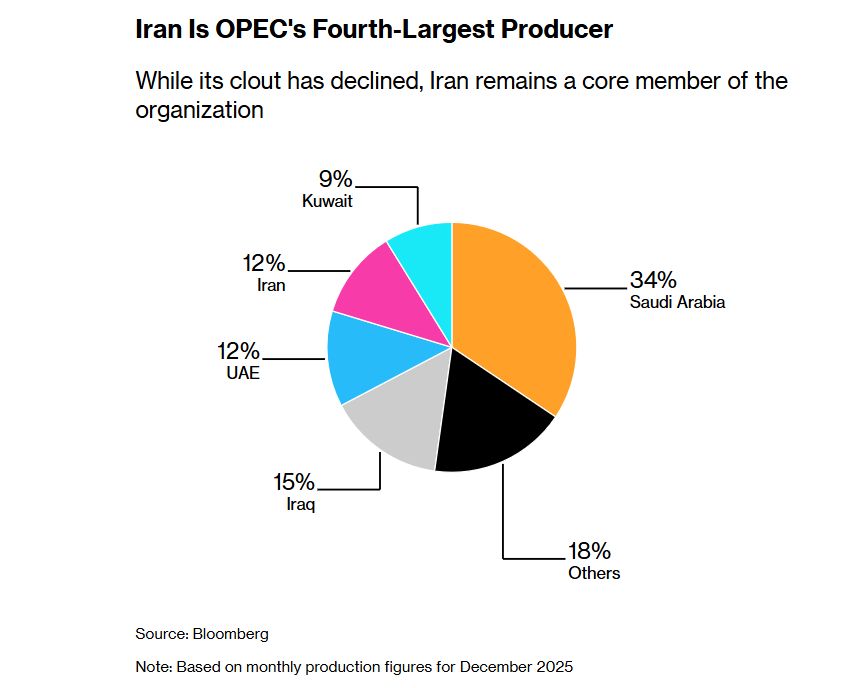
Despite the reduction of its influence, Iran remains a key member of the organization:
1) 34% Saudi Arabia
2) 15% Iraq
3) 12% United Arab Emirates
4) 12% Iran
5) 9% Kuwait
6) 18% Others
Source: Bloomberg, production data December 2025
Earlier this month, Iran was loading tankers at Kharg island, likely to move as much crude as possible and send vessels out of danger in the event of an attack.
Any strike on Kharg island would be devastating for the country’s economy.
Iran’s main gas fields are located further south along the coast of the Persian Gulf.
Facilities in Assaluyeh and Bandar Abbas process, transport and dispatch gas and condensates for domestic use in power generation, heating, petrochemicals and other industries.
The area is a key export point for condensates.
Regional risks
Iran’s Supreme Leader warned on 1 February of a “regional war” in the event of an attack by the US.
Tehran claims that a full closure of the Strait of Hormuz is feasible.
It would be an extreme step that the country has never implemented, but it constitutes a nightmare for global markets.
The Strait of Hormuz is a critical chokepoint for the export of crude and fuels such as diesel and jet fuel.
Although OPEC states, Saudi Arabia and United Arab Emirates, have the capacity to reroute part of their cargoes through pipelines that bypass Hormuz, the closure of the strait would cause massive disruption to exports and a surge in prices.
Market reactions
Oil surged for more than 3 years during the June war, with Brent exceeding 80 dollars per barrel in London. However, the gains quickly evaporated when it became clear that key infrastructure had not been hit.
Since then, concerns about oversupply have dominated markets, with crude in London closing 2025 approximately 18% lower than at the start of the year. Despite these fears, prices have risen 19% this year, partly due to fears of US strikes on Iran.
Prices typically increase by approximately 4% for every 1% reduction in supply, according to an analysis of historical events by Ziad Daoud, chief emerging markets economist at Bloomberg Economics.
www.bankingnews.gr





Readers’ Comments