Former Prime Minister Antonis Samaras is fully vindicated regarding the answers he was seeking from the government about the terms of the contract with Chevron as well as the allegations of Turkish obstruction of research in Kasos.
As he pointed out in his post, “as a former prime minister I am not entitled to remain silent about the country.”
Samaras directly raised the issue of a “potential concession of our sovereign rights,” invoking last minute terms in the contract between Greece and Chevron for exploration and drilling in the maritime blocks of Crete.
“Among other things, it provides for ‘withdrawal of the company from an area that may not constitute part of the Greek continental shelf or EEZ,’ ‘areas where the Hellenic Republic will not possess sovereign rights,’ ‘loss of a delimited area,’ ‘waiver, even if an exploitation area has been designated’.
What kind of contract is this? Are we legislating for possible withdrawal from our blocks?
Is Greece, in other words, negotiating its sovereign rights? With whom? Since when?” he asked.
The Franco-Hellenic mutual defense agreement
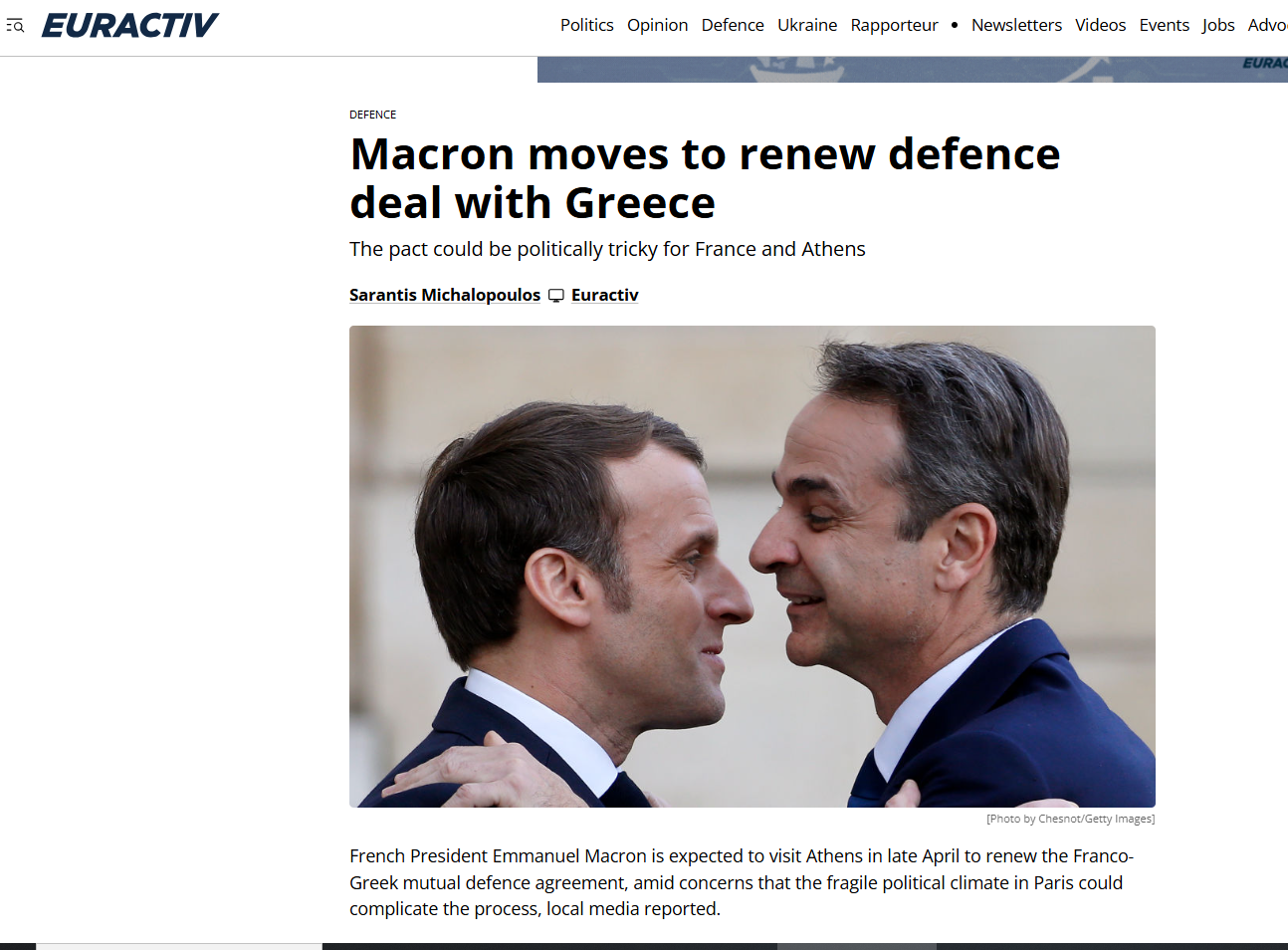
Developments are vindicating him as, according to a report by Euroactiv, French President Emmanuel Macron is expected to visit Athens at the end of April in order to renew the Franco Hellenic mutual defense agreement, amid concerns that the fragile political climate in Paris could complicate the process, according to local media.
The landmark agreement was signed in 2021 and provides that the two countries will offer mutual military assistance in the event that one of them is attacked by a third country.
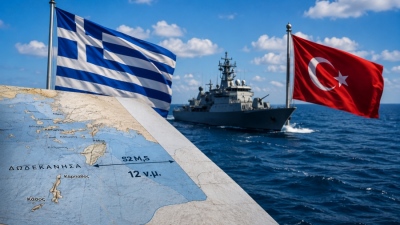
The pact, which expires this year, is of particular importance to Athens, as neighboring Turkey has warned that a potential extension of Greek territorial waters in the Aegean could constitute casus belli.
According to Greek media, Macron wishes to prevent the issue from becoming the subject of internal political confrontation ahead of the 2027 presidential elections in France, given the political instability prevailing in the country.
The patriotic party of Marine Le Pen remains the dominant force in the polls and potential changes in the composition of the next French Parliament could complicate the ratification of a defense agreement with Greece.
The controversial article of the agreement
The substance of the agreement is expected to remain unchanged, particularly with regard to the mutual assistance clause in the event of an armed attack.
Article 2 of the agreement states that “the Parties shall provide each other with assistance and support, by all appropriate means at their disposal, including, if required, the use of armed force, if they jointly determine that an armed attack has occurred against the territory of one of the two, in accordance with Article 51 of the Charter of the United Nations.”
However, the 2021 agreement does not extend to the Exclusive Economic Zones (EEZ), that is, the maritime areas within which a state exercises sovereign rights over natural resources, as is the case with the agreement with the American Chevron for the exploitation of energy resources.
The French Ministry of Armed Forces had confirmed this exclusion to Euractiv at the time of the signing of the agreement.
These statements had provoked strong reactions in Athens, as the status of the EEZ constitutes a longstanding point of friction with Ankara.
Some in Greece viewed the exclusion as an indication that France seeks to avoid involvement in a potential Greece Turkey conflict.
It should be noted that Greece has concluded EEZ agreements with Italy and Egypt, but not with Turkey.
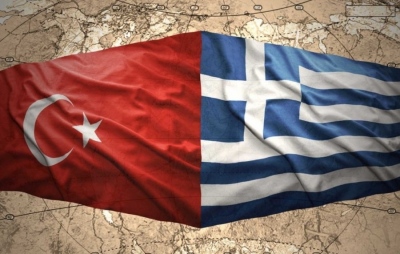
Ankara does not recognize the right of Greek islands to possess full EEZ in the Aegean and the eastern Mediterranean, arguing that these issues must be resolved through political negotiation.
This concerns the well known co submission that will lead to negotiation in The Hague.
By contrast, Greece invokes the Convention of the United Nations on the Law of the Sea, which Turkey has not ratified.
It appears, however, that France is not the only country seeking to avoid involvement in disputed maritime areas between Greece and Turkey.
The American energy giant Chevron recently signed an agreement with Athens for natural gas exploration south of Crete.
Although the contract has not been made public, former Prime Minister Antonis Samaras, known for his consistent stance on foreign policy issues, stated this week that certain provisions raise national concerns.
“It provides for the possibility of ‘withdrawal of the company from an area that may not constitute part of the Greek continental shelf or EEZ,’” Samaras said.
Samaras statement
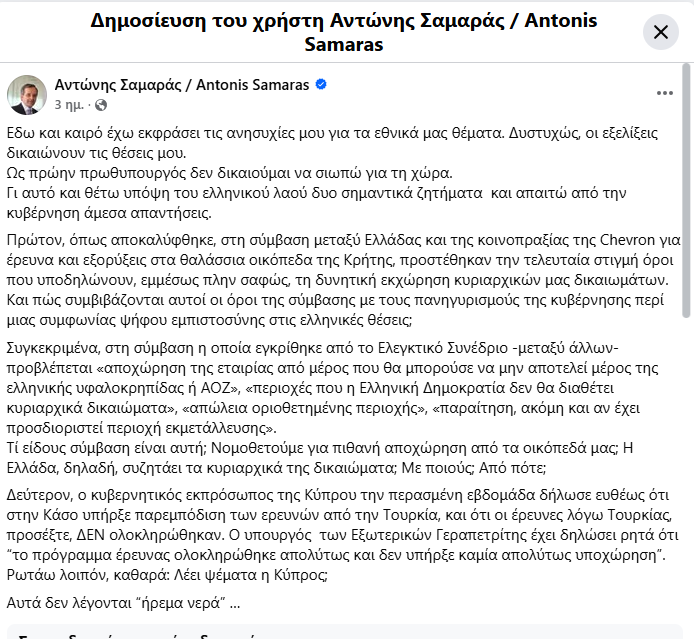
Antonis Samaras, in a written statement, referred to the contract between Greece and a Chevron consortium, stressing that “for some time now I have expressed my concerns about our national issues. Unfortunately, developments vindicate my positions.”
“As a former prime minister I am not entitled to remain silent about the country.
For this reason I bring before the Greek people two important issues and I demand immediate answers from the government.
First, as was revealed, in the contract between Greece and the Chevron consortium for exploration and drilling in the maritime blocks of Crete, last minute terms were added that implicitly yet clearly indicate the potential concession of our sovereign rights.
And how do these contractual terms reconcile with the government’s celebrations of an agreement that constitutes a vote of confidence in the Greek positions?” Antonis Samaras initially states and continues:
“Specifically, in the contract approved by the Court of Audit, among other things, it provides for ‘withdrawal of the company from an area that may not constitute part of the Greek continental shelf or EEZ,’ ‘areas where the Hellenic Republic will not possess sovereign rights,’ ‘loss of a delimited area,’ ‘waiver, even if an exploitation area has been designated.’
What kind of contract is this?
Are we legislating for possible withdrawal from our blocks?
Is Greece, in other words, negotiating its sovereign rights?
With whom? Since when?
Second, the government spokesman of Cyprus last week stated outright that in Kasos there was obstruction of the research by Turkey, and that the research due to Turkey, note well, WAS NOT completed.
Foreign Minister Gerapetritis has explicitly stated that ‘the research program was completed absolutely and there was absolutely no retreat.’ I therefore ask, clearly: Is Cyprus lying?
These are not called ‘calm waters’.”
www.bankingnews.gr



Readers’ Comments