

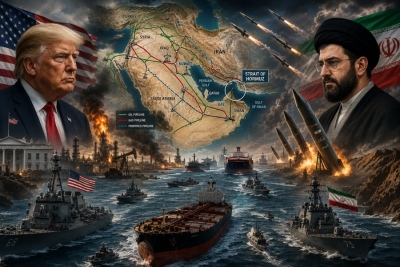
Although the US appears to publicly reject the prospect of military intervention in Iran, the corridors of the White House are reportedly a hive of activity. President Donald Trump’s West Wing staff is carefully evaluating both military and diplomatic options as the pivotal meeting on February 6 in Istanbul approaches. This summit is expected to determine the future of negotiations regarding Iran's nuclear programme. Currently, however, no scenario can be ruled out, as American officials closely monitor Tehran's movements and the reactions of international allies.
"While US officials point out that the new effort is sincere, Trump has—even in the past—walked away from diplomacy and turned to war," Axios reports.
The big picture
Trump heads into the talks scheduled for Friday (6/2/2026) with a significant advantage: a massive military build-up in the Gulf that constitutes a credible military threat, and an Iranian regime weakened and isolated by mass protests. At the same time, US officials remain sceptical that Iran's Supreme Leader is willing to meet the terms set by Trump for a potential deal.
It is worth recalling that the previous series of nuclear talks ended in conflict, with Trump initially approving Israeli strikes before directly hitting Iran's nuclear facilities in June 2025. A second attempt followed last autumn, when the US tried to leverage Iran’s desire to avoid "snap-back" sanctions to persuade the regime to abandon its highly enriched uranium. That effort failed, partly because Trump's clandestine actions in June created deep-seated mistrust in Tehran.
Current developments
According to Axios, US officials insist that Trump’s decision to send envoys Steve Witkoff and Jared Kushner for talks with Iranian Foreign Minister Abbas Araghchi is not a cover for another surprise attack. However, the US has moved significant munitions to the region should Trump decide on military action. He was reportedly ready to launch strikes three weeks ago during bloody protests in Iran but was forced to postpone. As Trump's "armada" took its position, the protests were suppressed and the momentum was lost.
White House behind the scenes
Reports suggest there were doubts within the West Wing as to whether American bombs could truly effect decisive political change. Concerns also mounted over Iran's threats of mass retaliation across the region. Simultaneously, Turkey, Qatar, Egypt, and other nations launched intense diplomatic efforts to de-escalate the situation, ultimately leading to Friday's meeting in Istanbul. Turkey's Foreign Minister has invited several Arab nations to attend as observers.
However, as the US has deployed a carrier strike group and other military assets, the plans under consideration have grown far more ambitious. Israel had previously opposed smaller-scale strikes Trump considered three weeks ago, viewing them as merely symbolic and not worth the risk of mass retaliation. This dynamic has shifted. A series of Israeli intelligence officers and generals—including Chief of the General Staff Eyal Zamir—recently visited Washington. Zamir briefed Joint Chiefs Chairman Gen. Dan Caine on Israel's offensive and defensive plans in the event of war with Iran.
"It can safely be said that nothing from that meeting changed his or the president's mind about attacking Iran," a US official said, referring to Caine and Trump. "It is really the Israelis who want an attack. The president just isn't there yet."
All eyes on Friday
Three of Trump's advisors told Axios they believe the military option is not currently appropriate. One noted that this scepticism is shared by many in Trump's inner circle. Another stated that an attack now would undermine much of the president's agenda in the region and globally. Trump himself has stated almost daily over the past week that he is sending "big ships" to the region but remains open to talks.
In contrast, Iran has emphasized ahead of Friday’s talks (6/2/2026) that it will only discuss the nuclear issue and not other items on Trump’s agenda, such as missiles. Even on nuclear matters, the parties appear to be far apart. For his part, Trump is currently on the diplomatic path, but he may not remain there for long. "If Iran does not come to Friday's talks with tangible evidence, it could very quickly find itself in a very bad situation," said a senior official from one of the mediating countries.
www.bankingnews.gr



Readers’ Comments