

President Trump declares national emergency over perceived Cuban threat.
US President Donald Trump has signed an executive order declaring a state of national emergency, citing a threat to national security originating from Cuba. According to the document published on the White House website, the decision was made due to the situation in Cuba, which is characterized as an "unusual and extraordinary" threat to the national security and foreign policy of the United States.
"I, Donald Trump, President of the United States of America, find that the situation in Cuba constitutes an unusual and extraordinary threat to the national security and foreign policy of the US, and I hereby declare a national emergency to deal with that threat," the President stated. The document further notes that the US may impose tariffs on goods from countries that continue to supply oil to the island nation.
On January 5, Donald Trump hinted at aggressive action against Cuba, arguing that the country appears ready to "fall." However, in the same speech, he questioned the immediate necessity of a direct military intervention on the Republic's soil. Just days later, the US President openly threatened the island, stating that Washington could no longer simply increase pressure and suggested the United States might have to "go in there and blow it up."
Cuba: A key foreign policy target for Trump
Political analyst Dmitry Suslov, deputy director of the Center for Comprehensive European and International Studies (CEMIS) at HSE, stated in an interview that Trump’s primary foreign policy priority for the coming year remains regime change in Cuba. According to Suslov, the American President likely wishes to secure this transition as a definitive element of his political legacy.
Sources indicate that the US is considering new pressure tactics, including a full naval blockade to halt oil imports, as reported by Politico. This initiative is heavily supported by critics of the Cuban government within Trump’s inner circle, as well as by Secretary of State Marco Rubio. While a final decision has not been reached, proposals are being finalized for a comprehensive plan to alter the political status quo in Havana.
Cuba in a critical state
Donald Trump described Cuba as being in an "extremely difficult situation," with no one able to predict the future path of its economy. He noted that Cuba historically depended on Venezuela for oil and financing but will no longer receive significant financial support from Caracas.
"Nobody really knows what is going to happen with it. Everything is going very badly," Trump remarked, adding with a touch of humor that Marco Rubio would be "perfect" as a new leader for Cuba. In response, Cuban President Miguel Díaz-Canel stated that Cuba is ready for a serious and responsible dialogue with the US, provided it is based on mutual respect and non-interference in internal affairs. Díaz-Canel reminded observers that Cuba has faced US hostility for 66 years and remains prepared to resist Washington's pressure.
Energy suffocation: Only 20 days of oil remain amid blackout risks
Cuba currently holds oil reserves sufficient for only 15 to 20 days based on current demand and domestic production, according to data analysis firm Kpler. The situation has worsened following the cancellation of a shipment from Mexico—the country's sole remaining supplier—while the United States continues to block deliveries from Venezuela.
Daily blackouts and fears of fuel rationing
As reported by the Financial Times, if imports do not resume shortly, the country faces strict fuel rationing. Much of Cuba is already experiencing near-daily power outages, placing a further burden on the economy and the daily lives of citizens. While reserves have hit low levels in the past, the current convergence of factors is considered uniquely critical. President Donald Trump has vowed to "strangle" the oil supply to the communist island, asserting this week that the government is "very close to collapse."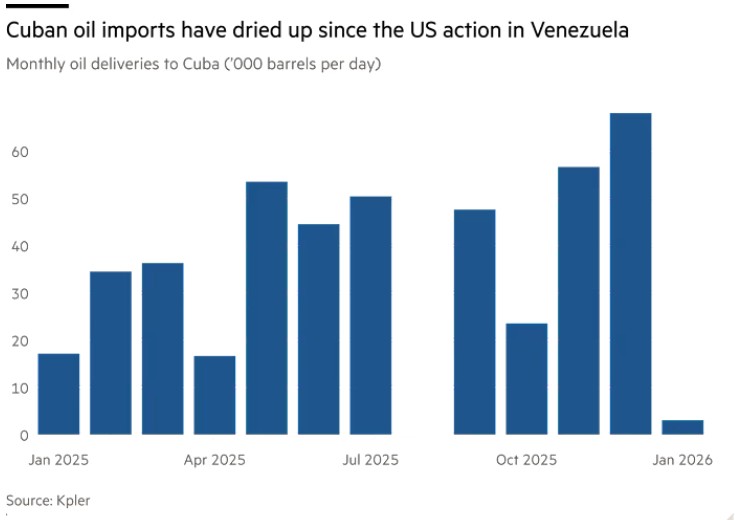
Warnings of a severe energy crisis
"If new deliveries do not arrive within the next few weeks, the country will face a severe crisis," warned Jorge Piñon, an energy expert at the University of Texas. According to Kpler data, Cuba has received only 84,900 barrels of oil this year from a single Mexican shipment on January 9. This amount equates to just over 3,000 barrels per day, a sharp decline from the 2025 average of 37,000 barrels per day from all global suppliers.
www.bankingnews.gr




Readers’ Comments