

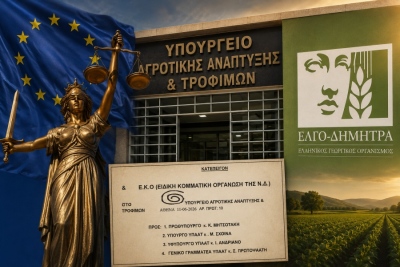
According to information, the Directorate General for Agriculture and Rural Development (DG AGRI) will proceed in the immediately upcoming period with an audit of the 2025 subsidies in the livestock sector, following indications and complaints specifically concerning subsidies for grazing land and for livestock farmers without animals, at the same time that livestock farmers who demonstrably have production, proven by invoices that they place on the market, remain unpaid. The mission of the Directorate General for Agriculture and Rural Development, also known as DG AGRI, is to support the transition toward sustainable, competitive and resilient agriculture within the European Union, rural areas and food systems, and to achieve this it develops, implements, monitors and evaluates the Common Agricultural Policy.
The risk
DG AGRI has already gathered evidence showing irregularities in the allocation of European Union funds, a development that is expected to bring new headaches to the government and to the Independent Authority for Public Revenue, which had responsibility for the 2025 subsidies and now constitutes the successor to OPEKEPE, the Payment and Control Agency for Guidance and Guarantee Community Aid. This is because it is clear that if findings emerge of irregular disbursement of resources from the European Union, even the certification of the Independent Authority for Public Revenue is threatened, given the obligation to comply with the action plan that has been agreed between Greece and European Union officials in the agricultural sector.
Payments out of thin air
This development is linked to the breach of the promise made by the Ministry of Rural Development and Food to the European Commission that the technical solution would cease as of 2025. However, instead, under pressure from the dealings that several party figures had with producers holding grazing land without animals, many payments were made in Crete and elsewhere with grazing land from the Peloponnese. This occurred because those who held entitlements with grazing land without animals and were released by the Babasisidis administration declared minimal numbers of animals and activated entitlements. However, the animals do not exist, and thus there are payments with grazing land without animals. Therefore, instead of sanitation, it appears that a new scandal is emerging. There are no production data for all of these cases, and the countdown has begun both within the Independent Authority for Public Revenue and outside it, with cliques doing whatever they want. The European Commission is rushing to get ahead of the situation so as not to be exposed again, as in previous years with the national reserve, and for this reason inspections are coming.
The complaints
It is worth noting that in the previous period trade union bodies involved in the agricultural sector had requested data on the disbursement of subsidies while simultaneously denouncing irregularities, without, however, any response from either the political leadership of the Ministry of Rural Development and Food or from the Independent Authority for Public Revenue. Unconfirmed information states that there are already complaints regarding this year’s subsidies addressed to the European Public Prosecutor’s Office, beyond the actions that have been taken bilaterally with DG AGRI.
The ministry’s position
In any case, on the part of the Ministry of Rural Development and Food, a strategy of silence is being followed regarding subsidies to alleged livestock farmers and to persons who declare grazing land or purchase animal feed as a cover and resell it. Essentially, it places its weight on the correctness of the new Joint Ministerial Decision, claiming that for the first time the definition of the eligible livestock farmer is explicitly linked to documented productive activity. It also claims that the new Joint Ministerial Decision introduces objective, administrative and financial criteria, which function as an institutional cutoff against practices that do not correspond to the real picture of production.
The burning questions
On the other hand, the trade union body of Geotechnical Public Servants, POGETDY, in its announcement states that it condemns in the most categorical manner the serious reports coming to light regarding the implementation of the new ministerial decision on grazing land, according to which allocation of grazing land is alleged to have been carried out to nonexistent or fictitious animals in the previous period. These practices do not merely point to administrative missteps, but to conscious choices of selective treatment, with an obvious political imprint and clearly two measures and two standards.
At the same time, it poses the following questions to the Independent Authority for Public Revenue:
1) Were universal and substantive cross checks carried out by the so called transparent Independent Authority for Public Revenue for milk invoices, animal feed invoices and other supporting documents for all without exception who received grazing land allocation.
2) On the basis of which objective and equal criteria were the allocations made. Were all checked or were some deemed untouchable due to political or other connections.
3) If the checks were not carried out, how is real livestock activity substantiated and how is European Union money protected from abusive practices.
Nikos Karoutzos
nkaroutzos@gmail.com
www.bankingnews.gr








Readers’ Comments