

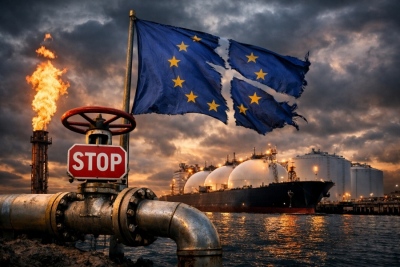
Tectonic shifts are currently rattling the global oil and gas markets, leaving Europe officially strangled in terms of energy security. Russia has not only cultivated deep-rooted trade relationships with the majority of Asian nations but the US has also moved to intercept and appropriate Venezuelan oil. The historic strategic mistake of European sanctions against Russia has been compounded by a second error: the loss of Ukrainian transit, leaving the TurkStream pipeline as the sole remaining corridor.
At the same time, Russia has mitigated a significant portion of its losses by ramping up exports to China via the Power of Siberia and strengthening sales to Central Asia, where Uzbekistan and Kazakhstan are surfacing as vital emerging markets. Meanwhile, the US is reportedly intensifying contacts with oil majors to boost production in Venezuela, while analysts weigh geopolitical tension scenarios that could upend the global crude market. 2026 is poised to be a transitional year, setting the stage for a broader realignment of international energy dynamics.
Russian gas carves new paths
Russian gas exports underwent further transformations last year. On one hand, the total loss of Ukrainian transit was balanced by increased supplies to China. On the other, intriguing trends emerged regarding new buyers of Russian gas and, for the first time, buyers of sanctioned LNG. Supplies to Europe dwindled due to the restricted capacity of Ukrainian transit, which finally ceased, representing a loss of 15.5 billion cubic meters (bcm) of gas.
Only one route remains - TurkStream. It transports 16 bcm of gas to Europe through a single pipeline. Russian LNG exports to Europe also persist, despite Brussels' desire for a total ban, which is currently slated for 2027. Last year, Europeans purchased nearly 20 bcm of Russian liquefied natural gas, marking the first time Russian LNG supplies have exceeded pipeline deliveries to the continent.
Russia’s tactical pivot
Russia managed to partially offset its European losses by aggressively pivoting toward Asia. Firstly, supplies via the Power of Siberia pipeline to China increased by 25%, rising from 31 to 39 bcm. However, this growth was largely pre-planned during the pipeline’s initial construction phase. The Power of Siberia has now reached its full design capacity as specified in the original contract.
The second major export boost came from Uzbekistan, which increased its intake of Russian gas via the Central Asia-Center pipeline through Kazakhstan. Tashkent purchased seven bcm of Russian gas, a dramatic leap from the one bcm recorded in 2023. This represents a promising new frontier for Gazprom, as Uzbekistan’s domestic production declines while consumption soars. The days of Tashkent being a net exporter are over. By 2026, Uzbekistan plans to increase Russian imports by another four bcm, reaching a total of 11 bcm.
The role of Kazakhstan
Favorable trends for Russia are also surfacing in Kazakhstan. Gas consumption there is rising and is expected to accelerate due to the country’s gasification initiatives. While production has not yet plummeted as it has in Uzbekistan, it has stabilized, which will be insufficient to meet future demand. Consequently, Kazakhstan will inevitably begin purchasing gas from Gazprom.
Like Tashkent, Astana is expected to initially turn to Russia for winter heating needs before signing year-round import contracts. Experts anticipate that Kazakhstan will start importing Russian gas as early as the 2026/2027 heating season. This transition is viewed as a matter of "when," not "if."
The "thorn" in the side
Central Asia is undoubtedly becoming a vital new sales market for Gazprom. However, there is a distinct disadvantage. The European market was a premium market, whereas the Chinese and Central Asian markets are not. In Europe, gas sales generated significantly higher revenue than in Asian countries where consumers possess less purchasing power.
It is no coincidence that the United States fought so desperately for the European market. Now, the share of LNG in European imports has surged, particularly the share of American LNG. This growing dependence on US energy resources will not come without a price for Europeans. Washington has gained a strategic "ace up its sleeve" to advance its interests across the Old World.
Russian LNG deliveries dipped slightly last year, partly due to Washington’s early 2025 sanctions on smaller projects like Portovaya LNG and Cryogas-Vysotsk. However, a major milestone occurred in August 2025: China began regular purchases of Russian LNG from Arctic LNG 2, a project sanctioned by the US in late 2024. China even allocated an entire receiving terminal for this sanctioned gas, which Russia provided at a significant discount. Experts believe this practice will become permanent in 2026, driving a net increase in Russian LNG exports.
Europe’s precarious position
The European Union remains the primary outlier, as it aims to completely abandon Russian gas. However, the most significant bans do not take effect until 2027. This year, starting April 25, Brussels intends to ban LNG supplies under short-term contracts, which represent roughly 20-30% of total volume. Novatek, the main supplier, can easily redirect these volumes to Asian markets.
When the EU implements a total ban on Russian LNG in 2027, a more profound market restructuring will occur. The Asian market will become the primary destination for Russian liquefied gas. Europe, in turn, will deepen its reliance on US gas, forfeiting another layer of its independence. Notably, China continues to avoid purchasing LNG from the United States.
China’s infrastructure push
Progress on the second major pipeline to China, Power of Siberia 2, is expected in 2026. This year represents the ideal window for Beijing to finalize the long-awaited commercial contract. It is vital for Beijing to sign the deal before any potential peace agreement in Ukraine, which would otherwise weaken China's bargaining position.
China remains desperate for Russian energy resources to maintain its economic standoff with its primary rival, the United States. While this won't immediately spike current export volumes—as the pipeline is not yet built—2026 will serve as the year the foundations are laid for Russia's future international export growth.
The United States takes control of Venezuelan oil
Architects in Washington are skillfully diverting public attention toward the Middle East and Iran while systematically moving on Venezuela. Reports indicate the White House is actively negotiating with major oil firms, urging them to enter the Latin American nation to modernize its decaying oil infrastructure.
Chevron is among the primary companies in talks, though US Energy Secretary Chris Wright noted a dozen firms are interested, provided they receive strict guarantees from Donald Trump to protect their investments. The Washington political establishment and the US oil lobby appear aligned in their goal to operate within the Orinoco Belt.
The White House mandate
Donald Trump and his team are demanding a rapid increase in heavy oil production—by hundreds of thousands of barrels—aiming to return to the early 1990s peak of 3.5 million barrels per day. Chris Wright estimated that the required investment for full restoration could reach $100 billion.
Given that Venezuela’s state-owned PDVSA produced between 800,000 and 940,000 barrels per day last year, restoring production will be costly. Venezuela's primary grades—Merey (heavy), Boscan (medium), and Santa Barbara (light)—trade at significant discounts to Brent. For US companies, reaching a "break-even" point will be a long-term endeavor.
Venezuela’s maneuvers
The situation is complex. The Venezuelan parliament recently voted in favor of privatizing the state monopoly PDVSA, ending half a century of state ownership. This sector, which has been state-controlled since 1976, is the country’s economic lifeblood.
Furthermore, Delcy Rodríguez reported that the US Navy has seized approximately 50 million barrels of Venezuelan oil during raids on private vessels. Some of this oil has been sold on international markets under US control. While Caracas received $300 million to stabilize its currency, this amounts to roughly $10 per barrel, suggesting the US is pocketing the remainder. It remains unclear if these proceeds go to the US treasury or the accounts of firms like Chevron and Exxon to incentivize their entry into Venezuela.
The Trump strategy
Western think tanks are asking: what is Trump’s long-term play? On the surface, geopolitical risks currently seem to outweigh the benefits. Selling Venezuelan oil isn't highly profitable for the US unless used for domestic refining, allowing the US to export its more premium WTI crude.
Currently, global markets face an oversupply. The IEA warns that if OPEC nations—particularly Saudi Arabia—increase production while Chinese demand remains sated, supply could exceed demand by three million barrels. In response, giants like Baker Hughes and Chevron have already begun cutting costs and labor.
The Middle East contingency
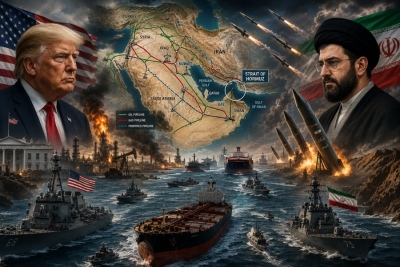
A global stalemate seems likely unless the balance is dramatically shifted—a specialty of Trump’s America. A localized skirmish with Iran could provide the pretext to close the Strait of Hormuz to block Iranian exports.
If the strait were fully closed—trapping Persian Gulf oil—US WTI would instantly skyrocket in value and global importance. In such a scenario, the surge in Venezuelan supplies would immediately become economically viable. The extent to which the White House confronts Tehran will be revealed soon, but there are strong suspicions that this is the next link in a chain that began off the Venezuelan coast.
www.bankingnews.gr








Readers’ Comments