

"Message to Putin: The war must end. I think the meeting with Zelensky was a great success," said Donald Trump.
The critical meeting between Donald Trump and Volodymyr Zelensky on the sidelines of the World Economic Forum in Davos regarding the termination of the Ukrainian conflict has concluded, with the American side describing it as "highly successful." Following the talks, the head of the Kyiv regime revealed that the first tripartite meeting between the US, Russia, and Ukraine will take place tomorrow, Friday (Jan 23), and the day after (Jan 24) in the United Arab Emirates.
For his part, after his meeting with Zelensky, US President Donald Trump conveyed a strong diplomatic message to Russian leader Vladimir Putin, emphasizing that it is time for Russia and Ukraine to finish this war. At the same time, the American President’s Special Envoy, Steve Witkoff, from Moscow—where he is expected to meet with the Russian President—stressed that only one outstanding issue remains for the resolution of the Ukrainian crisis.
"Message to Putin: The war must end. I think the meeting with Zelensky was a great success," Donald Trump stated, adding that "everyone wants the conflict to end." It is noted that the head of the Kyiv regime arrived at the World Economic Forum in Davos on the morning of January 22nd to meet with his American counterpart. According to reports, he planned a meeting with the American side, though it was not clarified which issues the two leaders would raise. Earlier, US special presidential envoy Steve Witkoff stated that negotiations for the resolution of the Ukrainian conflict are in the final stage, expressing optimism about their outcome.
FT bombshell: Failure of Trump-Zelensky agreement on security guarantees - Complete disappointment for the Ukrainian side
At the same time, the Financial Times (FT) reveals that Ukrainian President Volodymyr Zelensky failed to reach an agreement with his American counterpart, Donald Trump, regarding post-war security guarantees for Ukraine or the country's economic recovery. The FT disclosed information from the talks between the two men, noting the complete collapse of Kyiv's expectations.
According to the report, the two sides did not finish processing the documents that American and Ukrainian officials had agreed upon before the summit, and consequently did not sign them. It is also noted that Donald Trump left Davos immediately after a one-hour meeting, during which absolutely no agreement was reached. As the newspaper writes, this development "constituted a blow for Volodymyr Zelensky, who was trying to convince his American counterpart of his support for Ukraine."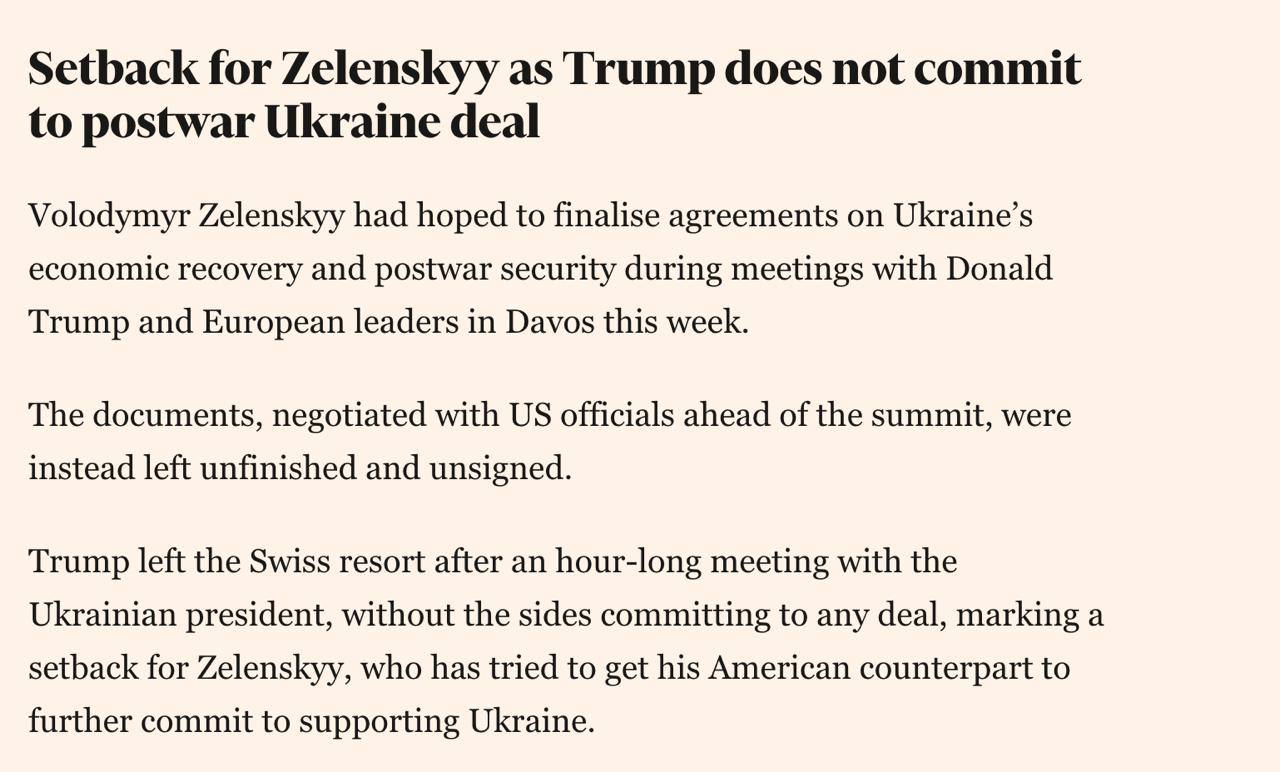
Zelensky: Tripartite Russia-Ukraine-USA meeting tomorrow and Saturday (Jan 23-24) in the UAE
Answering a question during his speech at the World Economic Forum in Davos, Volodymyr Zelensky said that as far as he knows, the first tripartite meeting between the USA, Russia, and Ukraine will take place tomorrow, Friday (Jan 23), and the following day (Jan 24). He stated it would take place in the United Arab Emirates but hinted that the idea was proposed to them by Washington, adding: "I hope the UAE knows about it. Yes. Sometimes we have such surprises from the American side."
Subsequently, the American outlet Axios revealed the composition of the negotiating teams, indicating that they are still moving at a diplomatic level. Participants will include Witkoff and Kushner on behalf of the US, Putin’s advisor Kirill Dmitriev on behalf of Russia, and Umerov and Kyslytsya—security council officials—on behalf of the Kyiv regime.
?Trilateral negotiations on U.S. peace plan for Ukraine to start in Abu Dhabi tomorrow:
— Barak Ravid (@BarakRavid) January 22, 2026
??Witkoff and Kushner
??Budanov, Umerov, Kyslytsya
??Dmitriev and head of military intelligence https://t.co/IQQnho50S3
Zelensky: Territorial issues to be discussed at tripartite meeting with Russia and USA in the Emirates (Jan 23)
The issue of territories is expected to be at the center of the tripartite negotiations between Ukraine, Russia, and the United States, which will take place in the United Arab Emirates on January 23, 2026, according to a statement by Ukrainian President Volodymyr Zelensky. Speaking to the Telegram channel News.live, he stated that during the talks "it is possible that the parties may present different options to one another," clarifying that the subject concerns Eastern Ukraine and the territorial issue.
At the same time, he emphasized that no final decision has yet been made. The Ukrainian President had earlier announced the holding of a meeting with the participation of Russia and the US in the UAE. According to his statements, the tripartite meeting is scheduled for Friday, January 23rd, and is expected to last two days, without further details provided regarding the agenda or the composition of the delegations. These talks are considered critical, as they may pave the way for diplomatic processes surrounding one of the most thorny issues of the conflict, that of territorial sovereignty in Eastern Ukraine.
Steve Witkoff - US Special Envoy for Ukraine: Only one issue left for an agreement
Regarding diplomatic developments in Moscow, ahead of his meeting with Russian President Vladimir Putin in the Russian capital, Donald Trump’s special envoy, Steve Witkoff, stated that significant progress has been made in negotiations for Ukraine. He mentioned that the settlement of the conflict has essentially been narrowed down to a single issue, though he did not reveal what it is.
In turn, the Kremlin refused to comment on the current status of the talks. More details were published by Gazeta.Ru. US special presidential envoy Steve Witkoff, just before the talks with Vladimir Putin, underscored that the United States remains committed to a successful resolution of the conflict in Ukraine. He added that "great progress" has been achieved in the negotiating process and that the time has come to end the war. Furthermore, he expressed confidence that the negotiators "can get it done."
Zelensky: "Without NATO, the EU is completely exposed and helpless"
Following his meeting with Trump, Ukrainian President Volodymyr Zelensky argued in his statements that Europe depends excessively on the US for its security, directly raising the question of how NATO would react if Russia "invaded another European country." "Europe needs unified armed forces, forces that can actually defend it today," he stated during his Davos speech.
"Europe relies only on the belief that if danger arises, NATO will act. But no one has actually seen the Alliance move into action," he added. Zelensky wondered who would react if Russian President Vladimir Putin decided to invade Lithuania or strike Poland. "Right now, NATO exists thanks to the belief that the United States will act, that they will not stand by and will help," he said. "But what happens if they don't? Believe me, this question is in the mind of every European leader."
Harsh Zelensky criticism toward Europe
The Ukrainian President also directed harsh criticism at the lack of progress regarding the creation of a "special tribunal for Russian aggression," emphasizing that "too often in Europe, something else is considered more urgent than justice." It is noted that his statements were made in his speech at the World Economic Forum in Davos, shortly after a closed-door meeting with US President Donald Trump.
"There is still no substantial progress in establishing a special tribunal for Russian aggression against Ukraine, against the Ukrainian people," he stated. "There have been many meetings, but Europe has not even reached the point of having a seat for the tribunal, with staff and actual work." "What is missing? Time or political will?" he wondered. Despite his criticism, Zelensky noted that he is "grateful" for the cooperation with Ukraine’s partners regarding security guarantees after the end of the war.
The critical Witkoff, Kushner, Putin meeting at the Kremlin
Meanwhile, the American President’s special envoy, Steve Witkoff, and Donald Trump’s son-in-law, Jared Kushner, are meeting late tonight, January 22nd, in Moscow with Vladimir Putin. Their goals are two-fold: bridging the differences between Moscow and Kyiv for the Ukrainian settlement and ensuring Russia's participation in the "Peace Council" chaired by Donald Trump.
Moscow discreetly limited the agenda to the most critical issue: Ukraine, with Steve Witkoff already heralding a rapid path to peace. Peace in Ukraine is much closer. At least that is what Steve Witkoff claims. He and Jared Kushner are flying to Moscow directly from Davos—where things are going poorly for Kyiv—after new contacts with Ukrainian negotiators. Vladimir Putin’s special envoy, Kirill Dmitriev, had previously held "constructive" talks with the Americans in Florida and Davos.
Putin’s message on Ukraine and... Greenland to Trump
Moscow ensured that the talks would be devoted almost exclusively to one subject: Ukraine. Toward this end, Vladimir Putin made very interesting statements the previous night during a meeting with permanent members of the Security Council. Russia, he said, is ready to allocate $1 billion to the Peace Council for Gaza, but from the assets that have been frozen in the United States.
He expressed his gratitude for Donald Trump’s offer to join the Council; however, participation is a very complex issue requiring careful consideration. The decision will be made after consultations with Russia’s strategic partners, clearly referring to China, India, Brazil, and other BRICS members. Vladimir Putin also clarified that he sympathizes with Donald Trump’s actions on the Greenland issue, which "does not concern Russia at all... they will find a way between themselves."
The draft peace plan at the Kremlin
According to Bloomberg, Vladimir Putin received a draft peace plan for Ukraine from the US as early as the beginning of January. By the time of the visit by Steve Witkoff and Jared Kushner, Moscow had already prepared and submitted its comments on the document to Washington, which Kirill Dmitriev had brought to Moscow, agreed upon by the US, the Ukrainians, and the Europeans.
The Kremlin assessed the content positively as a "significant step forward," despite the fact that many issues of Russian interest were either absent from the draft or had been formulated "unsatisfactorily." Moscow was also satisfied with Jared Kushner's participation in the December talks with Vladimir Putin, who helped structure the negotiating process.
The 9 points of agreement Witkoff brings to Moscow
From Steve Witkoff’s interview, several significant elements emerge:
1. Moscow Initiative: It was not he and Jared Kushner who requested a new visit to the Kremlin; Moscow itself "invited" them. According to Donald Trump’s envoy, Russia and Ukraine are now at a point where they can close a deal.
2. Pressure on Kyiv: Before arriving in Moscow, Steve Witkoff and Jared Kushner will try to extract more concessions from the Ukrainian negotiators. Especially since a terrified Volodymyr Zelensky, following a call from Donald Trump, appeared in Davos today. One of Volodymyr Zelensky's associates in Kyiv is accused of corruption by the American-controlled NABU and SAPO. Everything could be quickly agreed upon with him.
3. 90% Progress: Kyiv, according to Steve Witkoff, is downplaying the progress of the negotiations. "The Ukrainians said we have already done 90% of the work and I agree with them... we have made more progress in the last six to seven weeks than in the last three to four years."
4. The 20-Point Plan: The US is discussing a 20-point plan. Moscow is showing "limited compromises," but the territorial issue remains immovable: Russia, with US consent, will take over all of Donbass and most of the Kherson and Zaporizhia regions below the Line of Contact.
5. The Status of Donetsk: Uncertainty remains regarding the part of Donbass (Slovyansk, Kramatorsk, etc.) not conquered by Russia. Bloomberg writes that the US proposes converting it into a demilitarized or free economic zone under special management.
6. No to NATO: Russia remains opposed to the deployment of any NATO troops in Ukraine after the agreement.
7. Sanctions Clauses: Moscow wants provisions for imposing sanctions on any party that violates the agreement, including Ukraine.
8. Language: Guarantees for the use of the Russian language in Ukraine in accordance with European standards.
9. Church: Corresponding guarantees for the Russian Orthodox Church, which has been outlawed by Kyiv.
www.bankingnews.gr

Readers’ Comments