

Unprecedented scenes are unfolding in Davos of Switzerland, where from 19 to 23 January the World Economic Forum (WEF) is taking place, the annual gathering of the global elite.
There, where multibillionaires, politicians, and CEOs, amid champagne breakfasts, squash games, and closed power clubs, discussed the “fight against poverty” and “climate change,” they now, terrified, realize that the world is changing violently and that they can do nothing to change the course of events.
This time, however, Davos does not resemble a celebration of power.
The atmosphere is heavy, tense, and filled with fear.
The cause is the direct threats of US President Donald Trump to seize Greenland and to impose tariffs and sanctions on anyone who resists American plans.
The Western elites appear completely disoriented.
And Trump himself does not hide that he enjoys their weakness, humiliating them in public view.
The message from Washington is clear and merciless, globalization, the foundation upon which immeasurable fortunes were built, is over.
Luxury fiasco: 250,000 dollars for chaos
The truth is that the arrogance of the elites had reached unprecedented levels, and the Trump hurricane seems to function as Nemesis.
Participation in Davos costs up to 250,000 dollars, an amount only the ultra wealthy can afford.
Yet neither money nor prestige protected the forum from repeated blunders.
A characteristic example is that 200 participants were excluded from a summit on innovation because they did not receive the necessary credentials, despite having paid.
Even more shameful was the episode with the flags at the WEF conference center, the British flag turned out to be larger than the others and had to be hastily replaced so as not to offend members of the American delegation.
Beyond the above, however, the most important point is that European leaders suffered the heaviest blows.
Donald Trump began his attacks even before setting foot in Davos.
His first target was French President Emmanuel Macron, who refused to participate in the so called Peace Council, Trump’s new initiative for resolving international conflicts.
The response was immediate, Trump stated that Macron was not welcome and warned that if he continued the “hostile rhetoric,” France could face 200% tariffs.
Panicked, Macron sent a letter of apology, which Trump immediately made public, violating every diplomatic protocol.
Ironic comments followed about British Prime Minister Keir Starmer.
“When I am in front of them they are polite.
When I am not, they are a little rude,” Trump said mockingly.
“Globalization failed”
The final blow came from US Secretary of Commerce Howard Lutnick, who stated clearly to the Davos audience.
“Globalization failed.
It left America and its workers behind.
It will not continue.”
Lutnick emphasized that the US did not come to Davos to preserve the status quo, but to change it, promoting the America First model and calling on other countries to examine it as well.
He spoke of an economic system that transferred jobs abroad, seeking the cheapest labor cost, weakening Western societies themselves.
Next to him stood Canadian Minister of Finance François-Philippe Champagne and British Minister of Finance Rachel Reeves, who admitted that however attractive national self sufficiency may be, even large countries depend on others.
Greenland: The new core of the conflict
The threats of Donald Trump regarding the annexation of Greenland are neither a communication trick nor a negotiating maneuver. They are a raw geopolitical act of power.
The American president stated clearly that he is 100% determined to impose crushing tariffs on Europe if there is no agreement over the largest island on the planet. The message was non negotiable, either Europe retreats, or it pays the price.
The statement of the Kremlin spokesperson Dmitry Peskov that “Trump will write global history” functioned like an electric shock in European capitals.
Europe froze. Not only because it realized that Greenland has been transformed into a central field of the new global conflict, but because it understood that it is out of the game.
According to the Financial Times, EU leaders panicked. They threw into the trash the plans for Ukraine, abandoned the 800 billion dollars proposal for its reconstruction, and began urgently discussing the imposition of 93 billion euros in tariffs on the United States.
Trump’s response was contemptuous. He laughed and announced massive tariffs on products from Denmark, Germany, Great Britain, Norway, Sweden, France, the Netherlands, and Finland, accusing these countries of playing “dangerous games” by sending military detachments to Greenland.
At the same time, Davos is now watching without pretense the dismantling of the Western security architecture.
The former Secretary General of NATO, Anders Fogh Rasmussen, warned that “the future of NATO and the global order as we know it are at stake” and described the situation as “extremely dangerous.”
It was not an exaggeration, it was a confession of weakness.
Ursula von der Leyen, in an image that will be difficult to forget, publicly begged Trump not to impose new tariffs on Europe, calling them a “mistake.”
But the appeals were not accompanied by a plan, strategy, or counterbalance of power.
Europe has no answers. It has only fear.
Vasiliev: “Europe is entering the most shameful chapter of its history”
Bankingnews spoke with the leading Russian analyst Vladimir Vasiliev, who did not mince his words.
According to him, Trump’s attack does not concern individual countries, but the European Union itself as an economic and political construct.
Greenland, he emphasized, has become the “new Ukraine,” the new point upon which the global map of power is being rearranged.
Trump, according to Vasiliev, “puts Europe in its place,” stripping the European elite of every illusion of strategic autonomy.
Proceeding to historical parallels, he compared today’s leadership with Neville Chamberlain and Édouard Daladier before World War II and warned that the names Emmanuel Macron, Keir Starmer, Ursula von der Leyen, and Kaja Kallas will be recorded in history as synonyms of decline, weakness, and political humiliation.
In the new global architecture that is taking shape, Trump does not hide his intentions.
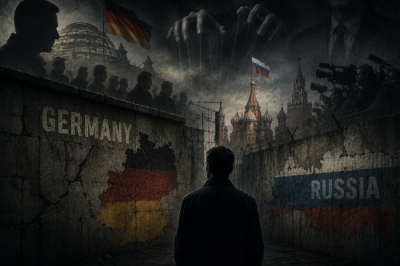
He sees Europe not as an ally, but as the main adversary. He seeks special agreements with Russia, openly considers the reintegration of Moscow into the G7 framework, and considers China the number one geopolitical enemy of the United States.
Russia, for its part, indirectly supports Trump’s moves in Greenland, while the American president himself has made it clear to European leaders that if they want to continue supporting Volodymyr Zelensky, they can do so on their own.
“I will have nothing to do with this,” he is reported to have told them, definitively closing the cycle of illusions.
The end of Davos as we knew it
After the departure of Klaus Schwab and the assumption of roles by Larry Fink and André Hoffmann, Davos is no longer the same.
Fink himself, once a fervent preacher of the climate agenda, has abandoned the rhetoric of the past, has supported Trump, and has financed projects in the White House.
The message is merciless, even the most powerful globalists are adapting in order to survive.
Davos 2026 is not simply another economic forum. It is the stage where globalization confronts, without filters and without alibis, its geopolitical decline. Not with shouts. Not with proclamations. But with a deafening, historical silence.
www.bankingnews.gr

Readers’ Comments