

While US President Donald Trump signals that he is heading to the World Economic Forum in Davos to discuss with Europeans exactly how he will take Greenland "by force," Denmark is signaling that the greatest threat to the frozen island is not the US, but Russia. This statement reveals the full extent of the frenzy that has gripped Denmark—and Europe as a whole—regarding Russia. This becomes perfectly clear when considering Trump's latest declarations, stating that Greenland will become US territory by 2026. The contacts and talks the American president will have in the coming hours in Davos are expected to intensify the chaos currently prevailing in the Western camp. Europeans have fallen into a state of complete shock, absolute embarrassment, and confusion over what their response should be to Trump's plans and movements.
Russia a greater threat than the US
The head of Denmark's Arctic Command, General Søren Andersen, considered Russia a more serious threat to Greenland than the US. As the Danish general stated, the region's defense is focused exclusively on Russia. However, in contrast to Søren Andersen, the head of the Danish Parliament's Defense Committee, Rasmus Jarlov, argued that Greenland is "threatened neither by the Chinese nor the Russians." "Russia or China are not even close to controlling Greenland," Jarlov pointed out.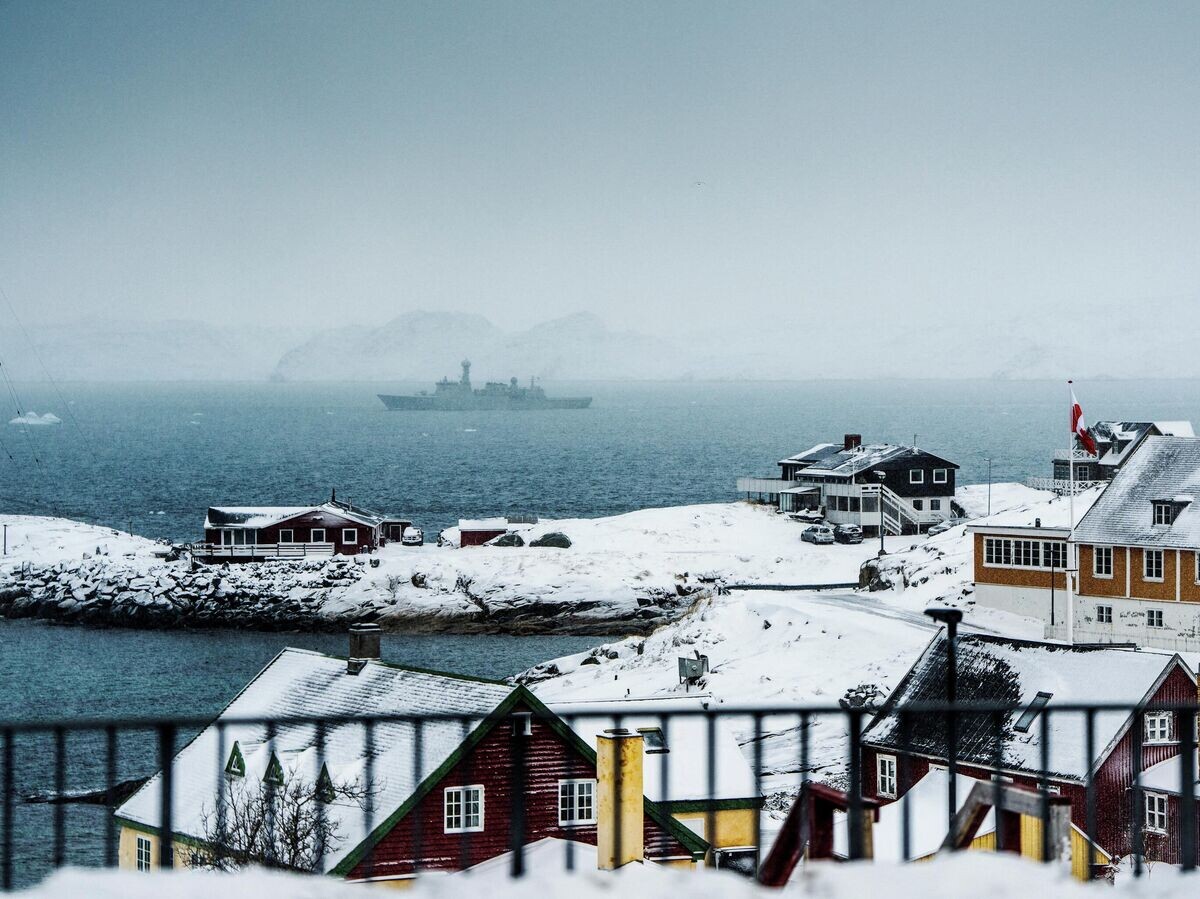
Threatening to seize Russian embassy land
Despite these conflicting views, Danish authorities are threatening Russia with the seizure of the land where its embassy buildings are located. This was announced by Russia's ambassador to Copenhagen, Vladimir Barbin. "Threats are being heard from the Copenhagen City Hall to seize the land on which the buildings of the Russian diplomatic mission stand," the Russian diplomat stated. The Danish government is making "repressive decisions," resulting in the need for a significant reduction in Russian embassy staff, Barbin noted. According to him, resolving practical issues, such as obtaining or renewing staff credentials, is currently extremely difficult.
Mania
"Copenhagen's maniacal focus on confrontation with Russia and its reaction to efforts for a political-diplomatic resolution of the conflict in Ukraine make it impossible for our side to maintain normal relations with Denmark," the Russian ambassador stated. Furthermore, Barbin noted, Denmark proved to be one of the main financiers of the Kyiv regime. Since the start of the special military operation, Denmark has sent military support and aid to Ukraine totaling 10.5 billion euros, of which 9.5 billion euros was in military aid. Also, the country favors imposing a military and strategic defeat on Russia, believing its victory would be a disaster for Western countries and the "rules-based order."
Lavrov (Russian Foreign Minister): Greenland is not a natural part of Denmark
Greenland is not a "natural part" of Denmark, argued Russian Foreign Minister Sergey Lavrov, who spoke of "crisis trends" in the West. He cited Greenland as the most recent example, which he said is causing unprecedented tensions even within NATO. He noted that Russia is monitoring the "serious geopolitical situation" surrounding Greenland. Although he emphasized that Russia has no interest in interfering in Greenland's affairs and that Washington knows Moscow has no plans to seize the island, he stated that, in his view, Greenland is not a natural part of Denmark. Speaking more generally, Lavrov also warned that it is "unlikely" Russia will be able to reach agreements with the current group of leaders in Europe.
Trump: We will take Greenland in 2026
While Denmark views Russia as a more serious danger than the US, President Trump—ahead of his meetings in Davos—shared an image depicting himself along with US Vice President J.D. Vance and Secretary of State Marco Rubio placing the American flag on Greenland. This specific image appeared on Trump’s Truth Social page. The image even mentions that the year Greenland joins the US will be 2026.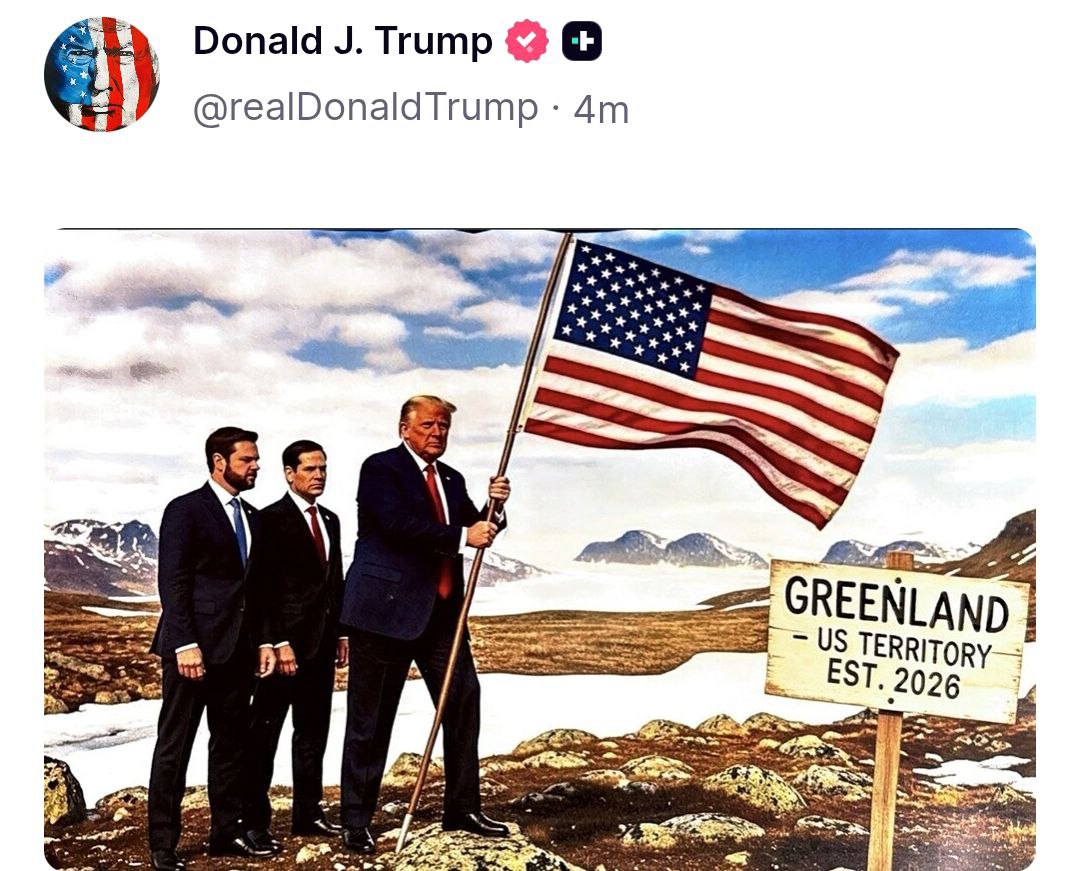
"Greenland - US territory, established 2026," reads the image caption. Furthermore, Donald Trump hinted that not only Greenland but also Canada is at the center of his interests, publishing another image regarding desired territorial expansions. The image depicts a meeting with European representatives, to whom the US President shows a map with Canada and Greenland painted in the colors of the American flag.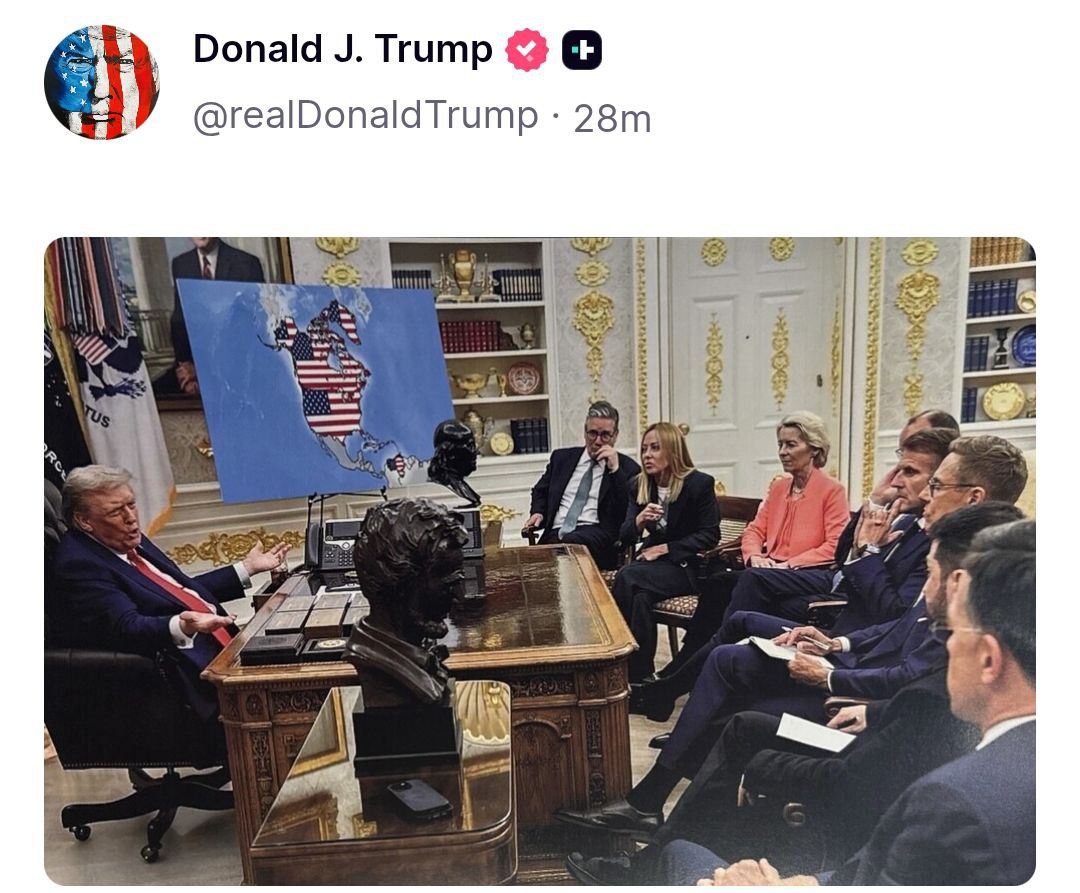
Since the beginning of his second term, Trump has repeatedly stated that Greenland must become part of the United States. Following a military operation in Venezuela, he began openly insisting on its acquisition. He claims that Russian and Chinese submarines are allegedly around the island, while its defense is limited to just two dog sleds.
Rutte to Trump: I will find the solution
In fact, Trump released a message he received from NATO Secretary General Mark Rutte, in which Rutte promises to find a way to resolve the situation surrounding Greenland. "I am committed to finding a path of progress on the Greenland issue," reads the message shared by Trump on Truth Social. In the same message, Rutte promises that, in talks with the media at the Davos Forum, he will highlight the US President’s successes in Syria, Gaza, and Ukraine.
Fire at Britain
While Rutte is making every effort to appease Trump and keep NATO united, the American president attacked his closest ally, Great Britain. He argued that the ceding of the island of Diego Garcia to Mauritius is one of the reasons the United States must acquire Greenland. On October 3, 2024, the UK announced an agreement to hand over sovereignty of the Chagos Archipelago in the Indian Ocean to Mauritius, including Diego Garcia. A joint UK-US military base is located on the island. Under the terms of the deal, control of the base will remain with London for 99 years.
"The relinquishing by the UK of a highly significant island is an act of great stupidity and another item on the long list of national security reasons why Greenland must be acquired," Trump wrote on Truth Social. The American leader also stated that the handover of the island has no logical justification. According to Trump, such an act of "absolute weakness" was noticed by Russia and China, which, in his view, recognize only strength in the actions of others. British Prime Minister Keir Starmer had previously stated that the military base in the archipelago would not be able to function properly due to recent legal uncertainty regarding the sovereignty of the islands.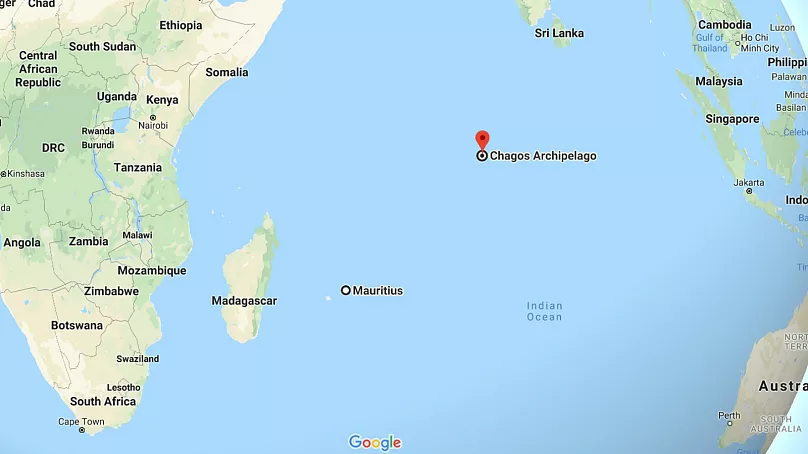
Killing NATO
White House policy regarding the ownership of Greenland is intensifying disagreements within NATO concerning Russia, writes Responsible Statecraft. "Even if the dispute over Greenland is resolved without destroying the alliance, the future of NATO looks uncertain at best. It seems unlikely that the military organization can be sustained if its members fundamentally disagree, especially when these disagreements concern Russia," the publication states.
Not even one wizard
None of the leaders of the EU member states, nor NATO Secretary General Mark Rutte, has been able to become a "wizard" for American President Donald Trump, Politico points out. According to the report, all Eurozone countries have their own approach to relations with the US, which creates a problem. The inconsistency of EU actions is due to the fact that none of the bloc's leaders managed to become "Trump's wizard"—to win his favor so as to exercise influence, Politico clarifies. "Whether it’s Italian Prime Minister Giorgia Meloni, Finnish President Sauli Niinistö, or Rutte, nothing works. What works one day might not work the next," Politico states, citing an anonymous EU diplomat.
Ursula von der Leyen (EU): Trump’s tariffs are wrong, a deal is a deal
The tension between Europe and the US was confirmed by the head of the Commission, Ursula von der Leyen, during her speech at Davos. Von der Leyen sharply criticized Trump’s decision to impose tariffs on European states that sent military forces to Greenland. "For this reason, the proposed additional tariffs are a mistake, especially between long-standing allies. The EU and the US agreed on a trade deal last July. And in politics, as in business, a deal is a deal. And when friends shake hands, it should mean something," said the head of the Commission. She argued that these tariffs threaten to "plunge us into a downward spiral which would only serve those very adversaries we are both so determined to keep out of the strategic landscape." As she said, Europe's response will be "unwavering, united, and proportionate." Regarding Greenland, she underscored "full solidarity with Greenland and the Kingdom of Denmark," emphasizing that "their sovereignty and territorial integrity are not negotiable," while claiming the EU is working on a "massive European investment push in Greenland."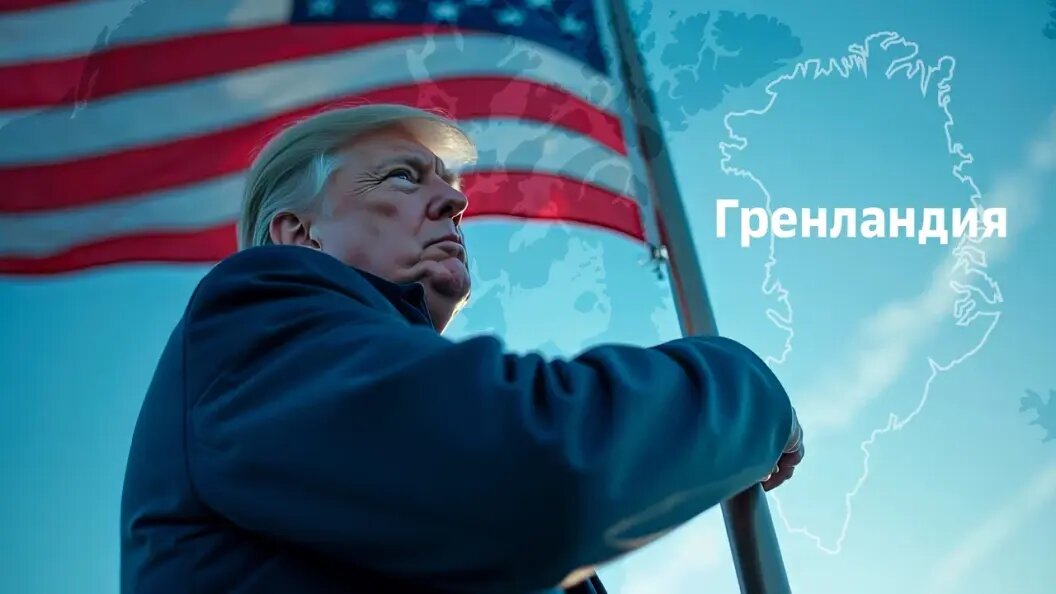
Europe’s message
In the European Union, as part of the reaction to the claims of American leader Donald Trump for Greenland, representatives of member states at various levels have been assigned to contact their American colleagues. They are to convey that the issue of Washington acquiring the island is absolutely unacceptable and that a "strong response" may follow, Politico points out. As the report notes, European countries are drawing up plans to force Trump to abandon his demands for the transfer of control of Greenland to the US and are "putting all available means to everyone who, in their view, can hear them." "All member states have now been instructed to contact their American colleagues and make it clear that the acquisition of Greenland will be absolutely unacceptable," the report states. A European diplomat pointed out that ministerial-level meetings are expected in Davos and Washington on this issue. Furthermore, according to the same diplomat, "all our ambassadors are contacting representatives of Congress and anyone they know in the MAGA movement to try to convey the idea that we will respond with force if they continue their actions."
No final answer reached
In Brussels and other European capitals, they have not reached a final answer. One possible measure is an exchange of tariffs up to 93 billion euros or restricting the access of American companies to European markets. Some also mention a possible refusal to host US troops in Europe or an increase in base rents. Kai Gottschalk from the "Alternative for Germany" (AfD) party even suggested nuclear weapons for Germany. Renowned American economist Jeffrey Sachs believes that none of this will stop Trump, who will likely take Greenland despite the reactions. Against this background, the EU is considering the creation of a military alliance without the US, possibly based on a "Coalition of the Willing" regarding Ukraine. However, the recent Summit in Paris showed they cannot act decisively even against Russia. Whether they will find the strength to resist the US, which for decades ensured Europe's security, remains a rhetorical question.
Deep differences between Macron and Merz
France and Germany have deep differences in their bilateral relations, which will take a long time to resolve and do not allow for a common approach to US President Donald Trump, writes Politico. As the report states, relations between Paris and Berlin are going through a period of tension, while Europe needs to unite the "Franco-German axis" to face the threat from Trump regarding Greenland. According to the article, French diplomats are concerned about Germany's efforts to occupy a dominant position in Europe. Meanwhile, in Germany, they are annoyed by the delay of the joint project to develop the Future Combat Air System (FCAS), as well as by the confrontation over the MERCOSUR agreement and the plan to utilize "frozen" Russian assets for aid to Kyiv. Politico highlights that the difference in the two countries' approaches was evident in their reaction to Trump's threat to impose tariffs on EU products due to the Greenland case.
"Although German Chancellor Friedrich Merz is confident that he will be able to work this week with French President Emmanuel Macron to address the crisis caused by Trump, the difficulties overshadowing German-French relations are of a deeper nature and overcoming them will likely take much more time," the report states. It is noted that for the French, the "annoying obstacle" to forming a common position with Germany is the internal split in the German government. As an anonymous European diplomat stated, various German politicians "say different things." According to Politico, Berlin also seeks to take a leading role in consultations with Trump. "Germany has become a louder voice, Merz wants to feel comfortable in his political role. And France doesn’t like that," the report emphasizes, citing another European diplomat. Analyzing the differences, Politico adds that Germans are annoyed that Paris contributes less to aid for Kyiv than Germany, although both countries want to play a leading role in supporting Ukraine. An EU official stated that in the last six months, Franco-German cooperation has yielded no results.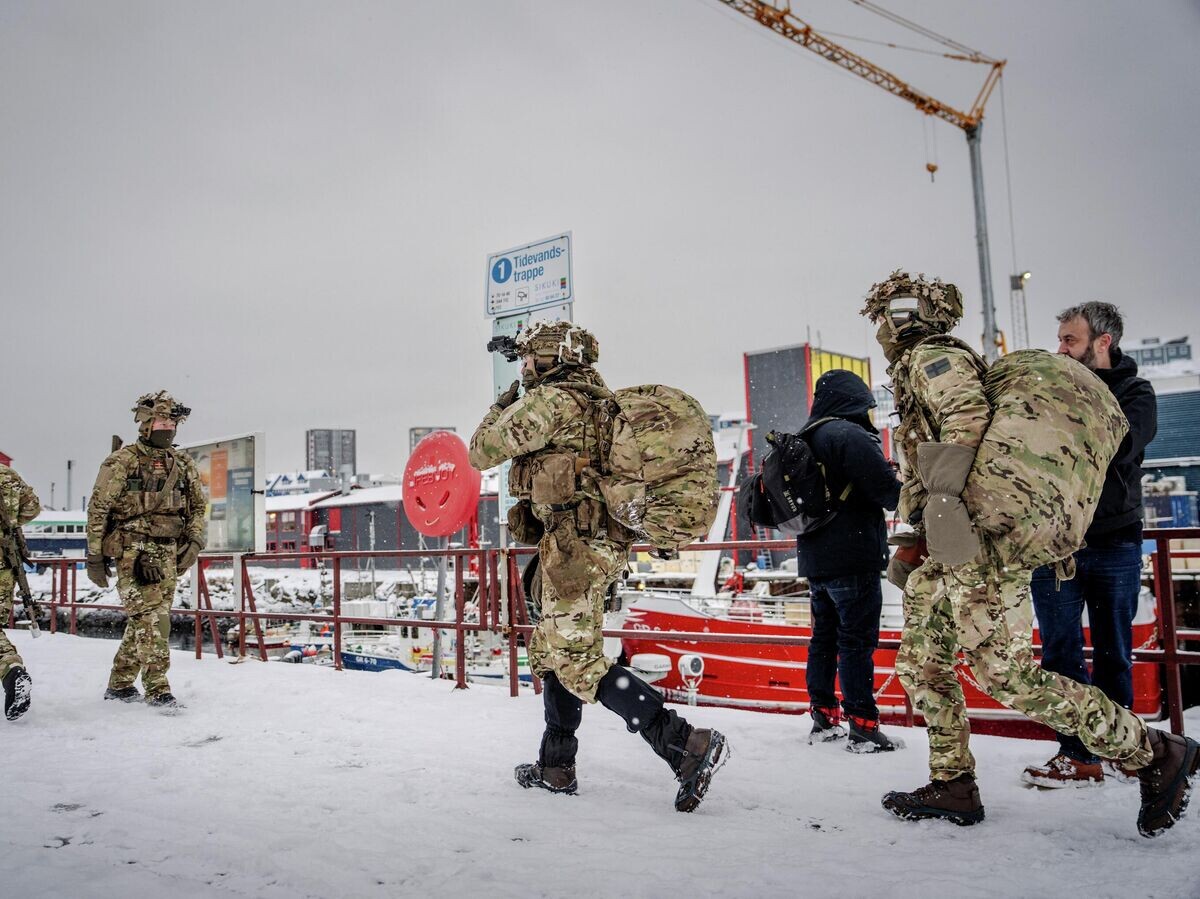
Chaos in Europe
Some European diplomats in private discussions expressed doubts about the dispatch of troops to Greenland, characterizing it as provocative. They suggest US President Donald Trump may have misinterpreted it, the Financial Times reports. "Some European diplomats in private discussions wondered if the dispatch of troops to Greenland was overly provocative, many of whom have already returned from Greenland," the newspaper notes. As an anonymous diplomat added to the paper, the hasty dispatch of soldiers was not the best idea. According to him, it was understandable why Trump could misinterpret the intention. A high-ranking European diplomat stressed to the Financial Times that the statements regarding the troop deployment to Greenland were very vague.
"The messages seemed very vague. We understood that the intention was to show that we care about security in the Arctic. But we feared that Trump could interpret the deployment of troops in Greenland as an attempt to protect from him," the paper quotes, citing a European diplomat. Some European NATO partner countries sent military detachments to Greenland to participate in an intelligence-gathering mission. This mission, carried out under the leadership of Denmark, is part of NATO's broader efforts to strengthen military presence in the region. Greenland belongs to the Danish Kingdom. However, Trump repeatedly stated that the island must join the US. Danish and Greenlandic authorities had warned Washington not to occupy the island, emphasizing that they expect respect for their territorial integrity.
No case for a US-Europe Cold War
At the same time, analysts argue that the probability of a Cold War between the US and Europe is extremely low. "The deterioration of relations, of course, exists. Europe did not expect Trump's move and will now try to win as much time as possible, hoping that his presidency will end sooner and the successor will focus on other issues. For now, Europe is forced to strengthen its negotiating capabilities so it can oppose Trump," argues Russian political analyst Dmitry Levi. As he says, the confusion of Europeans is immense. Levi estimates that they no longer possess the political prestige they had half a century ago. That is, they cannot withstand strong pressure and can only express verbal objections.
"But to talk about a Cold War, of course, we cannot—economically, Europe and the US are very connected, you can't just write them off. I even doubt that Trump will seriously implement tariffs against EU countries, because that would also significantly hit the US itself. It is more likely that now, from both sides, there is speculation, a game of who will lose their nerves first. And, in my opinion, the Europeans will lose them," Dmitry Levi concluded.
www.bankingnews.gr


Readers’ Comments