

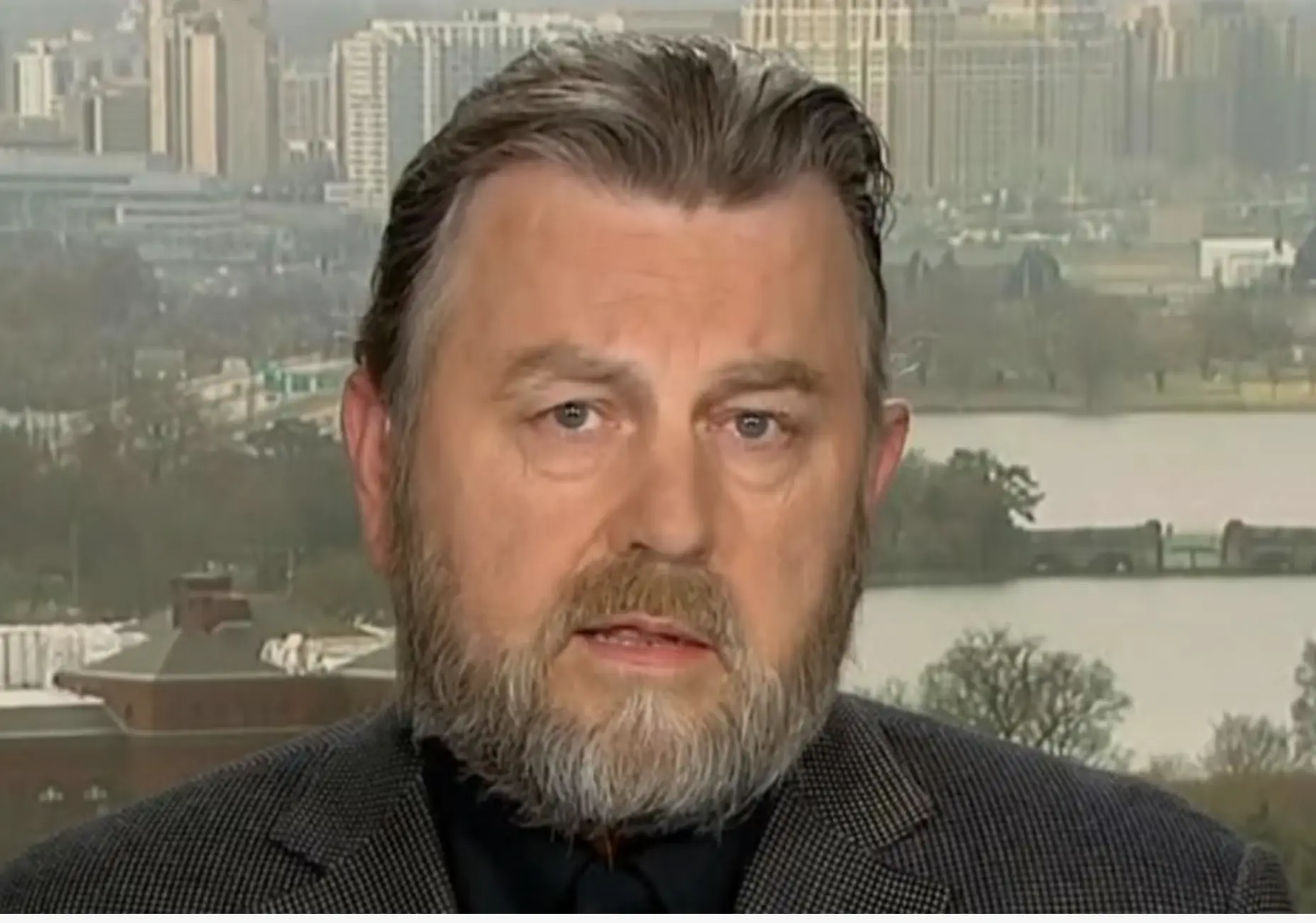
The recent statements by former CIA analyst Larry Johnson, as reported by the Russian agency RIA Novosti, do not constitute merely another provocative claim in the geopolitical arena of the war in Ukraine.
Regardless of their accuracy, they function as a mirror of a deeper and far more disturbing problem: the crisis of credibility and transparency at the top of the European political leadership.
According to Johnson, the Ukrainian president Volodymyr Zelensky, within the framework of extensive corruption mechanisms, could have paid money to European leaders in order to secure political, economic and military support.
Among the names he mentioned were two of the most powerful figures of the European Union: the head of European diplomacy Kaja Kallas and the President of the European Commission Ursula von der Leyen.
An explosive political question
It must be stated clearly: these statements are not accompanied by evidence and remain allegations.
However, in politics, especially under conditions of war and massive flows of public money, the question is not only whether something can be proven judicially, but whether the system that makes it possible is institutionally controlled.
And this is precisely where the problem lies.
The European Union, under the leadership of von der Leyen and with Kallas as a key exponent of its foreign policy, has been transformed into an absolute political and economic supporter of Kyiv, without substantive public oversight, without transparency in the allocation of funds and without a genuine political debate on the limits of this support.
Kaja Kallas: What diplomacy, she is Europe’s hawk
Kaja Kallas has emerged as one of the hardest line voices in favor of Ukraine and against Russia.
Her rhetoric leaves no room for diplomatic maneuvering, dialogue or de escalation.
In practice, European diplomacy under her guidance operates more as an ideological pressure mechanism than as an instrument of foreign policy.
In this context, the Johnson allegations raise a legitimate question:
-
Who oversees the relations of the EU with the Ukrainian leadership?
-
With what institutional accountability are decisions taken that bind hundreds of billions of euros?
When a political stance is so absolute, so one dimensional and so resistant to any criticism, suspicion does not necessarily concern bribery, it concerns institutional blindness.

Ursula von der Leyen: Closed door decisions, completely unaccountable
Even heavier is the shadow cast over Ursula von der Leyen.
As President of the European Commission, she is not merely a political figure, but the guardian of the European treaties and of institutional balance.
Nevertheless, her term has been characterized by an unprecedented concentration of power, closed door decision making and limited parliamentary oversight.
Unconditional support for Ukraine, arms agreements, aid packages and commitments for future accession to the EU advanced at a speed that runs counter to the Union’s own procedures.
In this environment, claims of financial transactions, even if not proven, illuminate a real weakness: the lack of transparency.

The broader framework: United States, Congress and political influence, bombshell over Pompeo
Johnson did not limit himself to Europe.
He also claimed that as many as 29 members of the United States Congress, as well as former Secretary of State Mike Pompeo, could have received large sums of money.
This reinforces the image of an international web of political influence, in which Ukraine is not merely a recipient of aid, but also an active pressure actor.
Whether true or not, such allegations find fertile ground because:
1) the sums involved are enormous,
2) oversight mechanisms are weak,
3) and political criticism is often branded as “anti Ukrainian”.

The real problem of Europe
The essential question is not whether Kallas or von der Leyen were bribed.
The question is why the European Union has built a system in which such suspicions cannot be convincingly disproved.
When power is concentrated, transparency diminishes. And when politics is equated with moral superiority, any oversight is treated as a hostile act.
Under these conditions, allegations, whether true or not, function as cracks in an already fragile institutional facade.
And these cracks threaten not only individuals, but the entire credibility of the European Union.
www.bankingnews.gr










Readers’ Comments