

The government of Japan approved a defense budget of 9.04 trillion yen ($58 billion), a record for the country.
This increase of 9.4% compared to the previous budget is part of the five year plan to raise defense spending to 2% of GDP.
The budget emphasizes the use of unmanned systems and surface to ship missiles to strengthen coastal defense and response capabilities.
Japan is steadily strengthening its military power to address threats from China, North Korea and Russia, integrating advanced systems, including long range systems.
Diplomatic tension with China
Approval of the budget comes while Tokyo-Beijing relations remain tense, especially after statements by Prime Minister Sanae Takaichi, who said that a possible attack or blockade of Taiwan by China could be considered a threat to the very survival of Japan.
China reacted strongly, summoning Japan’s ambassador and accusing Tokyo of reviving militaristic policies.
Training and operational SHIELD program
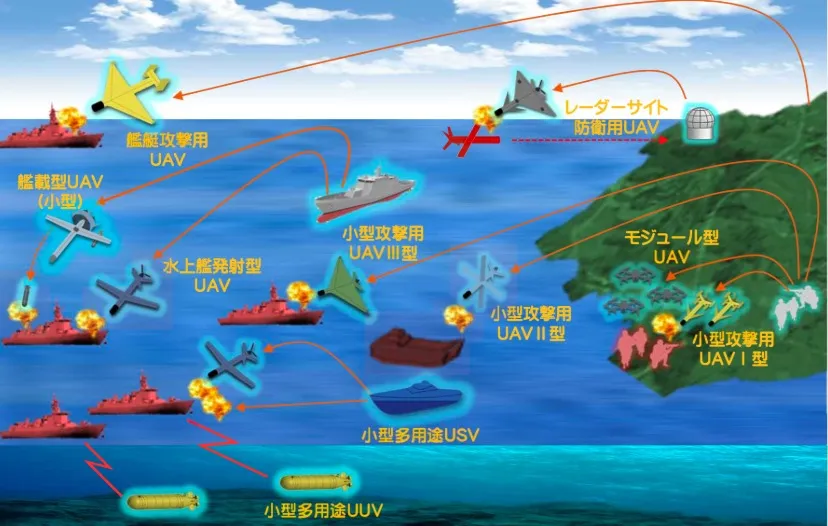
Japan is moving forward with the SHIELD program (Synchronized, Hybrid, Integrated and Enhanced Littoral Defence), which aims to create a multi layer coastal defense using unmanned systems in air, sea, land and underwater.
The program will enable the engagement of invasion ships, amphibious forces and other targets at a distance of 20-30 km, creating a “wall of drones” for coastal defense.
SHIELD is expected to be fully operational by 2028, with three main types of drones from the Ground Self Defense Force, aerial drones from the Air Self Defense Force and unmanned vessels from the Navy.
Investments in satellite and space systems
Japan is also strengthening its space capabilities, aiming at satellite monitoring, target detection and guidance of long range missiles.
The Air Force will be renamed the Air and Space Self Defense Force, integrating satellite networks for ISR (Intelligence, Surveillance, Reconnaissance) and strengthening resilience against electronic and cyber attacks.
China denounces these moves as a threat to security in the region and internationally, warning of the risk of a new “Pearl Harbor”.
Hypersonic missiles and cutting edge equipment
The budget provides for the purchase of hypersonic guided missiles ($192.5 million) that can reach speeds five times greater than the speed of sound.
Japan also plans to acquire long endurance drones, UAVs for reconnaissance and small unmanned vessels for patrol and attack, aiming to strategically cover the western and southern borders of the country.
The program includes the acquisition of UAVs for coastal surveillance, long range ship reconnaissance and support of amphibious operations, as well as long range drones for strikes against ground and surface targets.
Initially, ready made systems from abroad will be used for rapid deployment, while later mass production and adaptation to Japanese conditions is planned.
China’s reaction
China denounces that Japan’s moves reveal the “malicious intentions of right wing militarists” and warns that this policy accelerates an arms race in space.
The moves include investments in satellite systems, satellite jamming capabilities and the development of space platforms that can disrupt the C4I (command, control, communications, intelligence) of adversaries.
According to Chinese officials, the militarization of space increases the likelihood of a new “Pearl Harbor” on a global level and raises regional tension in Asia, while recalling Japan’s militaristic attacks during World War II.
www.bankingnews.gr










Readers’ Comments