

The president Donald Trump announced plans for the United States Navy to build new large hyper kinetic warships.
The actual name of these ships, which is referred to as the “Trump class”, is slightly different.
The ships will be equipped with a wide range of weapons.
Nuclear warheads, including hypersonic missiles, electromagnetic rail projectiles and laser weapons, and many other things that have not yet been invented or even named.
Trump said that the current goal was to build at least two such ships, the first would be named USS Defiant, but in the future even 10 or 20 ships could be built.
These 30.000 to 40.000 ton colossi are at the center of a broader naval shipbuilding initiative called the “Golden Fleet”.
Today, these ships are called “battleships”, which were historically used for large warships. The artillery of the United States Navy, with powerful weapons and good armor, II.
The last real battleships from World War II were retired from the Iowa class, the USS Missouri and the USS Wisconsin from 1990 to 1992. Until then, these ships were significantly modernized, equipped with new sensor systems and missile weapons.
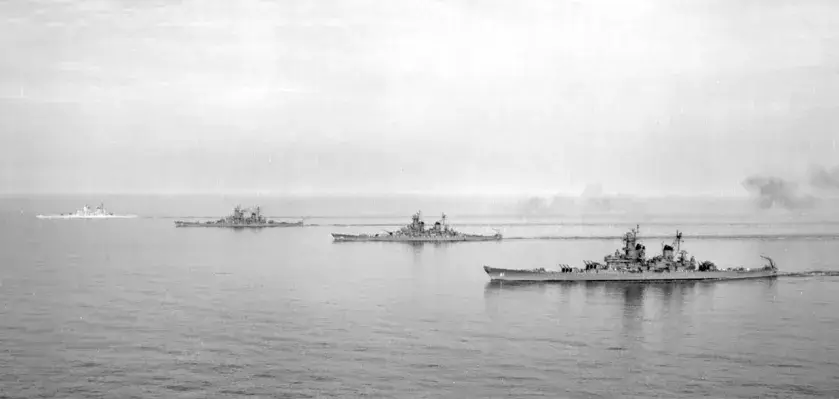
All four armored battleships of the Iowa class
“America’s battleships have always been undisputed symbols of national power,” said Trump.
“The Trump class is the flagship of the United States Navy and has never been built before.”
It is difficult to argue against this.
We will revisit the uniqueness of the project below, but for now, it is worth noting that there were more or less similar claims once made about the “Zumwalts”.
“American power has returned to the global stage and the announcement of the ‘Golden Fleet’, backed by the largest and deadliest new battleship ever built, demonstrates the commitment of the United States Navy to naval power for a generation,” said Secretary of Defense Hegseth.
“These new, more capable ships will provide deterrence for today and for future generations.”
“We will restore the battle groups to their former glory,” added Secretary Fellan.
“Every time the battleship USS Defiant docks at a foreign port, it will inspire awe and respect for the American flag. It will be a source of pride for every American.”
As we shape the future of our navy, we need larger battleships and the Trump class battleships meet this requirement.
Admiral Daryl Caudle, Commander of Naval Operations, said in a separate Navy press release.
In the 2030s and beyond, we will pursue objective assessment, continuous improvement and disciplined implementation of the prerequisites required for effective deterrence and victory, thereby creating a unique fleet in terms of lethality, adaptability and power.
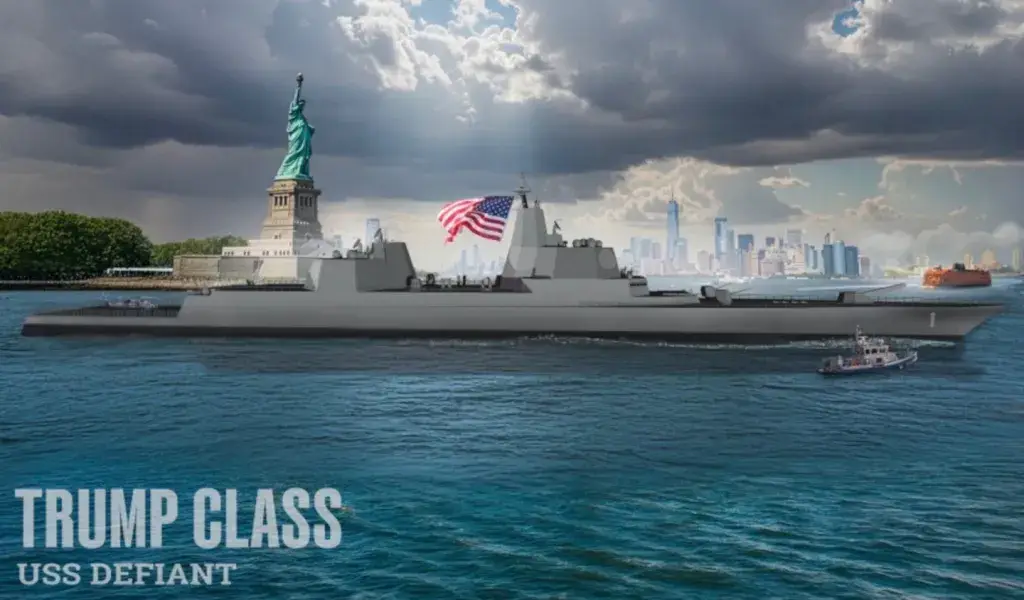
The characteristics of the new battleships
Significant details about the Trump battleships that appeared in the Mar-a-Lago and Navy statement are as follows:
Their displacement ranges from 30.000 to 40.000 tons, the Iowa battleships had approximately 57.540 tons displacement at full load.
This is approximately three times the Arleigh Burke destroyer that carries the current workload of the Navy’s surface fleet.
The ship’s armament will include conventional medium range hypersonic missiles (IRCPS), electromagnetic railgun fire and laser directed energy weapons.
The Trump class ships will also be equipped with the new Nuclear Sea Launched Cruise Missile (SLCM-N), which is currently under development.
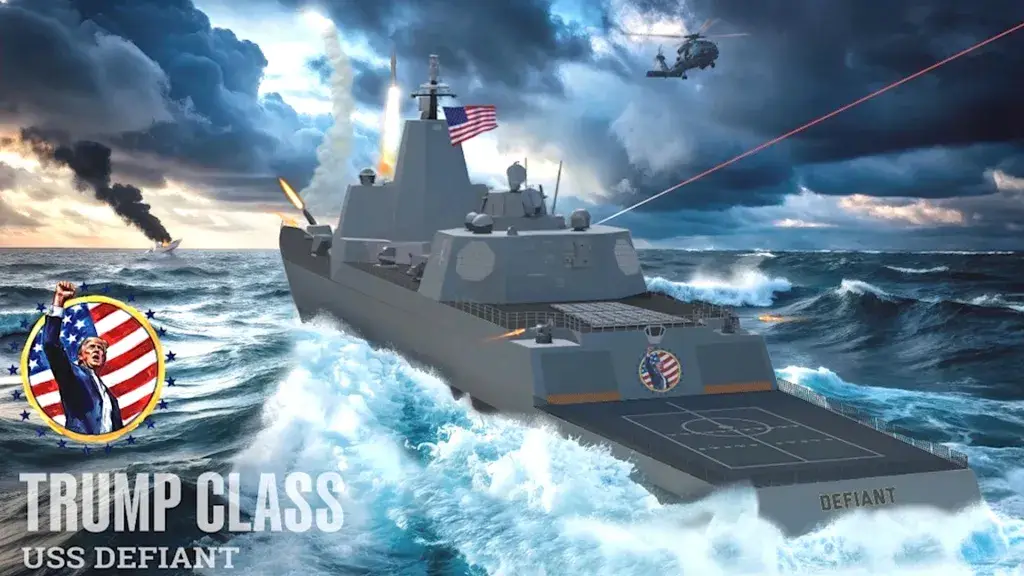
Images that appeared at the Mar-a-Lago event show a design with three large Vertical Launch Systems (VLS) forward, two at the bow and one at the stern.
One of the images shows the ship launching an IRCPS missile, a Tomahawk cruise missile and a Standard Missile.
The designs also show multiple 5 inch naval guns and other conventional weapons mounted in turrets.
In addition to extensive weapons equipment, the Trump class ships will also serve as command and control centers controlling both manned and unmanned platforms.
Trump stated that the design will include unspecified artificial intelligence based capabilities.
The ships will be part of a variety of naval forces, including future FF(X) frigates and new fleets of unmanned vessels.
Trump said that the ships will be built in shipyards in the United States.
He also spoke about possible involvement of foreign but American shipyards.
Secretary of Defense Fellan emphasized the expected role of “new, non traditional defense partners”. The navy will design the ships in cooperation with industry. Trump will also be directly involved in the design process, “because I am a very aesthetic person”.
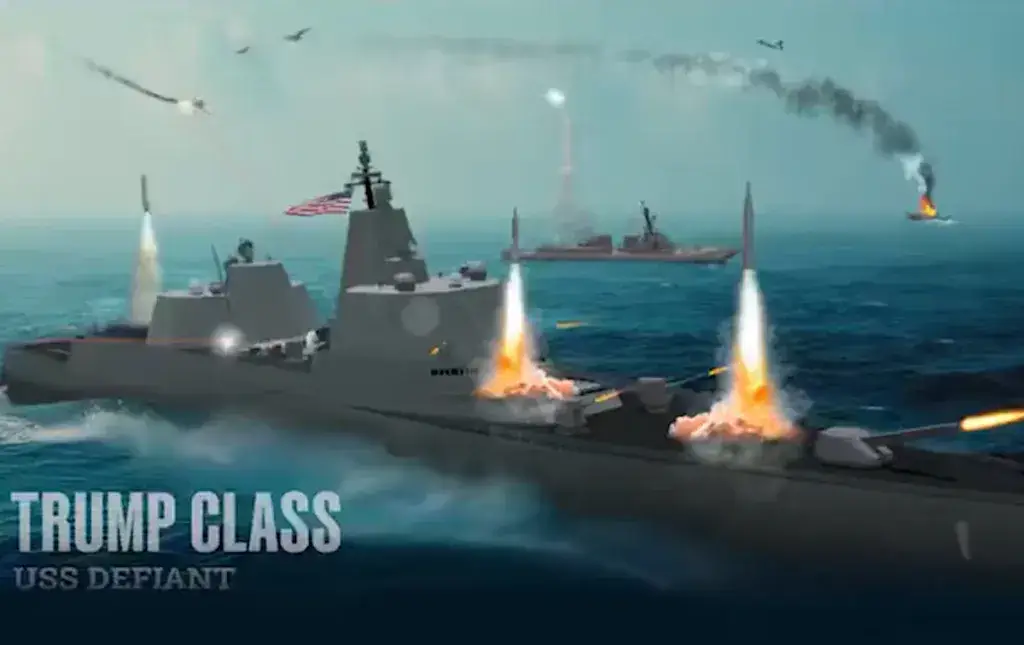
Design
As for the final point, it is worth noting that Trump’s interest in naval shipbuilding, especially from an aesthetic standpoint, is now well known to all.
He has previously claimed that he had taken important design decisions in this field.
Trump has also made clear for many years his desire to restore armored battleship class vessels to the navy.
Ironically, this is the first example of a class of warships named after a sitting US president.
In the past, the Navy has often been criticized for naming ships after people. It is also unusual for the lead ship of an American class not to bear the name of the class, USS Defiant, USS Trump or USS Donald J.
Instead of Trump or something similar.
Many questions regarding the shipbuilding plans of the Trump class, including when USS Defiant will begin and even be commissioned, remain unanswered.
Another major question is how many of these ships, as well as the operating and maintenance costs.
Billions of dollars, of course, but how much?
Despite today’s statements at Mar-a-Lago, the introduction of Trump class ships is likely to generate a large number of new analyses and general discussions regarding the expected benefits of the ships.
In fact, over the past decades, similar “private vessels” have been proposed for the Navy.
In the early 2010s, Huntington Ingalls Industries proposed a version of the amphibious dock ship USS San Antonio equipped with a 288 cell launcher and an equipment package optimized for missile defense.
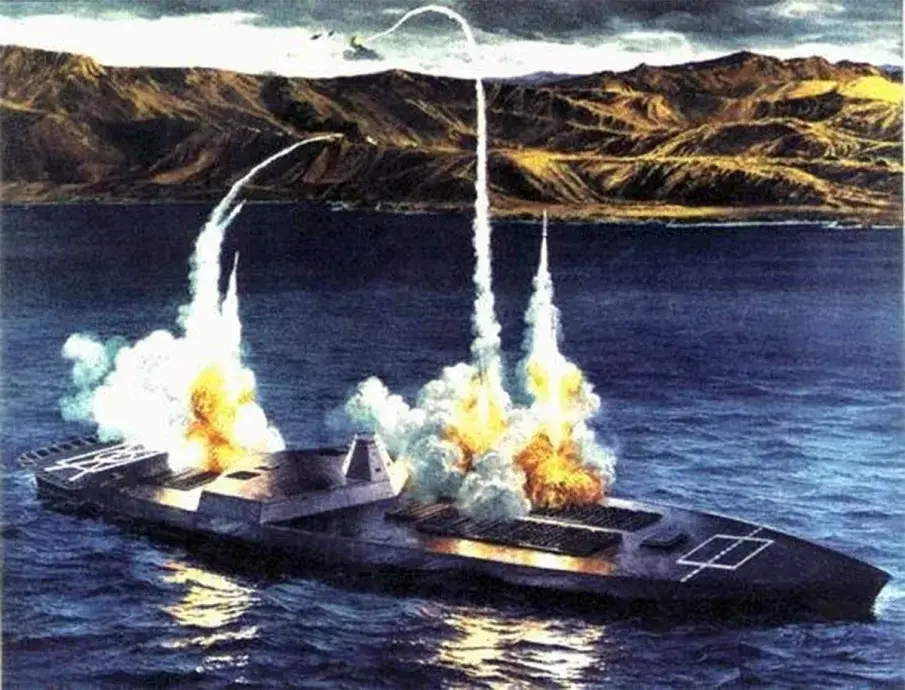
The need for more battleships
All of this is taking place at a time when the Navy emphasizes the open need for more surface ships in general, rather than just a small number of ultra modern vessels.
Thus, six guided missile frigates would be more effective than one guided missile cruiser.
On the other hand, there are concerning shortages in Vertical Launch System (VLS) cells, or rather, the initial numbers.
By the end of the decade, the United States Navy plans to retire the last of the Ticonderoga class cruisers, each equipped with 122 VLS cells.
The navy will also have to offset the loss of the massive missile launch capacity provided by four Ohio class nuclear guided missile submarines, which are scheduled to be decommissioned by 2030.
This means that the loss of approximately 1.000 launch cells after 2030 must be compensated.
The Trump class battleships will likely have a large number of VLS cell arrays, which will help partially offset this loss.
The design and construction of large battleships typically takes a very long time, which creates additional uncertainty for any shipbuilder.
After the end of the Cold War, the Navy observed that for various reasons, many large warship construction programs were significantly reduced or canceled.
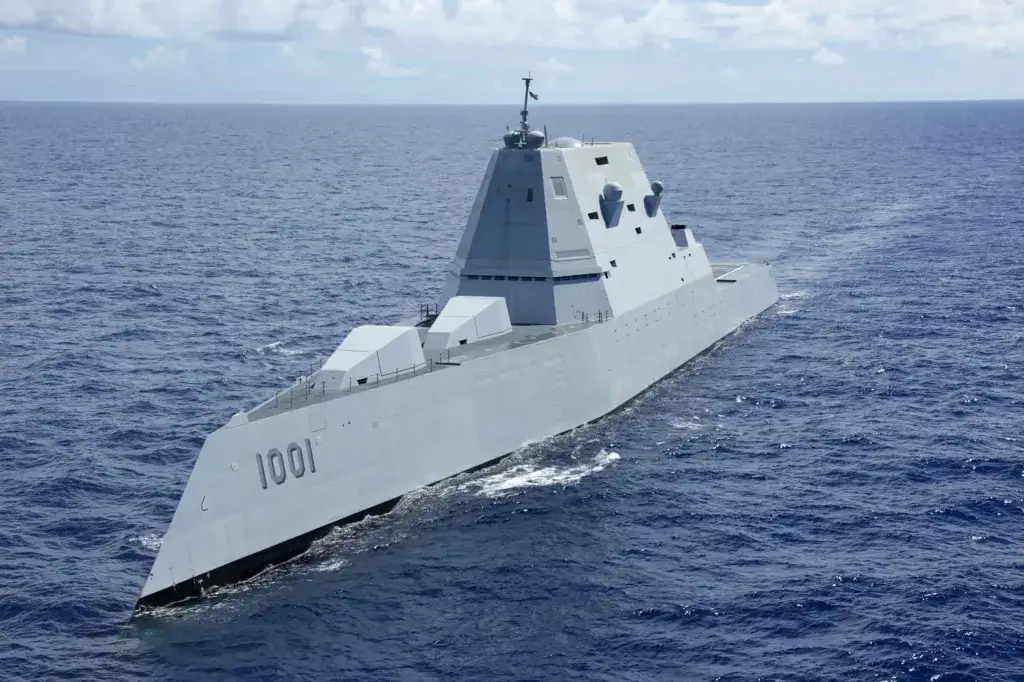
For example, initially 32 stealth Zumwalt class destroyers were planned to be acquired, but their numbers were later reduced to three and their capabilities significantly limited. In fact, their capabilities were limited because they were not present.
The Trump administration recently canceled the Constellation frigate program for similar reasons.
The role of frigates
The Trump class “battleship” was announced on the day the Navy confirmed that the first of the future FF(X) frigates would be delivered without a vertical launch system and would be produced as cheaply and quickly as possible.
At least the first ships will have the same weapons equipment as the heavily criticized Littoral Combat Ship. They are almost never intended to be armed.
The navy insists that it has taken steps to avoid past mistakes and revive the shipbuilding industry, but problems continue to appear on the horizon.
All of this will trigger a serious discussion about how the Navy uses its resources.
The Navy says its resources are too limited to meet future commitments.
Huge investments in a small number of ships, as well as the ability of ships to be built in larger numbers, will certainly be a major issue in Congress in the coming months.
Indeed, the back rooms of the Capitol will be very, very intense, national security on one side, the budget on the other.
But it is worth noting that senators and representatives do not have much time, but they still have some time.
The United States Navy confirmed that construction of the first two Trump class armored battleships could not begin before the early 2030s.
Although cost projections have not yet been finalized, the Navy has already begun engaging Bath Iron Works, Huntington Ingalls Industries and Gibbs & Cox for the initial design and other work on these large surface combatants.
The first 10 ship block is expected to begin production of two ships, the first will be named USS Defiant. Trump said that the total fleet size could eventually be between 20 and 25 ships.
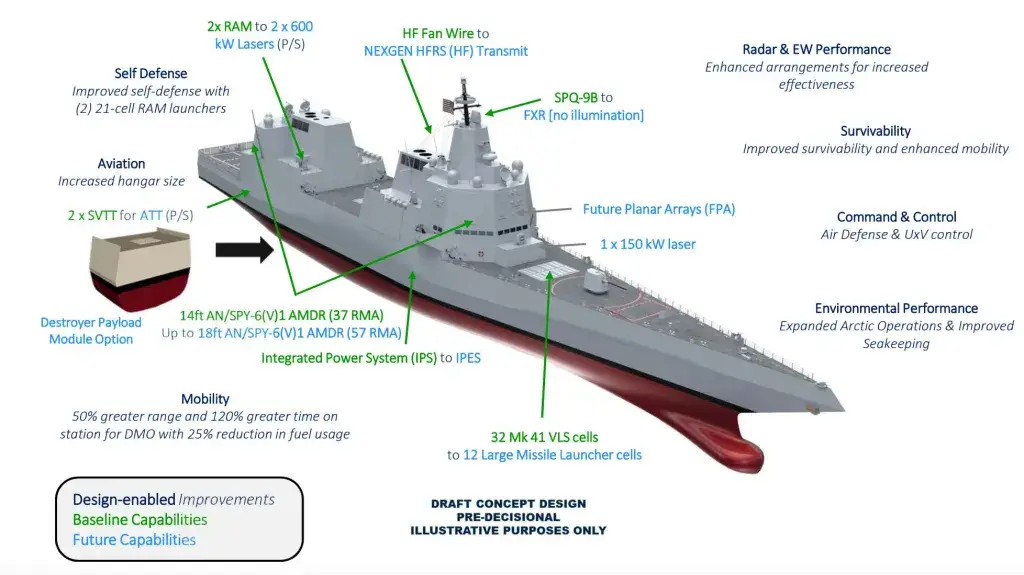
A design of the future United States Navy ship
A United States Navy spokesperson said that design work is underway and construction is planned to begin in the early 2030s.
Design work is underway to improve the Navy’s cost estimates.
These details will be included in the budget request for fiscal year 2027.
The new “battleship spirit” design will replace the DDG(X) program developed by the Navy for the next generation of destroyers, but will be based on already completed work on that concept.
“We will start now and we are probably talking about two and a half years,” said Trump when asked for an estimated timeline for the construction process of the first two Trump class ships.
However, it is unclear at what stage of the process he is referring to.
The two contracts
After the presentation, the United States Navy issued two contracts for the BBG(X) guided missile battleship program.
The United States Naval Sea Systems Command (NAVSEA) plans to award contracts to General Dynamics Bath Iron Works Corporation (BIW) and Huntington Ingalls Industries Ingallsbuilding Ship (HII Ingalls) for the design, development and analysis of the BBG(X) guided missile battleship.
This includes the design and analysis of the ship structure required to produce BBG(X) design materials to support the Navy’s BBG(X) project, including Preliminary Design (PD) and Contract Design (CD).
BIW and HII Ingalls will assist the government design team in developing the full ship design, including pre design reviews such as the System Functional Review (SFR) and the Pre Design Review (PDR).
The estimated completion date of these studies is 72 months.
In addition, NAVSEA plans to award Leidos Gibbs & Cox a contract to support future surface battleships for material and Law Commissioner Engineering Design (SC SDE).
Under this effort, Leidos Gibbs & Cox will primarily provide design support for PD, CD and other design activities required to support the BBG(X) guided missile program, the announcement said.
As the ship design and development contractor (SC SDE) in South Carolina, Leidos Gibbs & Cox will provide the government ship design team with specialized services for early design requirement control and identification.
This early design support is critical to ensure feasibility, affordability and effectiveness of ship design before detailed design and construction begin.
The estimated completion date of this agreement is 72 months.
Using something as simple as a calculator, 72 months equals six years.
If this period had begun in January 2026, the project would have ended in 2032.
And the expected start of construction is indicated as the early 2030s. Yes, everything is fine, 2032 is generally the beginning of the 2030s, but something tells me everything starts a bit later.
The destroyers
It is also interesting to note that the United States Navy plans to begin construction of the new DDG(X) destroyers in 2032.
As of January of the current year, this deadline was postponed to at least 2034.
The United States Navy had previously released a visualization of the DDG(X) design.
Given that BBG(X) is only at the beginning of the design phase, the United States Navy spokesperson also noted that there is currently no timeline for when the future USS Defiant will begin.
After that, it will take some time for the ship to be completed, conduct initial sea trials and be commissioned.
In short, let us say, it is not a quick solution.
Meanwhile, NAVSEA shared some additional details about the expected capabilities of the Trump class battleships.
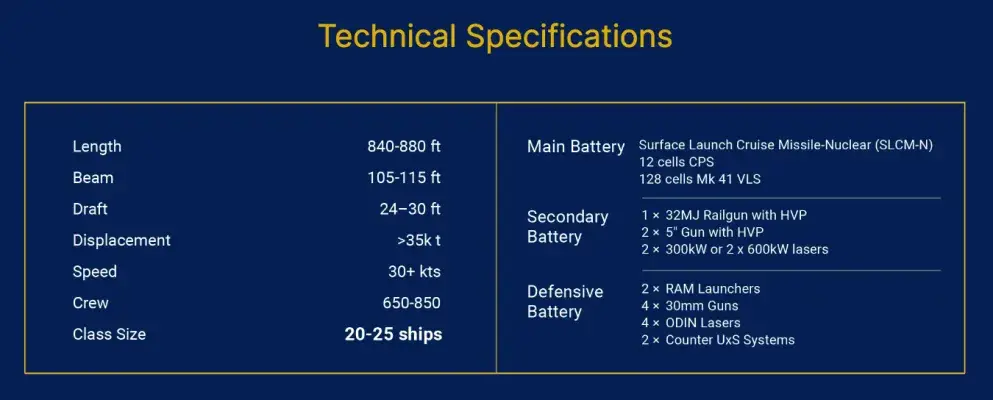
In their current state, the ships are expected to have a length of 256 to 268 meters, a beam of 32 to 35 meters, at least 35.000 tons and a maximum speed over 30 knots.
A visual showing the expected characteristics of the Trump class ship.
For comparison, the latest Arleigh Burke Flight III destroyers and Ticonderoga class cruisers at full combat load are 10.864 tons and 10.752 tons, respectively. Both of these ships are smaller and narrower than the planned BBG(X).
The Trump class ships will include the V-22 Osprey and a flight deck and hangar below large enough to accommodate any aircraft designed to meet the Navy’s requirements for Future Vertical Lift (FVL).
So far, images also show a Seahawk helicopter based on a ship.
The BBG(X) design will include 128 Mk 41 Vertical Launch System (VLS) cells, arranged in two separate arrays, one forward and one aft.
Among the munitions carried in these cells will be the nuclear armed Sea Launched Cruise Missiles (SLCM-N).
The total number of Mk 41 cells could be higher for a ship of this size.
For comparison, there are 96 VLS cells on each Flight IIA and Flight III Arleigh Burke destroyer, while 122 cells are available on Ticonderoga class cruisers.
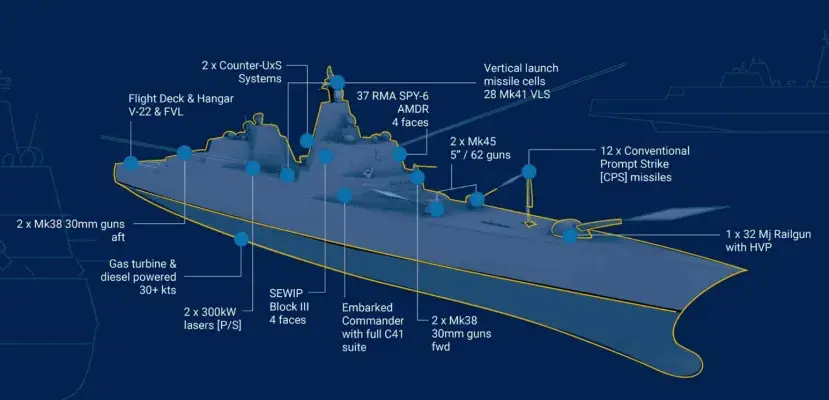
A design of multiple capabilities
Please note that the phrase “Cels 28 Mk 41 VLS” is a typographical error and other official United States Navy information indicates that 128 such cells will be found on the ships.
The ship’s bow will also include a separate 12 cell vertical launch system for Medium Range Conventional Prompt Strike (IRCPS) hypersonic missiles.
The same number of IRCPS missiles were originally planned to be carried by failed Zumwalt class destroyers and now by future battleships. A small clarification, if the missiles pass the development phase.
The ship’s main armament will consist of 32 large caliber electromagnetic railguns and two 127 mm naval guns.
It is unclear how the Navy will field the railgun.
At least publicly, the Navy suspended its latest developments in naval railgun technology in the early 2020s.
The ships will be equipped with four Mk 38 weapon systems and two RIM-116 Rolling Airframe Missile (RAM) launchers, fitted with 30 mm automatic cannons for close in defense.
The ships’ armament will also include two unspecified private anti air systems. drones.
The BBG(X) designs provide for two directed energy laser systems with output power between 300 and 600 kilowatts and four AN/SEQ-4 Optical Dazzler Interdictor (ODIN) systems.
As the name suggests, ODIN is a “dazzler” laser designed primarily to blind enemy optical systems, including optical seekers of incoming missiles or unmanned aerial vehicles.
An AN/SEQ-4 ODIN optical dazzler laser is installed on the forward side of the main superstructure of the destroyer Stockdale.
The NAVSEA systems
Regarding other systems, NAVSEA states that BBG(X) will be equipped with the AN/SPY-6(V)1 Air and Missile Defense Radar (AMDR), the AN/SLQ-32(V)7 Surface Electronic Warfare Improvement Program (SEWIP) Block III electronic warfare system and control capabilities.
It is expected that 650 to 850 personnel will be required to operate BBG(X), which is significantly larger than the typical crew of any existing Navy destroyer or cruiser.
According to the navy, as with the original DDG(X) concept, Defiant will use gas turbines and diesel engines to power an electrical grid that will supply the ship’s weapons systems and sensors.
But there are bigger questions regarding the Trump class battleship design, for example, how expensive will it be to produce, operate and maintain the ships?
Although the Navy has not yet announced an official figure, reports have emerged offering a wide range of baseline unit cost estimates, from 5 billion dollars to 15 billion dollars.
The cost of future DDG destroyers was expected to range from 3,3 billion to 4,4 billion dollars.
By contrast, according to the Government Accountability Office (GAO), the cost of each Zumwalt class destroyer of the United States Navy has exceeded 10 billion dollars, including research and development costs.
In the United States, many believe that this cost increase is primarily due to the reduction of the class from 32 to three, but the problem has more to do with the weapons on these ships than the money.
Weapons that have never been implemented and there is a possibility that 8 billion dollars will be spent more than 8 billion dollars.
The real concerns
Beyond the current needs of the American shipbuilding industry, which have become a growing national security concern in recent years, Trump’s ability to support his plans is another clear question mark.
The exclusive procurement contracts to be signed with Bath Iron Works and HII underline that these two companies are the only two companies with real experience in producing all kinds of large scale nuclear surface combatants in the United States.
Looking at the current timeline, the Trump class will have to survive several presidential terms and sessions of Congress.
The program could undergo significant changes or even be canceled before the keel of the first hull is laid, but only after billions of dollars in development costs.
This is an absolutely realistic situation, especially if those who do not favor Trump’s policies come to power.
Trump decided to create a game for himself today, and no one in the world can stop him.
However, even the US president, who is able to do everything, even if he wins another presidential term, and remember, this term ends on 20 January 2029, will still have to remember that this will not help.
2029 is the last year, and then there will be political maneuvering, or something else will allow him to remain in the White House for another four years.
But despite this, by 2033 and with all his desire, Trump will not be able to make the things he creates, that is, the end of his desire, operational.
In addition, according to the Navy’s own admission, work on the Trump class ships is still at an early stage.
Construction of the future USS Defiant will not begin until the early 2030s, so the planned battleship fleet will not exist anytime soon.
Especially given that Admiral Nakhimov has recently been heavily criticized, we are looking forward to seeing what this sudden giant ship frenzy in the United States will lead to.
It will be very interesting to see how the attempt to create a powerful navy for the United States with battleships unfolds.
And if it succeeds?
However, even if the deal does not materialize, as in the case of Zumwalt, Constellation, DDG(X), the shipyards will certainly be able to make some money.
www.bankingnews.gr











Readers’ Comments