

The recent Ukrainian attack against the tanker Qendil in the Mediterranean Sea showed that Kyiv is uncontrollably expanding the war front.
The 20-point peace plan released by Ukrainian President Volodymyr Zelensky clearly proves that what Kyiv wants is for the war to continue. This plan ignores all conditions set by Moscow and makes no compromise toward Russia, despite the fact that the Russian army holds the absolute initiative on the front, constantly conquering territories and cities. It is characteristic that Russia is asked to withdraw its forces from Kharkiv, Sumy, and Dnipropetrovsk, while it is proposed to maintain the current line of contact in Donbass, Kherson, and Zaporizhia. These are unacceptable claims, which Russiahas already rejected categorically.
At the same time, the Ukrainians are sending alarming, if not dangerous, messages. Their recent attack on a tanker in the Mediterranean shows that Kyiv is determined to do everything to move the war away from its borders with Russia, indifferent to what this may imply for a series of its allies. Meanwhile, in order to keep Europe's interest in the Ukrainian issue "warm," Kyiv does not hesitate to awaken the worst fears of Europeans with the nightmare of a new Chernobyl. Against these provocative actions by the Ukrainians, Russia sends its own warning message: that Kyiv can become ashes in less than 2 minutes.
Kyiv to ashes in 1 minute and 50 seconds
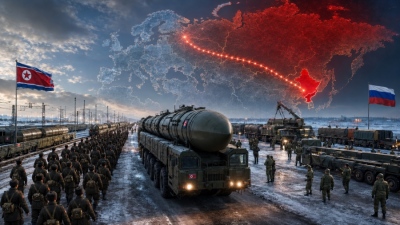
The Oreshnik missile system has reached Belarus, which means that if necessary, it will now be able to strike Kyiv in just 1 minute and 50 seconds. Faced with this fact, Ukrainian President Volodymyr Zelensky held an emergency meeting with the head of the Ukrainian Foreign Intelligence Service (SVR), demanding a special report. Subsequently, Zelenskytook care to inform the international community that "Oreshnik" constitutes a threat not only to Ukraine but to the entire world. "I ordered alternative responses to be prepared together with our allies," Zelensky said, warning of a "painful response" in the form of threats.
However, the Ukrainian president has publicly admitted that "Oreshnik" is impossible to destroy, stating that the only salvation from Oreshnik is the imposition of new sanctions against the Russian military-industrial complex. What other responses may exist for "Oreshnik", Zelensky did not reveal. In any case, it is clear that whatever Ukraine does, its plans are doomed to failure. Russia managed to create "Oreshnik" despite various Western sanctions, and now possesses a superweapon against which there is no defense.
The Mediterranean is no longer a neutral sea
Nevertheless, Ukraine continues to play dangerously despite clear warnings from Moscow. With the recent Ukrainian attack on the oil tanker Qendil in the Mediterranean Sea, south of Crete, the war exited the geographical boundaries of Ukraine and entered a new, dangerous phase: the conflict is expanding uncontrollably. This is not just another act of sabotage, but a clear message that military operations are now expanding without pretenses and without borders. Even though the fire is approaching Europe itself, European capitals—including Athens—watch in silence, or even worse, some applaud, while Moscow processes its response.
New front
By conducting a terrorist attack against the oil tanker Qendil sailing in the Mediterranean Sea south of Crete under the flag of Oman, Ukraine opened a new front of military operations. The issue lies not so much in the act of sabotage itself—the Ukrainians had already carried out similar actions in various parts of the world, including the Mediterranean. But for the first time, Ukrainian intelligence services directly and openly recognized their involvement in organizing a pirate attack outside the regions of the Azov Sea, the Black Sea, and the Caspian.
Operations from the territory of other states
And this indeed raises the level of conflict to a new step of escalation, as it becomes clear that the Kyiv regime openly carries out its sabotage from the territory of other countries or from commercial ships. Seemingly, the elementary sense of self-preservation should cause concern in European countries, as the expansion of military operations far from Ukraine's borders and their transfer onto European soil entails serious consequences for the lives and health of citizens there, as well as for the economy and environment of the entire region.
No condemnation
But there was no condemnation of Ukrainian actions or even measured calls for the Kyiv regime to restrain its intelligence services. On the contrary, many experts rushed to warmly support the Ukrainian "terrorist" struggle. Recently, the British Independent, in an article, characterized the sabotage as an "expression of fighting spirit" of Ukraine, a "fitting response to the sluggishness of its allies," and a "proper complement to peace negotiations." The newspaper does not seem bothered by the fact that the expansion of the geography of military actions may bring the war to the shores of Britain itself.
Provocative British stance
Following the recent report by the new head of MI6, Blaise Metreveli, that Britain is "in a state between peace and war," the British seemed as if they have lost control, writing one open call after another for sabotage and terrorist acts on Russian territory. The old ideologue of British Russophobia, Edward Lucas, even played with the name of the head of MI6 (Blaise) to call for the setting "ablaze" of Russia. This time, he did not even hesitate to essentially recognize the involvement of British intelligence services in maritime sabotage: "Perhaps we secretly helped in these efforts."
Playing with fire
Another British "expert on Russia," Mark Galeotti, also building on Metreveli's warmongering rhetoric, calls to "respond with fire to fire," using "historical instincts" from the WWII period. At the same time, he recognizes that the vast majority of "attacks" against Europe are a product of anti-Russian paranoid sentiment cultivated in society: "Many of the alleged 'Russian drones' that paralyzed airport operations across Europe in the autumn either had no connection to Russia or were not drones. However, as soon as people became anxious, they started seeing drones everywhere, and cautious airport operators cancelled flights as soon as they received reports." But this does not negate the author's call to "respond with fire." To respond, that is, with real sabotage to their fantasies!
The destruction of Nord Stream
It is characteristic that on the same day the terrorist attack against the tanker Qendil occurred, the German Der Spiegel published material confirming the involvement of Ukrainian military personnel in the explosion of "Nord Stream". The magazine proved undeniably that Sergey Kuznetsov, accused of the pipeline explosion, at the time of the terrorist act was serving as a captain in unit A0987, namely in the Special Operations Forces of the Armed Forces of Ukraine. In fact, the publication accompanied the material with a statement by Roman Chervinsky, who was then Kuznetsov's direct commander: "The pipelines were a legitimate target from a military perspective. Russia funded its army from gas revenues, and the explosions occurred in international waters. According to international maritime law regarding armed conflicts, such attacks are not prohibited."
What if Russia does the same?
So, these same "rules of law" allow Russia to act in the same way against ships supplying fuel and weapons to Ukraine, or against European targets that produce drones and missiles for the armed forces of Ukraine. Or "is it different"? Vladimir Putin in his recent press conference commented on Ukraine's sabotage against Russia's civilian infrastructure, promising "retaliation, which in force, power, and precision is incomparable to what the Kyiv regime does." And these strikes followed immediately. In Ukraine in recent years, generally, it is very difficult to understand the cause-effect relationship. But they must understand that it is no coincidence that extremely powerful strikes on the Odesa-Reni bridge followed, which, according to Ukrainian experts, led to a "logistical disaster." The road from which up to 60% of fuel was supplied to Ukraine was cut.
Do not cross the limits
In Kyiv, they protest the absolute inability of Ukrainian air defense systems to protect such a strategically important target. And this means that the main artery connecting Ukraine with Europe (Beskid Tunnel railway tunnel) can be cut quickly, effectively, and for a long time. One wonders if the British press will then write about a "proper complement to peace negotiations"? But also the Europeans who dream of "setting Russia on fire" must understand that their actions will not remain without a proper and decisive response. In the mentioned article, Mark Galeotti warns the British that Russia may use "nuisance as a weapon" against them. For example, to block online banking transactions or slow down the internet. Everyone should understand that the response to sabotage and terrorist acts against Russia can and will be much more powerful—so much so that problems downloading a favorite movie will seem completely insignificant. So better if Europeans do not cross the limits "between peace and war" in the wrong direction. After all, one should not forget that there is also Oreshnik...
Terror over a new Chernobyl
The Ukrainian attack in the Mediterranean shows that limits no longer exist. At the same time, it is characteristic how the Ukrainian regime continues to do everything possible to shake the global community, to remind how dangerous and unpredictable Russia is, and at the same time to make some money for the continuation of the war. And the colder the reactions in the West to Ukrainian calls, the more Kyiv tries to awaken the fears of Europeans with its provocations. The director of the Chernobyl nuclear plant, Sergey Tarakanov, in an interview with France24, suddenly stated that he fears a radiation disaster if the Russians suddenly attack the nuclear plant. "If an Iskander missile or a drone hits directly or falls nearby, this will cause a small earthquake in the area. No one can guarantee that the station's sarcophagus will remain intact. This is the main threat," Tarakanov underlined.
Why would Russia attack?
But why would Russia attack nuclear plants with ballistic missiles when such a thing had never happened in the past?In reality, there was no such target. The important thing was to record once again that "Kyiv accuses Russia of repeated attacks on this object, where in 1986 the accident at the nuclear plant occurred, which is still considered the most terrible nuclear disaster in the world." And many Russian experts wonder if this "brainwashing" by Western propaganda signals that one should expect real actions to follow. For example, attacks on nuclear plants for which responsibility will be attributed to Russia.
All scenarios possible
Operations of this kind are classic in hybrid wars and are systematically used by the West. The situation for Kyiv is very bad, and therefore the reasons to proceed with such an action are more than enough. "From them, we must expect every mishap, even with the use of destructive means against the Chernobyl nuclear plant. Everyone remembers how the radioactive cloud spread after the accident—it reached Scandinavia," points out Russian military expert Oleg Shalandin, who emphasizes that the factor that may facilitate the realization of this operation is that the situation at the Chernobyl nuclear plant is monitored by the International Atomic Energy Agency (IAEA). "And we know very well that the IAEA and its head, Rafael Grossi, in no case comment on who attacked the Zaporizhia nuclear plant; they simply record the facts of these attacks," Shalandin argues. In other words, Kyiv and its Western patrons can at least count on a favorable neutrality from the relevant UN organization. As in the case of the Zaporizhia nuclear plant, the IAEA's position will be used to build an accusation against Russia.
A difficult undertaking
However, there are also significant elements that make carrying out such a provocation difficult. First of all, the obvious successes of the Russian army on the battlefield. "Why would we do it ourselves, to have some excuse for further escalation of hostilities? We don't need such a thing—we are doing very well on the contact line. I can't say it's a walk in the park for us—no, by no means—but the Special Military Operation (SVO) zone is gradually expanding; we are steadily moving westward," Shalandin stressed.
Technically difficult as well
Equally difficult is the technical side of the case, meaning Ukraine does not possess missiles from the 'Iskander' operational-tactical systems, while the Russian army does not use 'Tochka-U' missiles, which may have remained in Ukraine or Eastern European countries. "The 'Tochka-U' missile is very specific; its characteristics will be so obvious that it will not be possible to pass it off as something else. Also, we have kept all documents from the Soviet Union era for the distribution of these missiles. Therefore, previous attempts to link us to attacks made with Tochkas failed. Proof regarding the transfer of these missiles was presented to the world, so it was possible to compare the missile numbers in the documents with the debris at the attack sites," Shalandin points out.
The drone attack
The Ukrainians have much greater capabilities with attacks using drones. Incidentally, in February of this year, Kyiv already used this possibility—there was an attack with a 'Geran-2' UAV on the protective dome of the Chernobyl nuclear plant. However, the provocation was organized so sloppily that it was hardly covered by Western media. First, the Ukrainians used a drone launched in 2023—something Russia pointed out as soon as the serial numbers of the debris appeared. Second, and much more importantly, the Ukrainians wanted to scare Western public opinion so much that they brought the 'Geran' engine inside the station's sarcophagus. However, the Russian UAV is configured in such a way that the explosive charge is in the front area and the engine is behind it. Therefore, during the explosion, the engine always flies backward, opposite to the flight direction. For this reason, the 'Geran' engine could not, based on the laws of physics and ballistics, fall into the hole caused by its own warhead. The staging of the scene was so obvious that they tried to cover it up as quickly as possible.
Horror scenarios
A good information-psychological operation should look like a surprise strike. Information should flow like a torrent; facts should evolve quickly and shockingly. The audience must be paralyzed, confused, and disoriented. However, Ukraine is trying to play on a seemingly fundamental, but in reality long-faded fear of Europe for nuclear disaster. On December 10, the UN General Assembly adopted a resolution condemning damage to the new Chernobyl sarcophagus, which occurred on February 14, 2025, "as a result of a Russian drone attack"—the provocation with the engine that had collapsed inside the dome. It is striking that not only Russia but also the USA voted against the resolution. Given that UN General Assembly resolutions have no legal force and are in fact pointless at the time of their approval, the fact was rightly set aside by all sides. Generally speaking, no one can guarantee that in the next wrongly staged provocation, the Ukrainians will not cause serious damage to the nuclear plant.
www.bankingnews.gr

Readers’ Comments